Sign In Start Free Trial
Account

Add to playlist

Create a Playlist

Modal Close icon
You need to login to use this feature.
  • Book Overview & Buying PyTorch Deep Learning Hands-On
  • Table Of Contents Toc
  • Feedback & Rating feedback
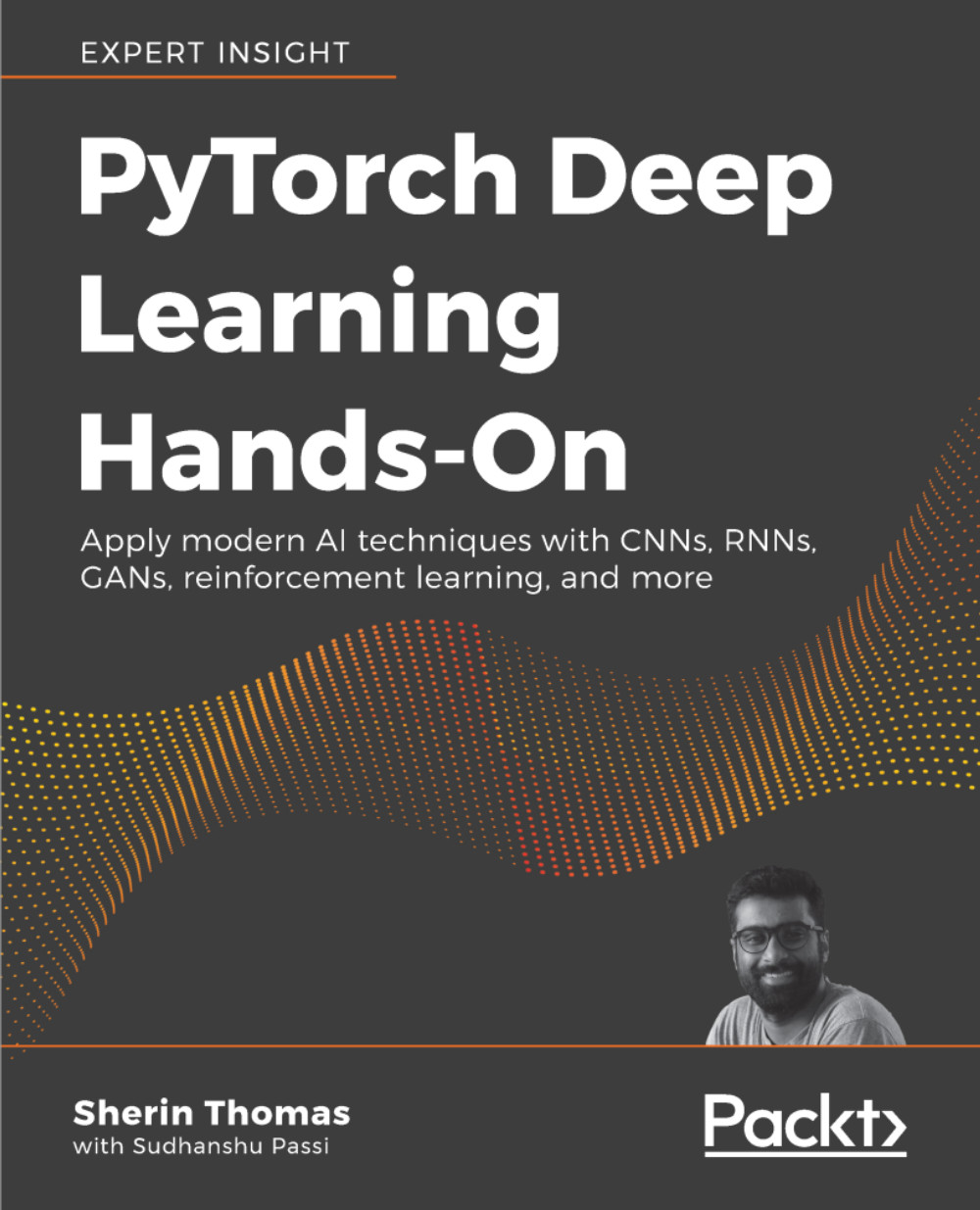
PyTorch Deep Learning Hands-On

PyTorch Deep Learning Hands-On

By : Sherin Thomas , Sudhanshu Passi
2.9 (10)
close
close
PyTorch Deep Learning Hands-On

PyTorch Deep Learning Hands-On

2.9 (10)
By: Sherin Thomas , Sudhanshu Passi

Overview of this book

PyTorch Deep Learning Hands-On is a book for engineers who want a fast-paced guide to doing deep learning work with PyTorch. It is not an academic textbook and does not try to teach deep learning principles. The book will help you most if you want to get your hands dirty and put PyTorch to work quickly. PyTorch Deep Learning Hands-On shows how to implement the major deep learning architectures in PyTorch. It covers neural networks, computer vision, CNNs, natural language processing (RNN), GANs, and reinforcement learning. You will also build deep learning workflows with the PyTorch framework, migrate models built in Python to highly efficient TorchScript, and deploy to production using the most sophisticated available tools. Each chapter focuses on a different area of deep learning. Chapters start with a refresher on how the model works, before sharing the code you need to implement it in PyTorch. This book is ideal if you want to rapidly add PyTorch to your deep learning toolset.
Table of Contents (11 chapters)
close
close
10
Index

Chapter 5. Sequential Data Processing

The major challenges that neural networks are trying to solve today are processing, understanding, compressing, and generating sequential data. Sequential data can be described vaguely as anything that has a dependency on the previous data point and the next data point. Handling different types of sequential data requires different techniques, although the basic approach can be generalized. We'll explore what the basic building blocks of sequential data processing units are as well as, the common problems and their widely accepted solutions.

In this chapter, we are going to look at sequential data. The canonical data that people use for sequential data processing is natural language, although time series data, music, sound, and others are also considered to be sequential data. Natural language processing (NLP) and understanding has been explored extensively and it's an active field of research right now. The human language...

Visually different images
CONTINUE READING
83
Tech Concepts
36
Programming languages
73
Tech Tools
Icon Unlimited access to the largest independent learning library in tech of over 8,000 expert-authored tech books and videos.
Icon Innovative learning tools, including AI book assistants, code context explainers, and text-to-speech.
Icon 50+ new titles added per month and exclusive early access to books as they are being written.
PyTorch Deep Learning Hands-On
notes
bookmark Notes and Bookmarks search Search in title playlist Add to playlist font-size Font size

Change the font size

margin-width Margin width

Change margin width

day-mode Day/Sepia/Night Modes

Change background colour

Close icon Search
Country selected

Close icon Your notes and bookmarks

Confirmation

Modal Close icon
claim successful

Buy this book with your credits?

Modal Close icon
Are you sure you want to buy this book with one of your credits?
Close
YES, BUY

Submit Your Feedback

Modal Close icon
Modal Close icon
Modal Close icon