
Sign In Start Free Trial
Account

Add to playlist

Create a Playlist

Modal Close icon
You need to login to use this feature.
  • Book Overview & Buying Getting Started with Tableau 2018.x
  • Table Of Contents Toc
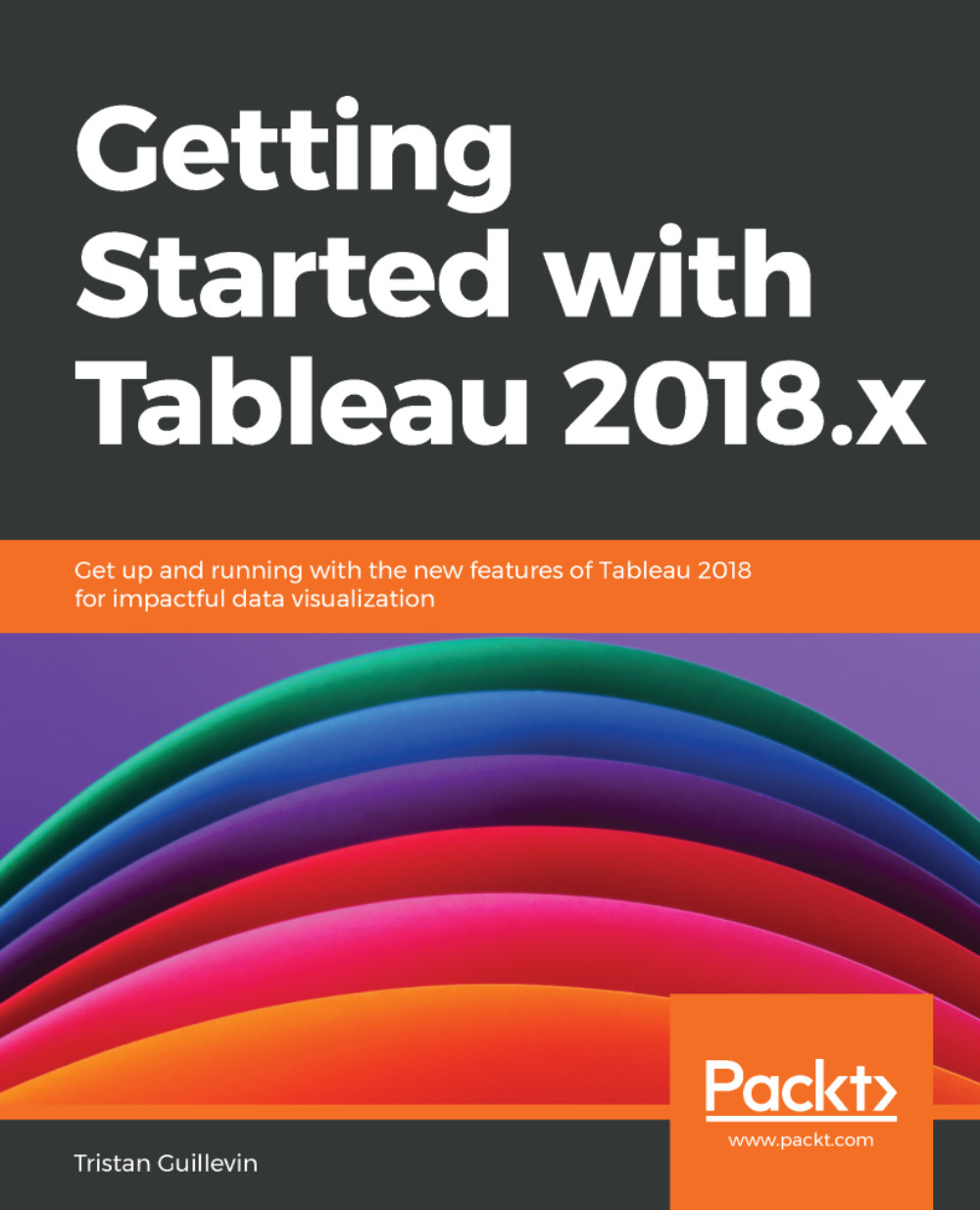
Getting Started with Tableau 2018.x

Getting Started with Tableau 2018.x

By : Tristan Guillevin
4 (3)
close
close
Getting Started with Tableau 2018.x

Getting Started with Tableau 2018.x

4 (3)
By: Tristan Guillevin

Overview of this book

Tableau is one of the leading business intelligence tools used worldwide, in organizations of every scale. In its latest release, Tableau 2018 promises richer and more useful features related to visual analytics, reporting, dashboarding, and a host of other data visualization aspects. Getting Started with Tableau 2018.x will get you up and running with these features. The book starts with all the new functionalities of the different Tableau 2018 versions, along with concrete examples of how to use them. However, if you're new to Tableau, don't worry! The rest of the book will guide you through each major aspect of Tableau with examples. You'll learn how to connect to data, build a data source, visualize your data, build a dashboard, and share it online. In the final chapters, you'll also learn advanced techniques such as creating a cross-database join, data blending, and more. By the end of the book, you will have a firm understanding of how to effectively use Tableau to create quick, cost-effective, and business-efficient business intelligence solutions.
Table of Contents (16 chapters)
close
close
Lock Free Chapter
1
Catching Up with Tableau 2018

Using multiple Measures

In the previous chapter, you only used one Measure at a time on the row or column shelf. Let's see what happens when you use more than one.

To be precise, we'll see what happens when you use more than one Continuous field at a time in the row or column shelf. However, in the majority of cases, the Measures are Continuous and the Dimensions are Discrete. 

If you use more than one Continuous field at a time in row or column, Tableau creates different axes, and the Marks shelf splits by the number of Continuous fields (plus one for All). Each Marks shelf can have a different type and properties. If you change the Marks type or properties for All, all the Marks are affected. 

Let's build an example together:

  1. Put the...
CONTINUE READING
83
Tech Concepts
36
Programming languages
73
Tech Tools
Icon Unlimited access to the largest independent learning library in tech of over 8,000 expert-authored tech books and videos.
Icon Innovative learning tools, including AI book assistants, code context explainers, and text-to-speech.
Icon 50+ new titles added per month and exclusive early access to books as they are being written.
Getting Started with Tableau 2018.x
notes
bookmark Notes and Bookmarks search Search in title playlist Add to playlist download Download options font-size Font size

Change the font size

margin-width Margin width

Change margin width

day-mode Day/Sepia/Night Modes

Change background colour

Close icon Search
Country selected

Close icon Your notes and bookmarks

Confirmation

Modal Close icon
claim successful

Buy this book with your credits?

Modal Close icon
Are you sure you want to buy this book with one of your credits?
Close
YES, BUY

Submit Your Feedback

Modal Close icon
Modal Close icon
Modal Close icon