
Sign In Start Free Trial
Account

Add to playlist

Create a Playlist

Modal Close icon
You need to login to use this feature.
  • Book Overview & Buying Hands-On Data Science with SQL Server 2017
  • Table Of Contents Toc
Hands-On Data Science with SQL Server 2017

Hands-On Data Science with SQL Server 2017

By : Marek Chmel , Vladimír Mužný
close
close
Hands-On Data Science with SQL Server 2017

Hands-On Data Science with SQL Server 2017

By: Marek Chmel , Vladimír Mužný

Overview of this book

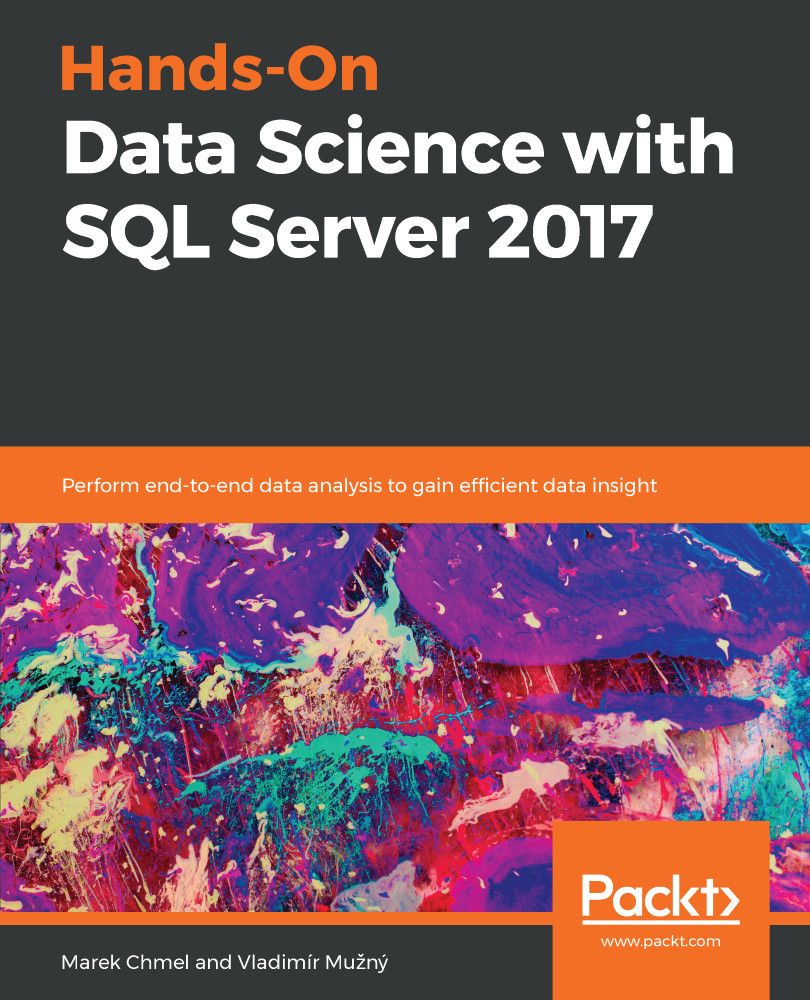
SQL Server is a relational database management system that enables you to cover end-to-end data science processes using various inbuilt services and features. Hands-On Data Science with SQL Server 2017 starts with an overview of data science with SQL to understand the core tasks in data science. You will learn intermediate-to-advanced level concepts to perform analytical tasks on data using SQL Server. The book has a unique approach, covering best practices, tasks, and challenges to test your abilities at the end of each chapter. You will explore the ins and outs of performing various key tasks such as data collection, cleaning, manipulation, aggregations, and filtering techniques. As you make your way through the chapters, you will turn raw data into actionable insights by wrangling and extracting data from databases using T-SQL. You will get to grips with preparing and presenting data in a meaningful way, using Power BI to reveal hidden patterns. In the concluding chapters, you will work with SQL Server integration services to transform data into a useful format and delve into advanced examples covering machine learning concepts such as predictive analytics using real-world examples. By the end of this book, you will be in a position to handle the growing amounts of data and perform everyday activities that a data science professional performs.
Table of Contents (14 chapters)
close
close

Summary

In this chapter, we covered an overview of .NET development on SQL Server. Using .NET, custom objects help us to enhance SQL Server's capabilities in many ways. This is especially true when we need to create our own aggregation functions, as .NET programming is the only way to do it. However, overusing CLR objects may also lead to many issues and disappointed users.

The first part of this chapter was dedicated to providing an overview of SQLCLR. Here, we looked at how this works and when it is beneficial to use it. We then started to create an empty end-to-end SQL Server Database Project to demonstrate the development life cycle.

After the introductory section, we explored development in more detail. During this section, we developed and published our own CLR aggregation calculating statistical moments. The additional knowledge taken from this section describes what...

CONTINUE READING
83
Tech Concepts
36
Programming languages
73
Tech Tools
Icon Unlimited access to the largest independent learning library in tech of over 8,000 expert-authored tech books and videos.
Icon Innovative learning tools, including AI book assistants, code context explainers, and text-to-speech.
Icon 50+ new titles added per month and exclusive early access to books as they are being written.
Hands-On Data Science with SQL Server 2017
notes
bookmark Notes and Bookmarks search Search in title playlist Add to playlist download Download options font-size Font size

Change the font size

margin-width Margin width

Change margin width

day-mode Day/Sepia/Night Modes

Change background colour

Close icon Search
Country selected

Close icon Your notes and bookmarks

Confirmation

Modal Close icon
claim successful

Buy this book with your credits?

Modal Close icon
Are you sure you want to buy this book with one of your credits?
Close
YES, BUY

Submit Your Feedback

Modal Close icon
Modal Close icon
Modal Close icon