Sign In Start Free Trial
Account

Add to playlist

Create a Playlist

Modal Close icon
You need to login to use this feature.
  • Book Overview & Buying Data Science Algorithms in a Week
  • Table Of Contents Toc
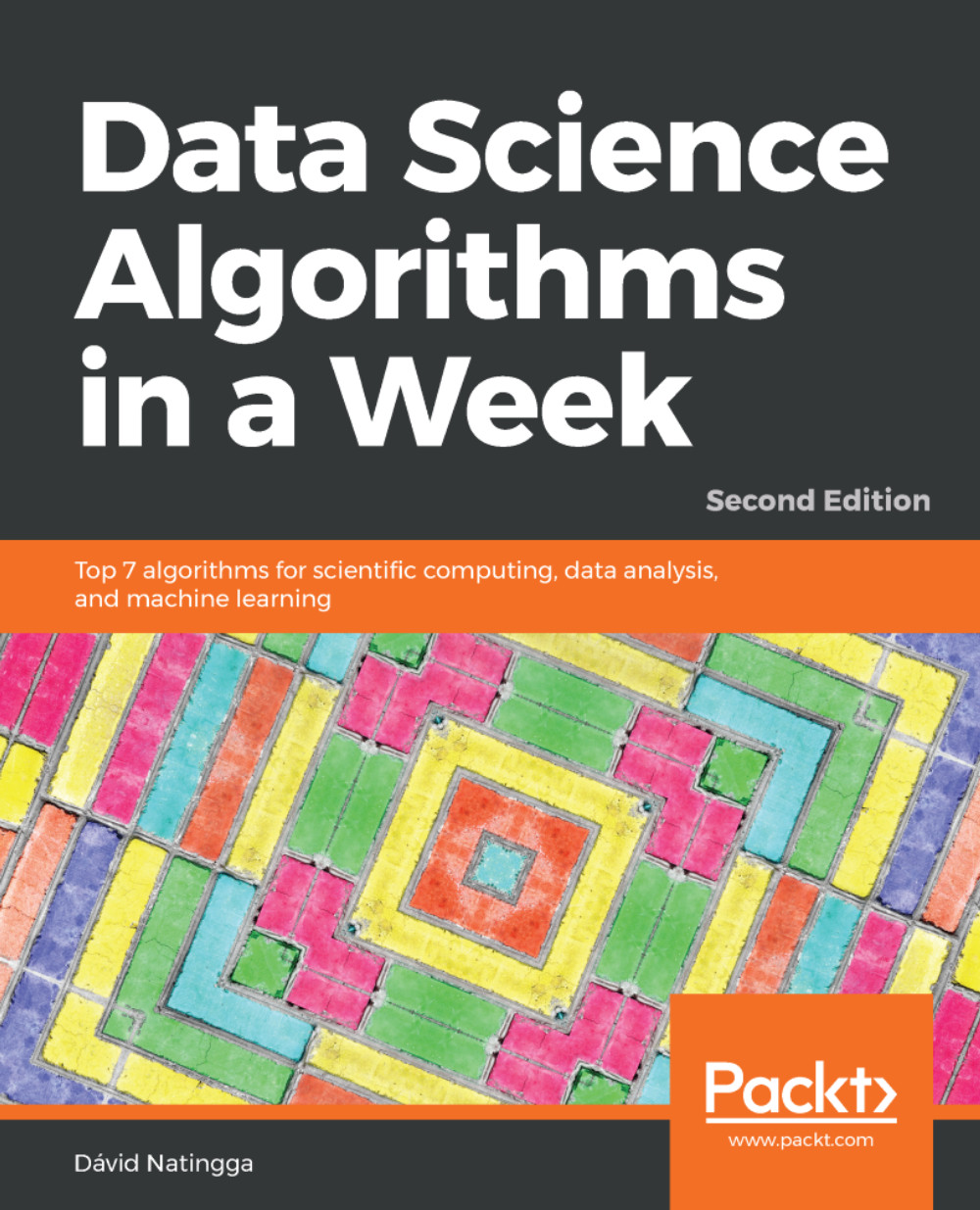
Data Science Algorithms in a Week

Data Science Algorithms in a Week - Second Edition

By : Natingga, David Toth
3.7 (3)
close
close
Data Science Algorithms in a Week

Data Science Algorithms in a Week

3.7 (3)
By: Natingga, David Toth

Overview of this book

Machine learning applications are highly automated and self-modifying, and continue to improve over time with minimal human intervention, as they learn from the trained data. To address the complex nature of various real-world data problems, specialized machine learning algorithms have been developed. Through algorithmic and statistical analysis, these models can be leveraged to gain new knowledge from existing data as well. Data Science Algorithms in a Week addresses all problems related to accurate and efficient data classification and prediction. Over the course of seven days, you will be introduced to seven algorithms, along with exercises that will help you understand different aspects of machine learning. You will see how to pre-cluster your data to optimize and classify it for large datasets. This book also guides you in predicting data based on existing trends in your dataset. This book covers algorithms such as k-nearest neighbors, Naive Bayes, decision trees, random forest, k-means, regression, and time-series analysis. By the end of this book, you will understand how to choose machine learning algorithms for clustering, classification, and regression and know which is best suited for your problem
Table of Contents (12 chapters)
close
close
10
Glossary of Algorithms and Methods in Data Science

Medical tests – basic application of Bayes' theorem


A patient takes a special cancer test that has an accuracy of test_accuracy=99.9%—if the result is positive, then 99.9% of the patients tested will suffer from that particular type of cancer. Conversely, 99.9% of the patients with a negative result will not suffer from that particular cancer.

Suppose that a patient is tested and the result is positive. What is the probability of that patient suffering from that particular type of cancer?

Analysis

We will use Bayes' theorem to ascertain the probability of the patient having cancer:

To ascertain the prior probability that a patient has cancer, we have to find out how frequently cancer occurs among people. Say that we find out that 1 person in 100,000 suffers from this kind of cancer. Therefore, P(cancer)=1/100,000. So, P(test_positive|cancer) = test_accuracy=99.9%=0.999 given by the accuracy of the test.

P(test_positive) has to be computed as follows:

Therefore, we can calculate the following:

So...

CONTINUE READING
83
Tech Concepts
36
Programming languages
73
Tech Tools
Icon Unlimited access to the largest independent learning library in tech of over 8,000 expert-authored tech books and videos.
Icon Innovative learning tools, including AI book assistants, code context explainers, and text-to-speech.
Icon 50+ new titles added per month and exclusive early access to books as they are being written.
Data Science Algorithms in a Week
notes
bookmark Notes and Bookmarks search Search in title playlist Add to playlist download Download options font-size Font size

Change the font size

margin-width Margin width

Change margin width

day-mode Day/Sepia/Night Modes

Change background colour

Close icon Search
Country selected

Close icon Your notes and bookmarks

Confirmation

Modal Close icon
claim successful

Buy this book with your credits?

Modal Close icon
Are you sure you want to buy this book with one of your credits?
Close
YES, BUY

Submit Your Feedback

Modal Close icon
Modal Close icon
Modal Close icon