


-
Book Overview & Buying
-
Table Of Contents

Hands-On Machine Learning with C++ - Second Edition
By :


Hands-On Machine Learning with C++
By:
Overview of this book
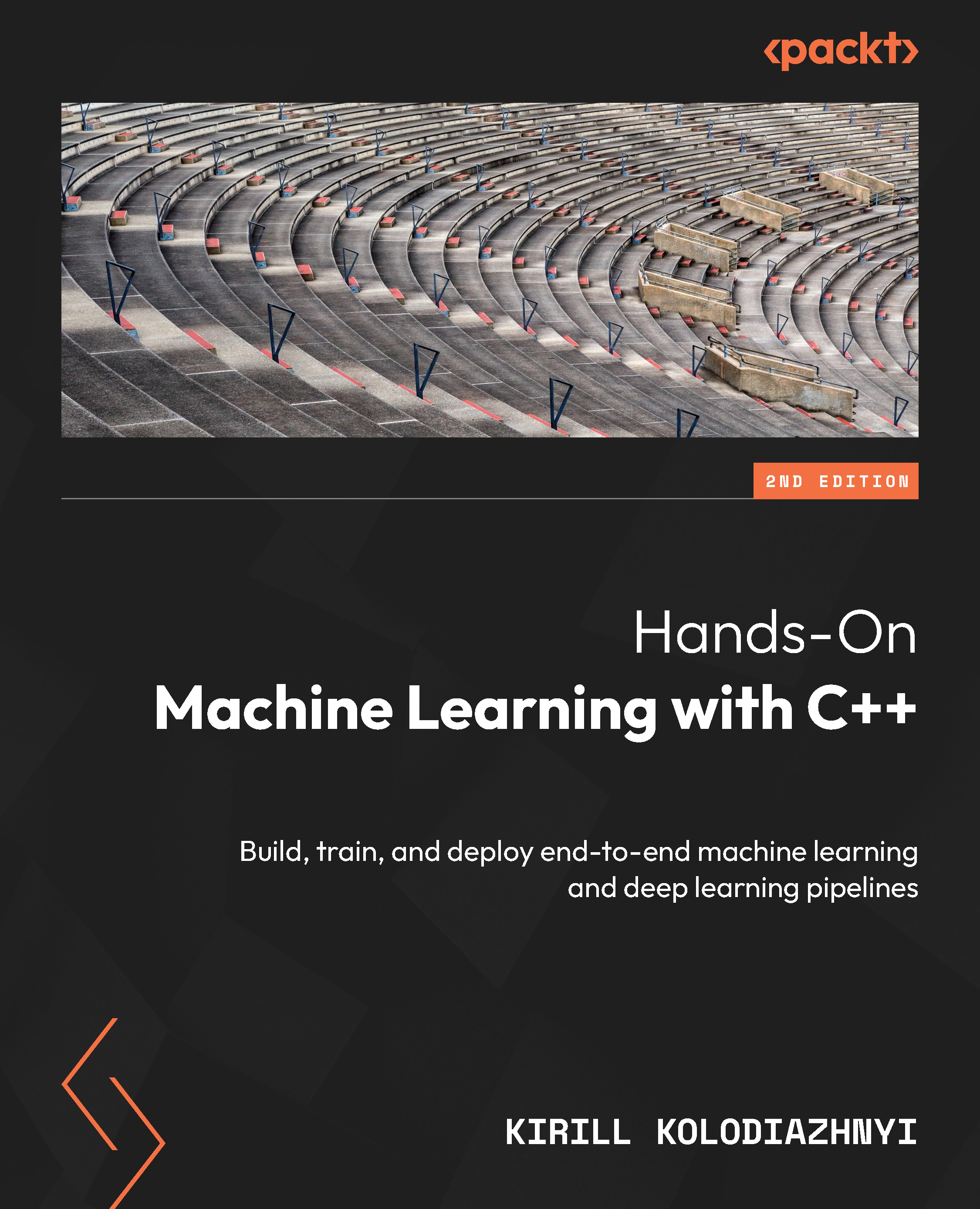
Written by a seasoned software engineer with several years of industry experience, this book will teach you the basics of machine learning (ML) and show you how to use C++ libraries, along with helping you create supervised and unsupervised ML models.
You’ll gain hands-on experience in tuning and optimizing a model for various use cases, enabling you to efficiently select models and measure performance. The chapters cover techniques such as product recommendations, ensemble learning, anomaly detection, sentiment analysis, and object recognition using modern C++ libraries. You’ll also learn how to overcome production and deployment challenges on mobile platforms, and see how the ONNX model format can help you accomplish these tasks.
This edition is updated with key topics such as sentiment analysis implementation using transfer learning and transformer-based models, with tracking and visualizing ML experiments with MLflow. An additional section shows how to use Optuna for hyperparameter selection. The section on model deployment into mobile platform includes a detailed explanation of real-time object detection for Android with C++.
By the end of this C++ book, you’ll have real-world machine learning and C++ knowledge, as well as the skills to use C++ to build powerful ML systems.
*Email sign-up and proof of purchase required
Table of Contents (19 chapters)
Preface


Introduction to Machine Learning with C++
Data Processing
Measuring Performance and Selecting Models
Section 2: Machine Learning Algorithms
Clustering
Anomaly Detection

Dimensionality Reduction
Classification
Recommender Systems
Ensemble Learning
Section 3: Advanced Examples
Neural Networks for Image Classification
Sentiment Analysis with Recurrent Neural Networks
Section 4: Production and Deployment Challenges
Exporting and Importing Models
Deploying Models on Mobile and Cloud Platforms
Other Books You May Enjoy


