Sign In Start Free Trial
Account

Add to playlist

Create a Playlist

Modal Close icon
You need to login to use this feature.
  • Book Overview & Buying Data Science for Marketing Analytics
  • Table Of Contents Toc
Data Science for Marketing Analytics

Data Science for Marketing Analytics

By : Tommy Blanchard, Debasish Behera, Pranshu Bhatnagar
2.8 (5)
close
close
Data Science for Marketing Analytics

Data Science for Marketing Analytics

2.8 (5)
By: Tommy Blanchard, Debasish Behera, Pranshu Bhatnagar

Overview of this book

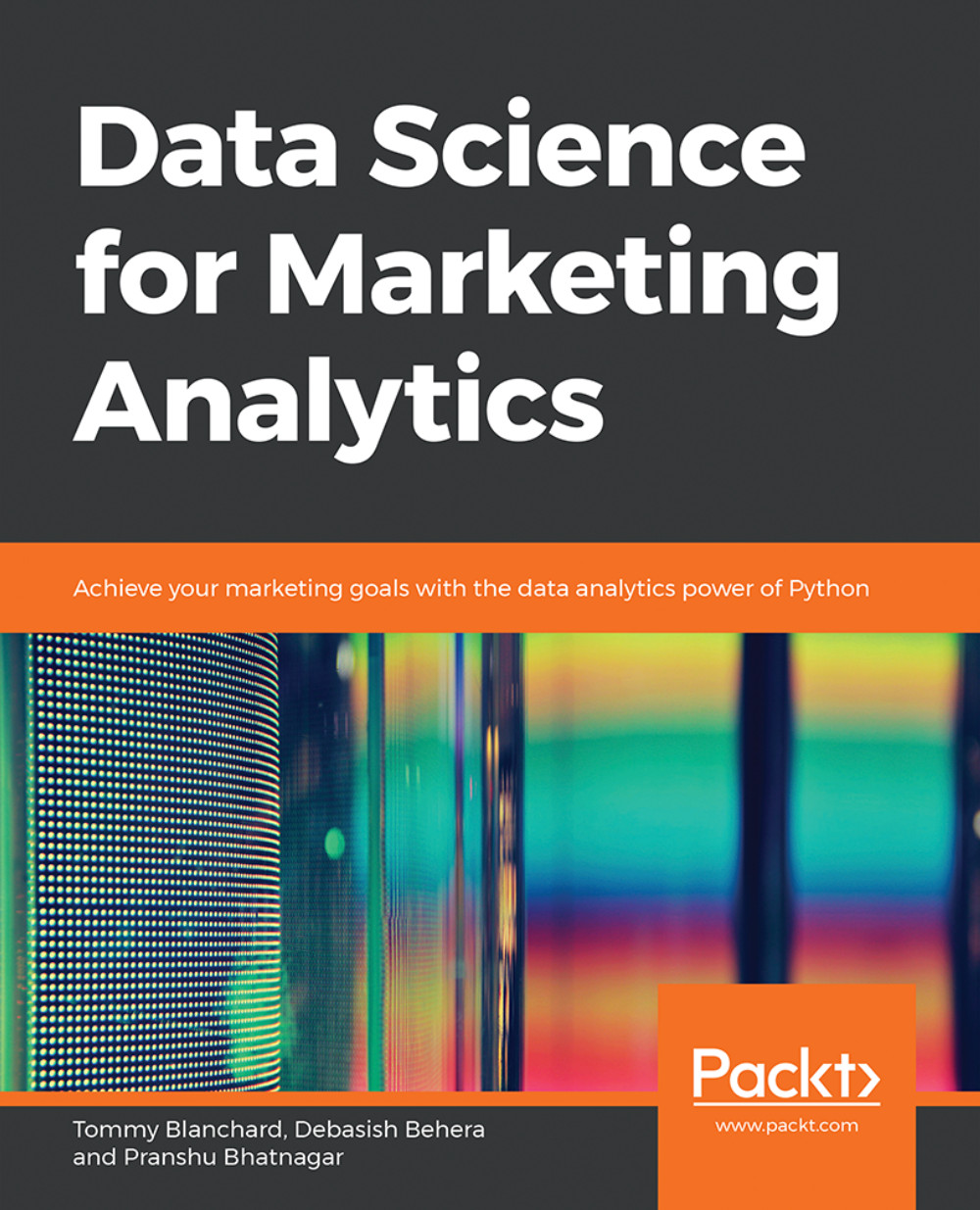
Data Science for Marketing Analytics covers every stage of data analytics, from working with a raw dataset to segmenting a population and modeling different parts of the population based on the segments. The book starts by teaching you how to use Python libraries, such as pandas and Matplotlib, to read data from Python, manipulate it, and create plots, using both categorical and continuous variables. Then, you'll learn how to segment a population into groups and use different clustering techniques to evaluate customer segmentation. As you make your way through the chapters, you'll explore ways to evaluate and select the best segmentation approach, and go on to create a linear regression model on customer value data to predict lifetime value. In the concluding chapters, you'll gain an understanding of regression techniques and tools for evaluating regression models, and explore ways to predict customer choice using classification algorithms. Finally, you'll apply these techniques to create a churn model for modeling customer product choices. By the end of this book, you will be able to build your own marketing reporting and interactive dashboard solutions.
Table of Contents (12 chapters)
close
close
Data Science for Marketing Analytics
Preface

Summary


It’s important to not only be able to perform clustering, but also use several different types of clustering algorithms and evaluate the performance of each using multiple methods, so that the correct tool can be used for the job. In this chapter, we learned various methods for choosing the number of clusters, including judgment-based methods such as visual inspection of cluster overlap and elbow determination using the sum of squared errors, and objective methods such as evaluating the silhouette score. Each of these methods has strengths and weaknesses—the more abstract and quantified the measure is, the further removed we are from understanding why a particular clustering seems to be failing or succeeding. However, as we have seen, making judgments is often difficult, especially with complex data, and this is where quantifiable methods, in particular the silhouette score, tend to shine. In practice, sometimes one measure will not give a clear answer while another does; this is...

CONTINUE READING
83
Tech Concepts
36
Programming languages
73
Tech Tools
Icon Unlimited access to the largest independent learning library in tech of over 8,000 expert-authored tech books and videos.
Icon Innovative learning tools, including AI book assistants, code context explainers, and text-to-speech.
Icon 50+ new titles added per month and exclusive early access to books as they are being written.
Data Science for Marketing Analytics
notes
bookmark Notes and Bookmarks search Search in title playlist Add to playlist font-size Font size

Change the font size

margin-width Margin width

Change margin width

day-mode Day/Sepia/Night Modes

Change background colour

Close icon Search
Country selected

Close icon Your notes and bookmarks

Confirmation

Modal Close icon
claim successful

Buy this book with your credits?

Modal Close icon
Are you sure you want to buy this book with one of your credits?
Close
YES, BUY

Submit Your Feedback

Modal Close icon
Modal Close icon
Modal Close icon