Sign In Start Free Trial
Account

Add to playlist

Create a Playlist

Modal Close icon
You need to login to use this feature.
  • Book Overview & Buying The Applied Artificial Intelligence Workshop
  • Table Of Contents Toc
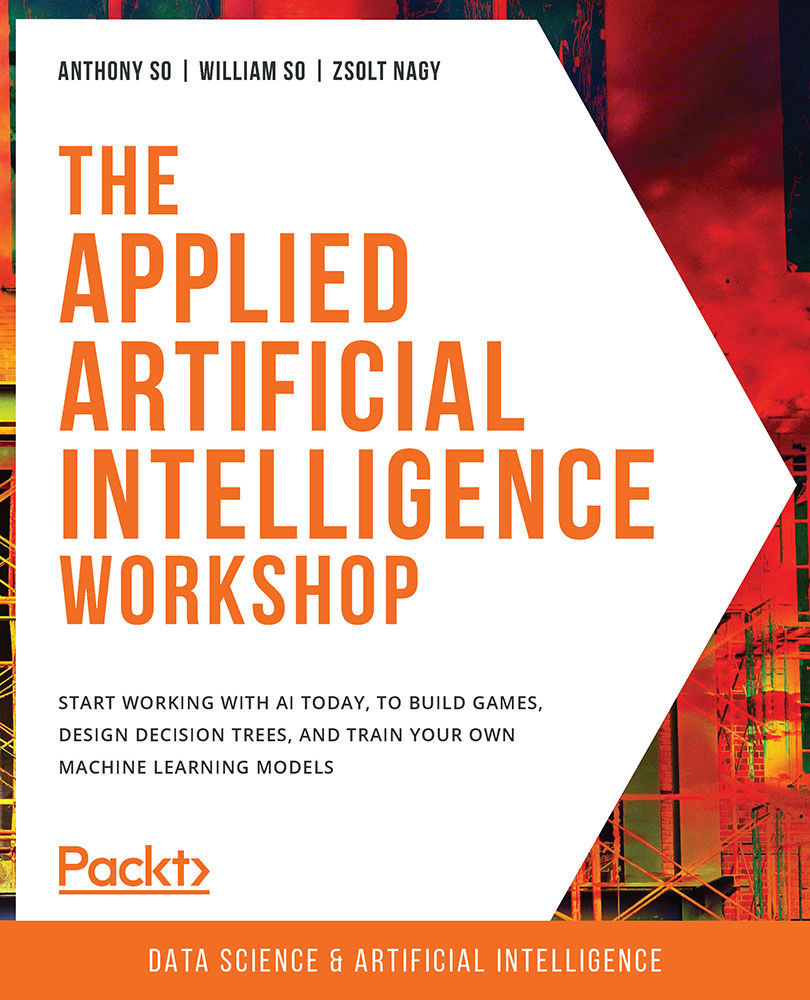
The Applied Artificial Intelligence Workshop

The Applied Artificial Intelligence Workshop

By : Anthony So , William So , Nagy
5 (1)
close
close
The Applied Artificial Intelligence Workshop

The Applied Artificial Intelligence Workshop

5 (1)
By: Anthony So , William So , Nagy

Overview of this book

You already know that artificial intelligence (AI) and machine learning (ML) are present in many of the tools you use in your daily routine. But do you want to be able to create your own AI and ML models and develop your skills in these domains to kickstart your AI career? The Applied Artificial Intelligence Workshop gets you started with applying AI with the help of practical exercises and useful examples, all put together cleverly to help you gain the skills to transform your career. The book begins by teaching you how to predict outcomes using regression. You will then learn how to classify data using techniques such as k-nearest neighbor (KNN) and support vector machine (SVM) classifiers. As you progress, you’ll explore various decision trees by learning how to build a reliable decision tree model that can help your company find cars that clients are likely to buy. The final chapters will introduce you to deep learning and neural networks. Through various activities, such as predicting stock prices and recognizing handwritten digits, you’ll learn how to train and implement convolutional neural networks (CNNs) and recurrent neural networks (RNNs). By the end of this applied AI book, you’ll have learned how to predict outcomes and train neural networks and be able to use various techniques to develop AI and ML models.
Table of Contents (8 chapters)
close
close
Preface

Data Preprocessing

Before building a classifier, we need to format our data so that we can keep relevant data in the most suitable format for classification and remove all the data that we are not interested in.

The following points are the best ways to achieve this:

  • Replacing or dropping values:

    For instance, if there are N/A (or NA) values in the dataset, we may be better off substituting these values with a numeric value we can handle. Recall from the previous chapter that NA stands for Not Available and that it represents a missing value. We may choose to ignore rows with NA values or replace them with an outlier value.

    Note

    An outlier value is a value such as -1,000,000 that clearly stands out from regular values in the dataset.

    The fillna() method of a DataFrame does this type of replacement. The replacement of NA values with an outlier looks as follows:

    df.fillna(-1000000, inplace=True)

    The fillna() method changes all NA values into numeric values.

    This numeric value...

CONTINUE READING
83
Tech Concepts
36
Programming languages
73
Tech Tools
Icon Unlimited access to the largest independent learning library in tech of over 8,000 expert-authored tech books and videos.
Icon Innovative learning tools, including AI book assistants, code context explainers, and text-to-speech.
Icon 50+ new titles added per month and exclusive early access to books as they are being written.
The Applied Artificial Intelligence Workshop
notes
bookmark Notes and Bookmarks search Search in title playlist Add to playlist download Download options font-size Font size

Change the font size

margin-width Margin width

Change margin width

day-mode Day/Sepia/Night Modes

Change background colour

Close icon Search
Country selected

Close icon Your notes and bookmarks

Confirmation

Modal Close icon
claim successful

Buy this book with your credits?

Modal Close icon
Are you sure you want to buy this book with one of your credits?
Close
YES, BUY

Submit Your Feedback

Modal Close icon
Modal Close icon
Modal Close icon