Sign In Start Free Trial
Account

Add to playlist

Create a Playlist

Modal Close icon
You need to login to use this feature.
  • Book Overview & Buying Data Science Projects with Python
  • Table Of Contents Toc
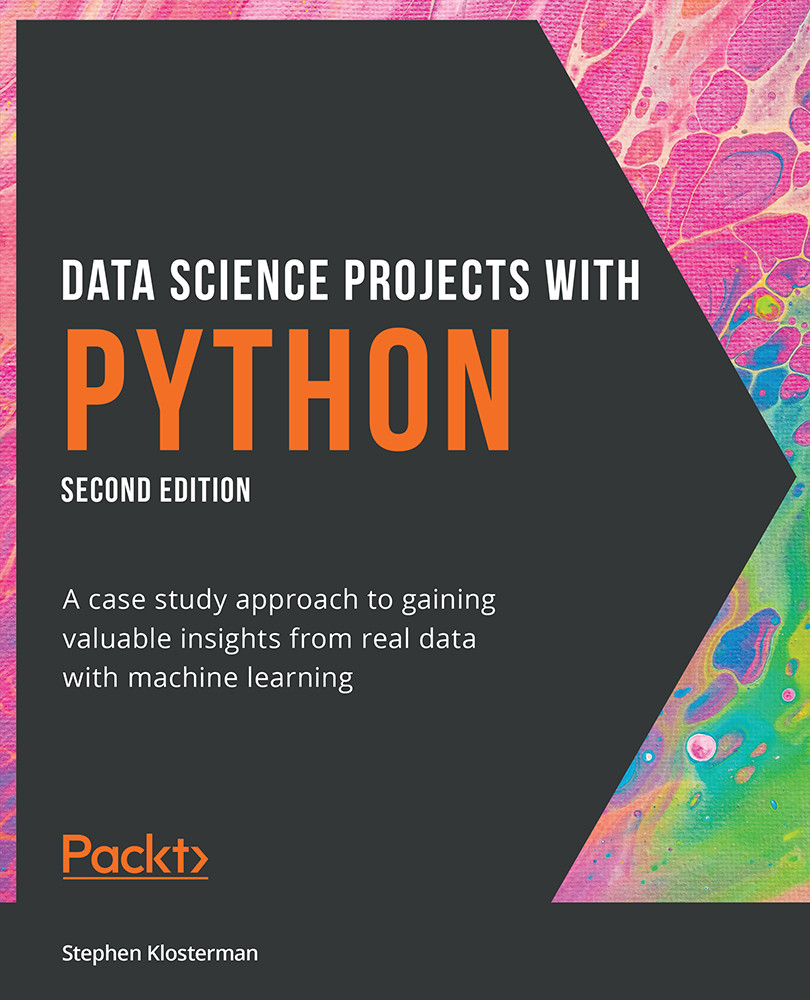
Data Science Projects with Python

Data Science Projects with Python - Second Edition

By : Stephen Klosterman
4.7 (60)
close
close
Data Science Projects with Python

Data Science Projects with Python

4.7 (60)
By: Stephen Klosterman

Overview of this book

If data is the new oil, then machine learning is the drill. As companies gain access to ever-increasing quantities of raw data, the ability to deliver state-of-the-art predictive models that support business decision-making becomes more and more valuable. In this book, you’ll work on an end-to-end project based around a realistic data set and split up into bite-sized practical exercises. This creates a case-study approach that simulates the working conditions you’ll experience in real-world data science projects. You’ll learn how to use key Python packages, including pandas, Matplotlib, and scikit-learn, and master the process of data exploration and data processing, before moving on to fitting, evaluating, and tuning algorithms such as regularized logistic regression and random forest. Now in its second edition, this book will take you through the end-to-end process of exploring data and delivering machine learning models. Updated for 2021, this edition includes brand new content on XGBoost, SHAP values, algorithmic fairness, and the ethical concerns of deploying a model in the real world. By the end of this data science book, you’ll have the skills, understanding, and confidence to build your own machine learning models and gain insights from real data.
Table of Contents (9 chapters)
close
close
Preface

Cross-Validation: Choosing the Regularization Parameter

By now, you may suspect that we could use regularization in order to decrease the overfitting we observed when we tried to model the synthetic data in Exercise 4.02, Generating and Modeling Synthetic Classification Data. The question is, how do we choose the regularization parameter, C? C is an example of a model hyperparameter. Hyperparameters are different from the parameters that are estimated when a model is trained, such as the coefficients and the intercept of a logistic regression. Rather than being estimated by an automated procedure like the parameters are, hyperparameters are input directly by the user as keyword arguments, typically when instantiating the model class. So, how do we know what values to choose?

Hyperparameters are more difficult to estimate than parameters. This is because it is up to the data scientist to determine what the best value is, as opposed to letting an optimization algorithm find it. However...

CONTINUE READING
83
Tech Concepts
36
Programming languages
73
Tech Tools
Icon Unlimited access to the largest independent learning library in tech of over 8,000 expert-authored tech books and videos.
Icon Innovative learning tools, including AI book assistants, code context explainers, and text-to-speech.
Icon 50+ new titles added per month and exclusive early access to books as they are being written.
Data Science Projects with Python
notes
bookmark Notes and Bookmarks search Search in title playlist Add to playlist download Download options font-size Font size

Change the font size

margin-width Margin width

Change margin width

day-mode Day/Sepia/Night Modes

Change background colour

Close icon Search
Country selected

Close icon Your notes and bookmarks

Confirmation

Modal Close icon
claim successful

Buy this book with your credits?

Modal Close icon
Are you sure you want to buy this book with one of your credits?
Close
YES, BUY

Submit Your Feedback

Modal Close icon
Modal Close icon
Modal Close icon