


-
Book Overview & Buying
-
Table Of Contents

Machine Learning with LightGBM and Python
By :


Machine Learning with LightGBM and Python
By:
Overview of this book
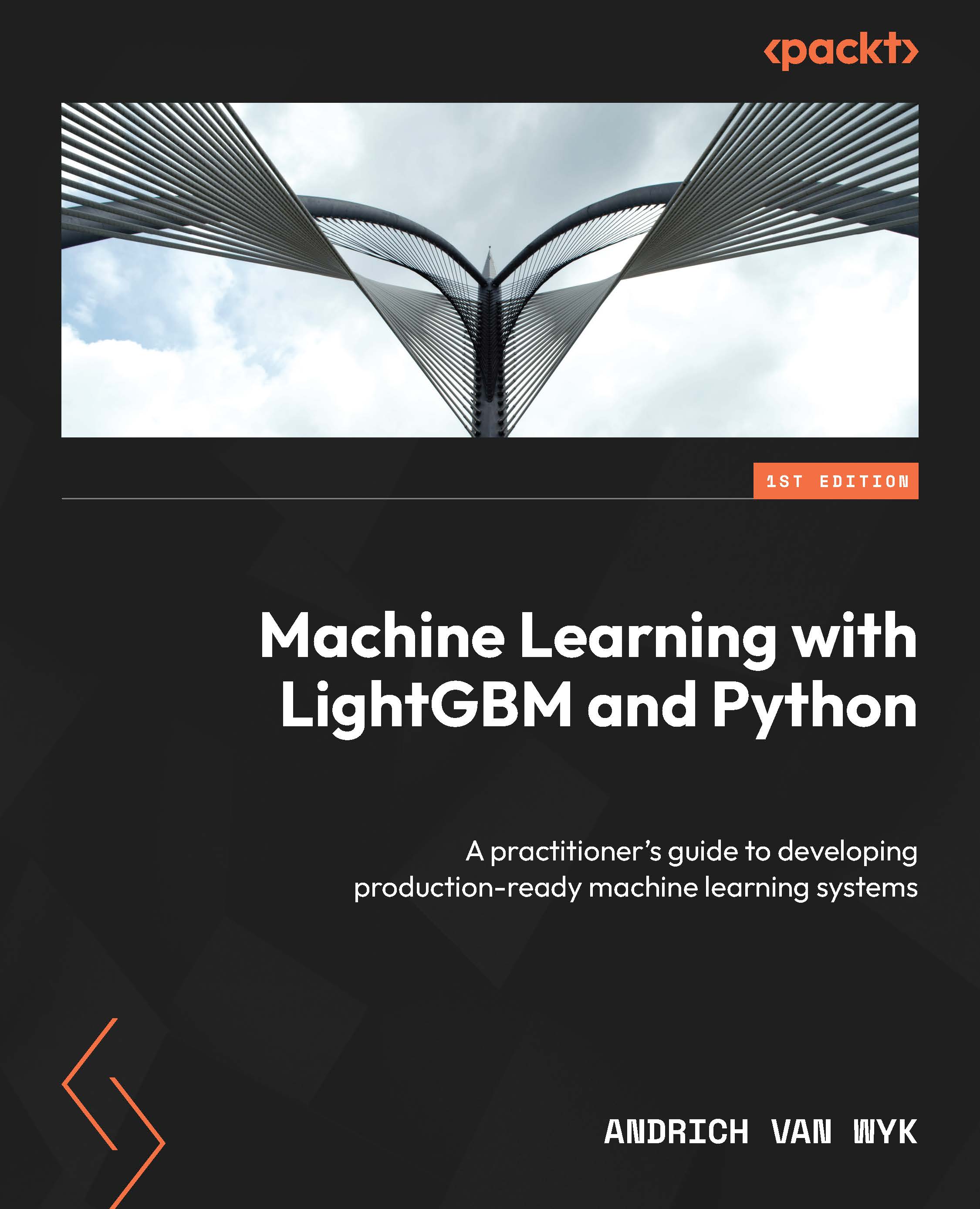
Machine Learning with LightGBM and Python is a comprehensive guide to learning the basics of machine learning and progressing to building scalable machine learning systems that are ready for release.
This book will get you acquainted with the high-performance gradient-boosting LightGBM framework and show you how it can be used to solve various machine-learning problems to produce highly accurate, robust, and predictive solutions. Starting with simple machine learning models in scikit-learn, you’ll explore the intricacies of gradient boosting machines and LightGBM. You’ll be guided through various case studies to better understand the data science processes and learn how to practically apply your skills to real-world problems. As you progress, you’ll elevate your software engineering skills by learning how to build and integrate scalable machine-learning pipelines to process data, train models, and deploy them to serve secure APIs using Python tools such as FastAPI.
By the end of this book, you’ll be well equipped to use various -of-the-art tools that will help you build production-ready systems, including FLAML for AutoML, PostgresML for operating ML pipelines using Postgres, high-performance distributed training and serving via Dask, and creating and running models in the Cloud with AWS Sagemaker.
Table of Contents (17 chapters)
Preface


Part 1: Gradient Boosting and LightGBM Fundamentals
 Free Chapter
Chapter 1: Introducing Machine Learning
Chapter 2: Ensemble Learning – Bagging and Boosting
Chapter 3: An Overview of LightGBM in Python
Chapter 4: Comparing LightGBM, XGBoost, and Deep Learning
Part 2: Practical Machine Learning with LightGBM
Chapter 5: LightGBM Parameter Optimization with Optuna
Chapter 6: Solving Real-World Data Science Problems with LightGBM
Chapter 7: AutoML with LightGBM and FLAML
Part 3: Production-ready Machine Learning with LightGBM
Chapter 8: Machine Learning Pipelines and MLOps with LightGBM

Chapter 9: LightGBM MLOps with AWS SageMaker
Chapter 10: LightGBM Models with PostgresML
Chapter 11: Distributed and GPU-Based Learning with LightGBM
Index


