


-
Book Overview & Buying
-
Table Of Contents

Learn Amazon SageMaker - Second Edition
By :


Learn Amazon SageMaker
By:
Overview of this book
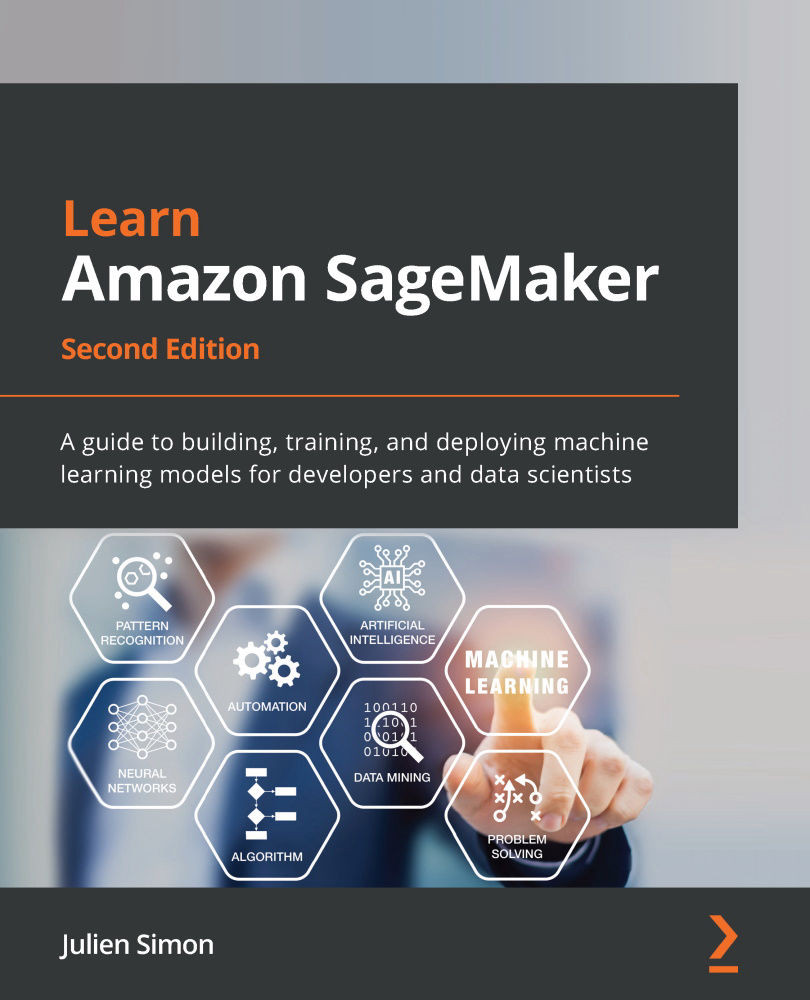
Amazon SageMaker enables you to quickly build, train, and deploy machine learning models at scale without managing any infrastructure. It helps you focus on the machine learning problem at hand and deploy high-quality models by eliminating the heavy lifting typically involved in each step of the ML process. This second edition will help data scientists and ML developers to explore new features such as SageMaker Data Wrangler, Pipelines, Clarify, Feature Store, and much more.
You'll start by learning how to use various capabilities of SageMaker as a single toolset to solve ML challenges and progress to cover features such as AutoML, built-in algorithms and frameworks, and writing your own code and algorithms to build ML models. The book will then show you how to integrate Amazon SageMaker with popular deep learning libraries, such as TensorFlow and PyTorch, to extend the capabilities of existing models. You'll also see how automating your workflows can help you get to production faster with minimum effort and at a lower cost. Finally, you'll explore SageMaker Debugger and SageMaker Model Monitor to detect quality issues in training and production.
By the end of this Amazon book, you'll be able to use Amazon SageMaker on the full spectrum of ML workflows, from experimentation, training, and monitoring to scaling, deployment, and automation.
Table of Contents (19 chapters)
Preface


Section 1: Introduction to Amazon SageMaker
 Free Chapter
Chapter 1: Introducing Amazon SageMaker
Chapter 2: Handling Data Preparation Techniques
Section 2: Building and Training Models
Chapter 3: AutoML with Amazon SageMaker Autopilot
Chapter 4: Training Machine Learning Models
Chapter 5: Training CV Models
Chapter 6: Training Natural Language Processing Models
Chapter 7: Extending Machine Learning Services Using Built-In Frameworks
Chapter 8: Using Your Algorithms and Code
Section 3: Diving Deeper into Training
Chapter 9: Scaling Your Training Jobs
Chapter 10: Advanced Training Techniques
Section 4: Managing Models in Production
Chapter 11: Deploying Machine Learning Models
Chapter 12: Automating Machine Learning Workflows

Chapter 13: Optimizing Prediction Cost and Performance
Other Books You May Enjoy


