


-
Book Overview & Buying
-
Table Of Contents

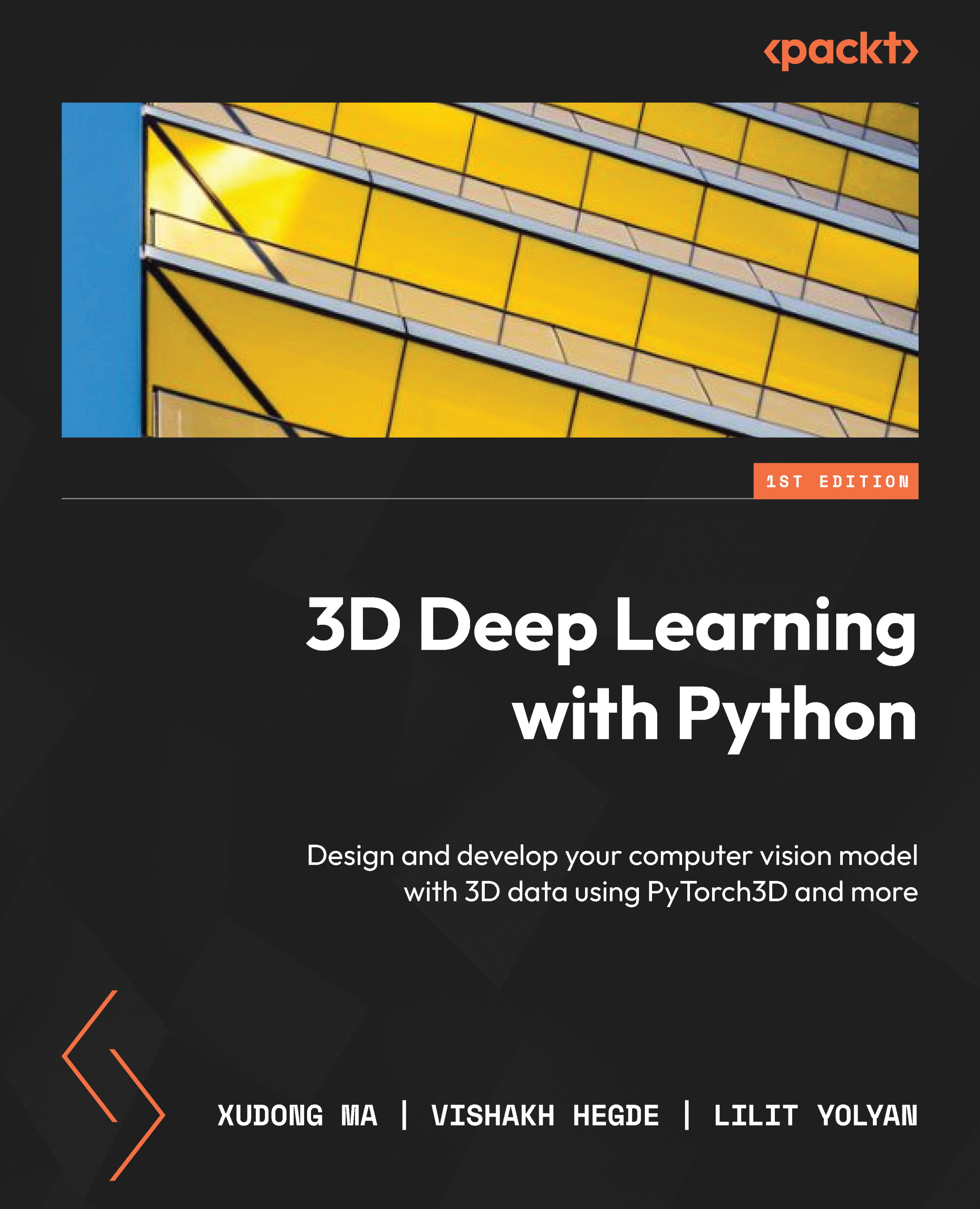
3D Deep Learning with Python
By :


3D Deep Learning with Python
By:
Overview of this book
With this hands-on guide to 3D deep learning, developers working with 3D computer vision will be able to put their knowledge to work and get up and running in no time.
Complete with step-by-step explanations of essential concepts and practical examples, this book lets you explore and gain a thorough understanding of state-of-the-art 3D deep learning. You’ll see how to use PyTorch3D for basic 3D mesh and point cloud data processing, including loading and saving ply and obj files, projecting 3D points into camera coordination using perspective camera models or orthographic camera models, rendering point clouds and meshes to images, and much more. As you implement some of the latest 3D deep learning algorithms, such as differential rendering, Nerf, synsin, and mesh RCNN, you’ll realize how coding for these deep learning models becomes easier using the PyTorch3D library.
By the end of this deep learning book, you’ll be ready to implement your own 3D deep learning models confidently.
Table of Contents (16 chapters)
Preface


PART 1: 3D Data Processing Basics
 Free Chapter
Chapter 1: Introducing 3D Data Processing
Chapter 2: Introducing 3D Computer Vision and Geometry
PART 2: 3D Deep Learning Using PyTorch3D
Chapter 3: Fitting Deformable Mesh Models to Raw Point Clouds
Chapter 4: Learning Object Pose Detection and Tracking by Differentiable Rendering
Chapter 5: Understanding Differentiable Volumetric Rendering
Chapter 6: Exploring Neural Radiance Fields (NeRF)

PART 3: State-of-the-art 3D Deep Learning Using PyTorch3D
Chapter 7: Exploring Controllable Neural Feature Fields
Chapter 8: Modeling the Human Body in 3D
Chapter 9: Performing End-to-End View Synthesis with SynSin
Chapter 10: Mesh R-CNN
Index


