Sign In Start Free Trial
Account

Add to playlist

Create a Playlist

Modal Close icon
You need to login to use this feature.
  • Book Overview & Buying Graph Machine Learning
  • Table Of Contents Toc
Graph Machine Learning

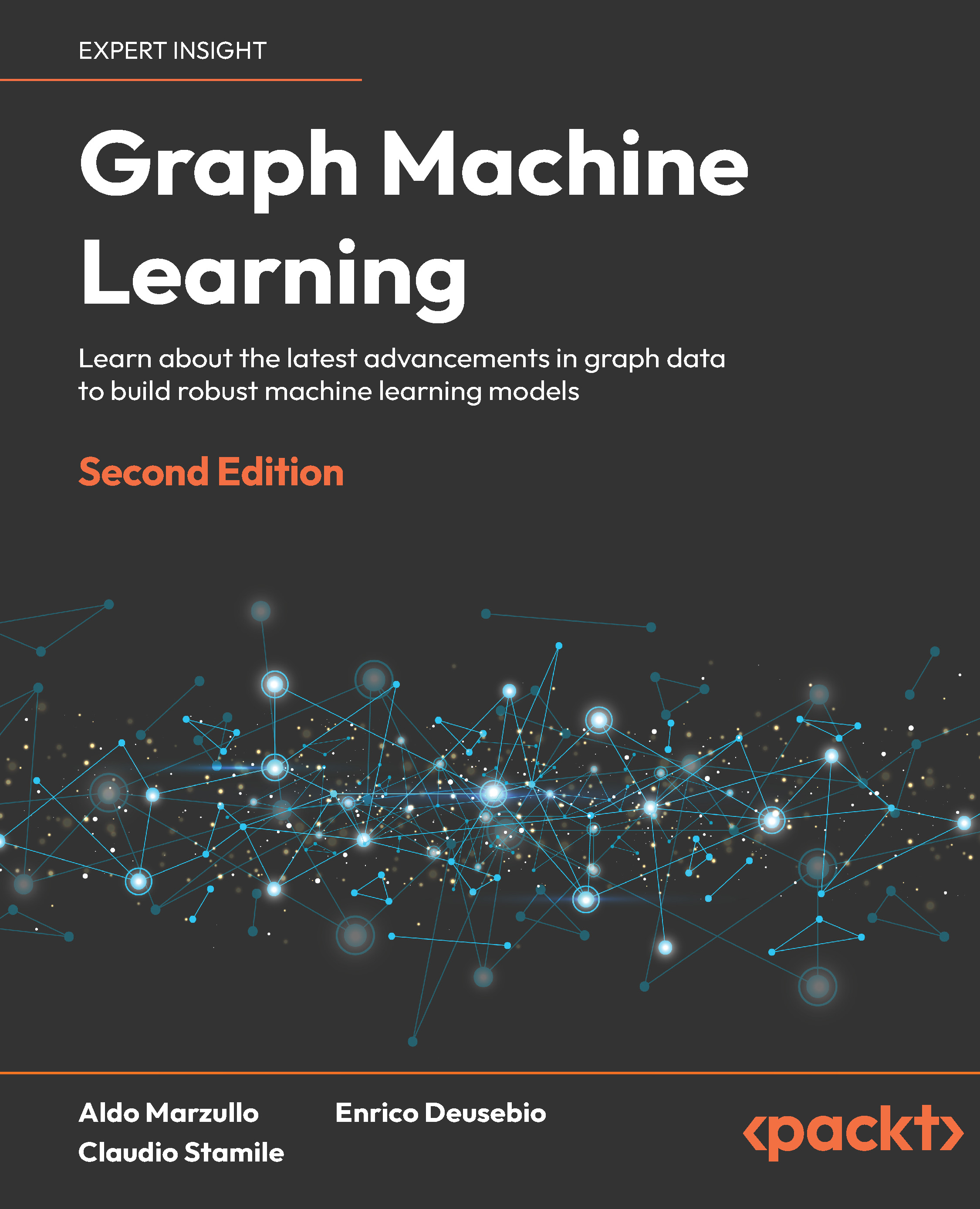
Graph Machine Learning - Second Edition

By : Aldo Marzullo, Enrico Deusebio, Claudio Stamile
close
close
Graph Machine Learning

Graph Machine Learning

By: Aldo Marzullo, Enrico Deusebio, Claudio Stamile

Overview of this book

Graph Machine Learning, Second Edition builds on its predecessor’s success, delivering the latest tools and techniques for this rapidly evolving field. From basic graph theory to advanced ML models, you’ll learn how to represent data as graphs to uncover hidden patterns and relationships, with practical implementation emphasized through refreshed code examples. This thoroughly updated edition replaces outdated examples with modern alternatives such as PyTorch and DGL, available on GitHub to support enhanced learning. The book also introduces new chapters on large language models and temporal graph learning, along with deeper insights into modern graph ML frameworks. Rather than serving as a step-by-step tutorial, it focuses on equipping you with fundamental problem-solving approaches that remain valuable even as specific technologies evolve. You will have a clear framework for assessing and selecting the right tools. By the end of this book, you’ll gain both a solid understanding of graph machine learning theory and the skills to apply it to real-world challenges. *Email sign-up and proof of purchase required -
Table of Contents (20 chapters)
close
close
1
Part 1: Introduction to Graph Machine Learning
5
Part 2: Machine Learning on Graphs
9
Part 3: Practical Applications of Graph Machine Learning
14
Part 4: Advanced topics in Graph Machine Learning
18
Index

Summary

In this chapter, we covered concepts such as graphs, nodes, and edges. We reviewed graph representation methods and explored how to visualize graphs. We also defined properties that are used to characterize networks or parts of them.

We went through a well-known Python library to deal with graphs, NetworkX, and learned how to use it to apply theoretical concepts in practice. We then ran examples and toy problems that are generally used to study the properties of networks, as well as benchmark performance and the effectiveness of network algorithms. We also provided you with some useful links to repositories where network datasets can be found and downloaded, together with some tips on how to parse and process them.

In the next chapter, we will go beyond defining notions of ML on graphs. We will learn how more advanced and latent properties can be automatically found by specific ML algorithms.

Get This Book’s PDF Version and Exclusive Extras

Scan the QR code (or go to packtpub.com/unlock). Search for this book by name, confirm the edition, and then follow the steps on the page.

Note: Keep your invoice handy. Purchases made directly from Packt don’t require one.

CONTINUE READING
83
Tech Concepts
36
Programming languages
73
Tech Tools
Icon Unlimited access to the largest independent learning library in tech of over 8,000 expert-authored tech books and videos.
Icon Innovative learning tools, including AI book assistants, code context explainers, and text-to-speech.
Icon 50+ new titles added per month and exclusive early access to books as they are being written.
Graph Machine Learning
notes
bookmark Notes and Bookmarks search Search in title playlist Add to playlist download Download options font-size Font size

Change the font size

margin-width Margin width

Change margin width

day-mode Day/Sepia/Night Modes

Change background colour

Close icon Search
Country selected

Close icon Your notes and bookmarks

Confirmation

Modal Close icon
claim successful

Buy this book with your credits?

Modal Close icon
Are you sure you want to buy this book with one of your credits?
Close
YES, BUY

Submit Your Feedback

Modal Close icon
Modal Close icon
Modal Close icon