


-
Book Overview & Buying
-
Table Of Contents

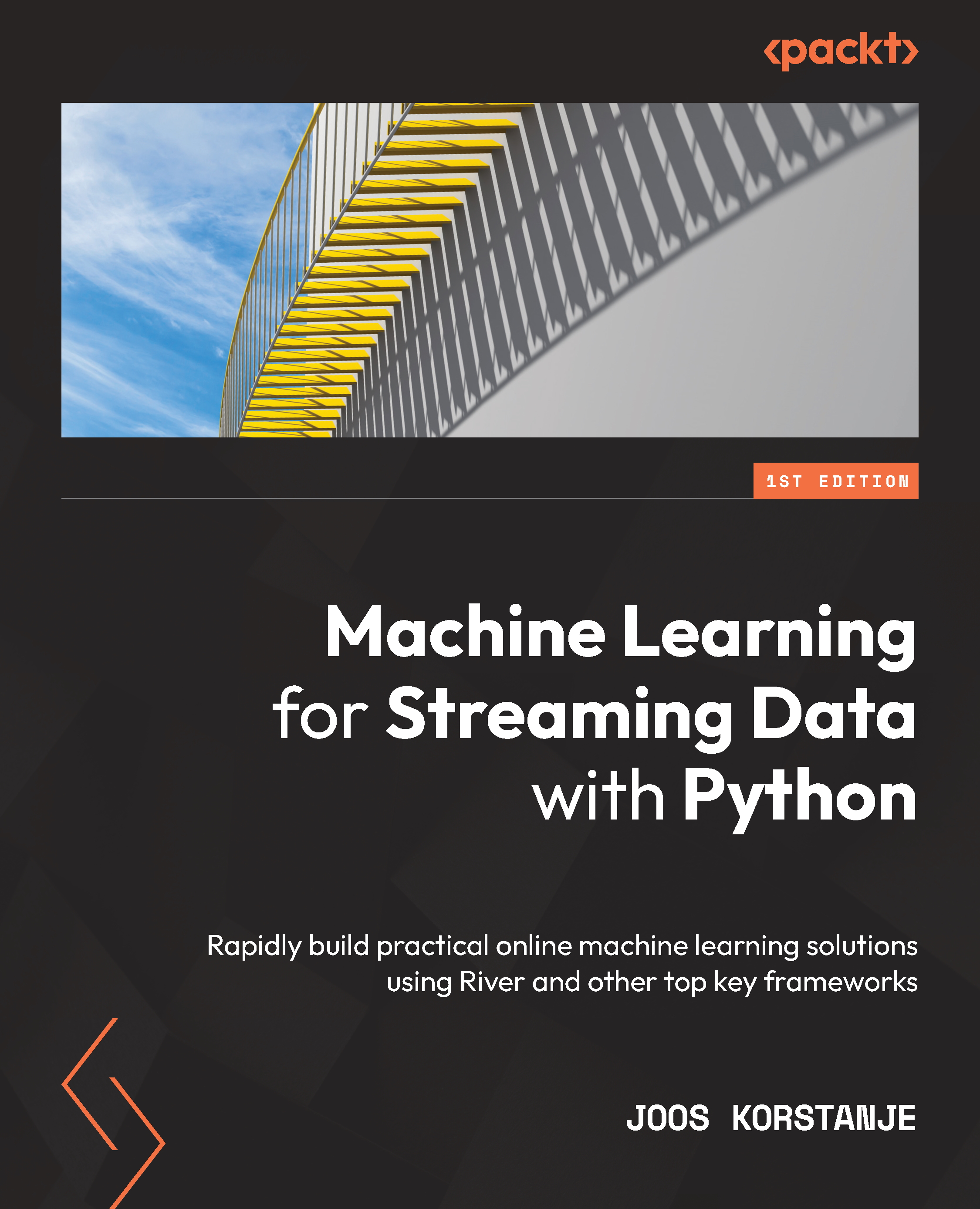
Machine Learning for Streaming Data with Python
By :


Machine Learning for Streaming Data with Python
By:
Overview of this book
Streaming data is the new top technology to watch out for in the field of data science and machine learning. As business needs become more demanding, many use cases require real-time analysis as well as real-time machine learning. This book will help you to get up to speed with data analytics for streaming data and focus strongly on adapting machine learning and other analytics to the case of streaming data.
You will first learn about the architecture for streaming and real-time machine learning. Next, you will look at the state-of-the-art frameworks for streaming data like River. Later chapters will focus on various industrial use cases for streaming data like Online Anomaly Detection and others. As you progress, you will discover various challenges and learn how to mitigate them. In addition to this, you will learn best practices that will help you use streaming data to generate real-time insights.
By the end of this book, you will have gained the confidence you need to stream data in your machine learning models.
Table of Contents (17 chapters)
Preface


Part 1: Introduction and Core Concepts of Streaming Data
 Free Chapter
Chapter 1: An Introduction to Streaming Data
Chapter 2: Architectures for Streaming and Real-Time Machine Learning

Chapter 3: Data Analysis on Streaming Data
Part 2: Exploring Use Cases for Data Streaming
Chapter 4: Online Learning with River
Chapter 5: Online Anomaly Detection
Chapter 6: Online Classification
Chapter 7: Online Regression
Chapter 8: Reinforcement Learning
Part 3: Advanced Concepts and Best Practices around Streaming Data
Chapter 9: Drift and Drift Detection
Chapter 10: Feature Transformation and Scaling
Chapter 11: Catastrophic Forgetting
Chapter 12: Conclusion and Best Practices
Other Books You May Enjoy


