Sign In Start Free Trial
Account

Add to playlist

Create a Playlist

Modal Close icon
You need to login to use this feature.
  • Book Overview & Buying Data Labeling in Machine Learning with Python
  • Table Of Contents Toc
Data Labeling in Machine Learning with Python

Data Labeling in Machine Learning with Python

By : Vijaya Kumar Suda
5 (3)
close
close
Data Labeling in Machine Learning with Python

Data Labeling in Machine Learning with Python

5 (3)
By: Vijaya Kumar Suda

Overview of this book

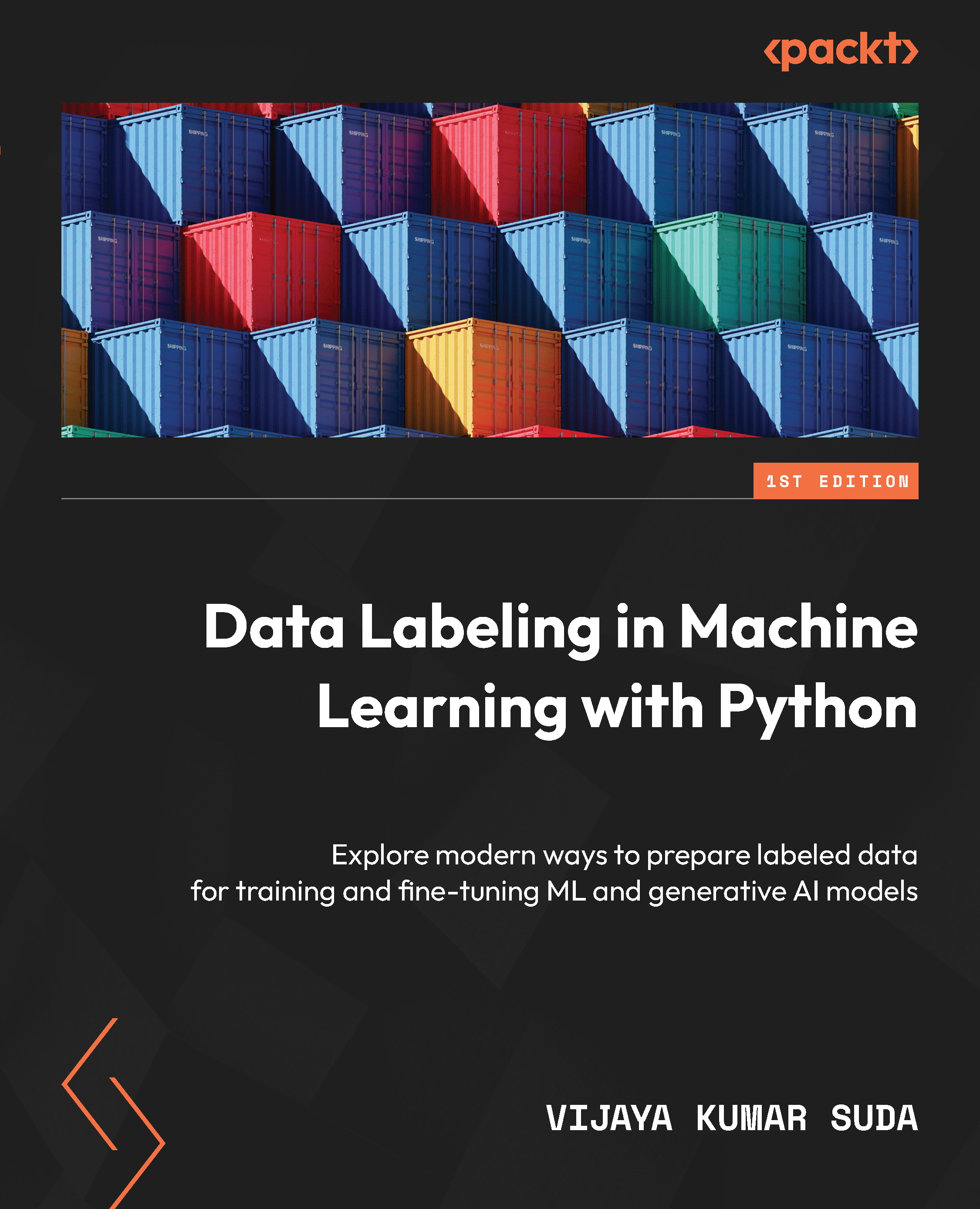
Data labeling is the invisible hand that guides the power of artificial intelligence and machine learning. In today’s data-driven world, mastering data labeling is not just an advantage, it’s a necessity. Data Labeling in Machine Learning with Python empowers you to unearth value from raw data, create intelligent systems, and influence the course of technological evolution. With this book, you'll discover the art of employing summary statistics, weak supervision, programmatic rules, and heuristics to assign labels to unlabeled training data programmatically. As you progress, you'll be able to enhance your datasets by mastering the intricacies of semi-supervised learning and data augmentation. Venturing further into the data landscape, you'll immerse yourself in the annotation of image, video, and audio data, harnessing the power of Python libraries such as seaborn, matplotlib, cv2, librosa, openai, and langchain. With hands-on guidance and practical examples, you'll gain proficiency in annotating diverse data types effectively. By the end of this book, you’ll have the practical expertise to programmatically label diverse data types and enhance datasets, unlocking the full potential of your data.
Table of Contents (18 chapters)
close
close
1
Part 1: Labeling Tabular Data
5
Part 2: Labeling Image Data
9
Part 3: Labeling Text, Audio, and Video Data

Exploring Data for Machine Learning

Imagine embarking on a journey through an expansive ocean of data, where within this vastness are untold stories, patterns, and insights waiting to be discovered. Welcome to the world of data exploration in machine learning (ML). In this chapter, I encourage you to put on your analytical lenses as we embark on a thrilling quest. Here, we will delve deep into the heart of your data, armed with powerful techniques and heuristics, to uncover its secrets. As you embark on this adventure, you will discover that beneath the surface of raw numbers and statistics, there exists a treasure trove of patterns that, once revealed, can transform your data into a valuable asset. The journey begins with exploratory data analysis (EDA), a crucial phase where we unravel the mysteries of data, laying the foundation for automated labeling and, ultimately, building smarter and more accurate ML models. In this age of generative AI, the preparation of quality training data is essential to the fine-tuning of domain-specific large language models (LLMs). Fine-tuning involves the curation of additional domain-specific labeled data for training publicly available LLMs. So, fasten your seatbelts for a captivating voyage into the art and science of data exploration for data labeling.

First, let’s start with the question: What is data exploration? It is the initial phase of data analysis, where raw data is examined, visualized, and summarized to uncover patterns, trends, and insights. It serves as a crucial step in understanding the nature of the data before applying advanced analytics or ML techniques.

In this chapter, we will explore tabular data using various libraries and packages in Python, including Pandas, NumPy, and Seaborn. We will also plot different bar charts and histograms to visualize data to find the relationships between various features, which is useful for labeling data. We will be exploring the Income dataset located in this book’s GitHub repository (a link for which is located in the Technical requirements section). A good understanding of the data is necessary in order to define business rules, identify matching patterns, and, subsequently, label the data using Python labeling functions.

By the end of this chapter, we will be able to generate summary statistics for the given dataset. We will derive aggregates of the features for each target group. We will also learn how to perform univariate and bivariate analyses of the features in the given dataset. We will create a report using the ydata-profiling library.

We’re going to cover the following main topics:

  • EDA and data labeling
  • Summary statistics and data aggregates with Pandas
  • Data visualization with Seaborn for univariate and bivariate analysis
  • Profiling data using the ydata-profiling library
  • Unlocking insights from data with OpenAI and LangChain
CONTINUE READING
83
Tech Concepts
36
Programming languages
73
Tech Tools
Icon Unlimited access to the largest independent learning library in tech of over 8,000 expert-authored tech books and videos.
Icon Innovative learning tools, including AI book assistants, code context explainers, and text-to-speech.
Icon 50+ new titles added per month and exclusive early access to books as they are being written.
Data Labeling in Machine Learning with Python
notes
bookmark Notes and Bookmarks search Search in title playlist Add to playlist download Download options font-size Font size

Change the font size

margin-width Margin width

Change margin width

day-mode Day/Sepia/Night Modes

Change background colour

Close icon Search
Country selected

Close icon Your notes and bookmarks

Confirmation

Modal Close icon
claim successful

Buy this book with your credits?

Modal Close icon
Are you sure you want to buy this book with one of your credits?
Close
YES, BUY

Submit Your Feedback

Modal Close icon
Modal Close icon
Modal Close icon