Sign In Start Free Trial
Account

Add to playlist

Create a Playlist

Modal Close icon
You need to login to use this feature.
  • Book Overview & Buying Building Statistical Models in Python
  • Table Of Contents Toc
Building Statistical Models in Python

Building Statistical Models in Python

By : Huy Hoang Nguyen, Paul N Adams, Stuart J Miller
4.9 (11)
close
close
Building Statistical Models in Python

Building Statistical Models in Python

4.9 (11)
By: Huy Hoang Nguyen, Paul N Adams, Stuart J Miller

Overview of this book

The ability to proficiently perform statistical modeling is a fundamental skill for data scientists and essential for businesses reliant on data insights. Building Statistical Models with Python is a comprehensive guide that will empower you to leverage mathematical and statistical principles in data assessment, understanding, and inference generation. This book not only equips you with skills to navigate the complexities of statistical modeling, but also provides practical guidance for immediate implementation through illustrative examples. Through emphasis on application and code examples, you’ll understand the concepts while gaining hands-on experience. With the help of Python and its essential libraries, you’ll explore key statistical models, including hypothesis testing, regression, time series analysis, classification, and more. By the end of this book, you’ll gain fluency in statistical modeling while harnessing the full potential of Python's rich ecosystem for data analysis.
Table of Contents (22 chapters)
close
close
1
Part 1:Introduction to Statistics
7
Part 2:Regression Models
10
Part 3:Classification Models
13
Part 4:Time Series Models
17
Part 5:Survival Analysis

Software and environment setup

Python is one of the most popular programming languages for data science and machine learning thanks to the large open source community that has driven the development of these libraries. Python’s ease of use and flexible nature made it a prime candidate in the data science world, where experimentation and iteration are key features of the development cycle. While there are new languages in development for data science applications, such as Julia, Python currently remains the key language for data science due to its wide breadth of open source projects, supporting applications from statistical modeling to deep learning. We have chosen to use Python in this book due to its positioning as an important language for data science and its demand in the job market.

Python is available for all major operating systems: Microsoft Windows, macOS, and Linux. Additionally, the installer and documentation can be found at the official website: https://www.python.org/.

This book is written for Python version 3.8 (or higher). It is recommended that you use whatever recent version of Python that is available. It is not likely that the code found in this book will be compatible with Python 2.7, and most active libraries have already started dropping support for Python 2.7 since official support ended in 2020.

The libraries used in this book can be installed with the Python package manager, pip, which is part of the standard Python library in contemporary versions of Python. More information about pip can be found here: https://docs.python.org/3/installing/index.html. After pip is installed, packages can be installed using pip on the command line. Here is basic usage at a glance:

Install a new package using the latest version:

pip install SomePackage

Install the package with a specific version, version 2.1 in this example:

pip install SomePackage==2.1

A package that is already installed can be upgraded with the --upgrade flag:

pip install SomePackage –upgrade

In general, it is recommended to use Python virtual environments between projects and to keep project dependencies separate from system directories. Python provides a virtual environment utility, venv, which, like pip, is part of the standard library in contemporary versions of Python. Virtual environments allow you to create individual binaries of Python, where each binary of Python has its own set of installed dependencies. Using virtual environments can prevent package version issues and conflict when working on multiple Python projects. Details on setting up and using virtual environments can be found here: https://docs.python.org/3/library/venv.html.

While we recommend the use of Python and Python’s virtual environments for environment setups, a highly recommended alternative is Anaconda. Anaconda is a free (enterprise-ready) analytics-focused distribution of Python by Anaconda Inc. (previously Continuum Analytics). Anaconda distributions come with many of the core data science packages, common IDEs (such as Jupyter and Visual Studio Code), and a graphical user interface for managing environments. Anaconda can be installed using the installer found at the Anaconda website here: https://www.anaconda.com/products/distribution.

Anaconda comes with its own package manager, conda, which can be used to install new packages similarly to pip.

Install a new package using the latest version:

conda install SomePackage

Upgrade a package that is already installed:

conda upgrade SomePackage

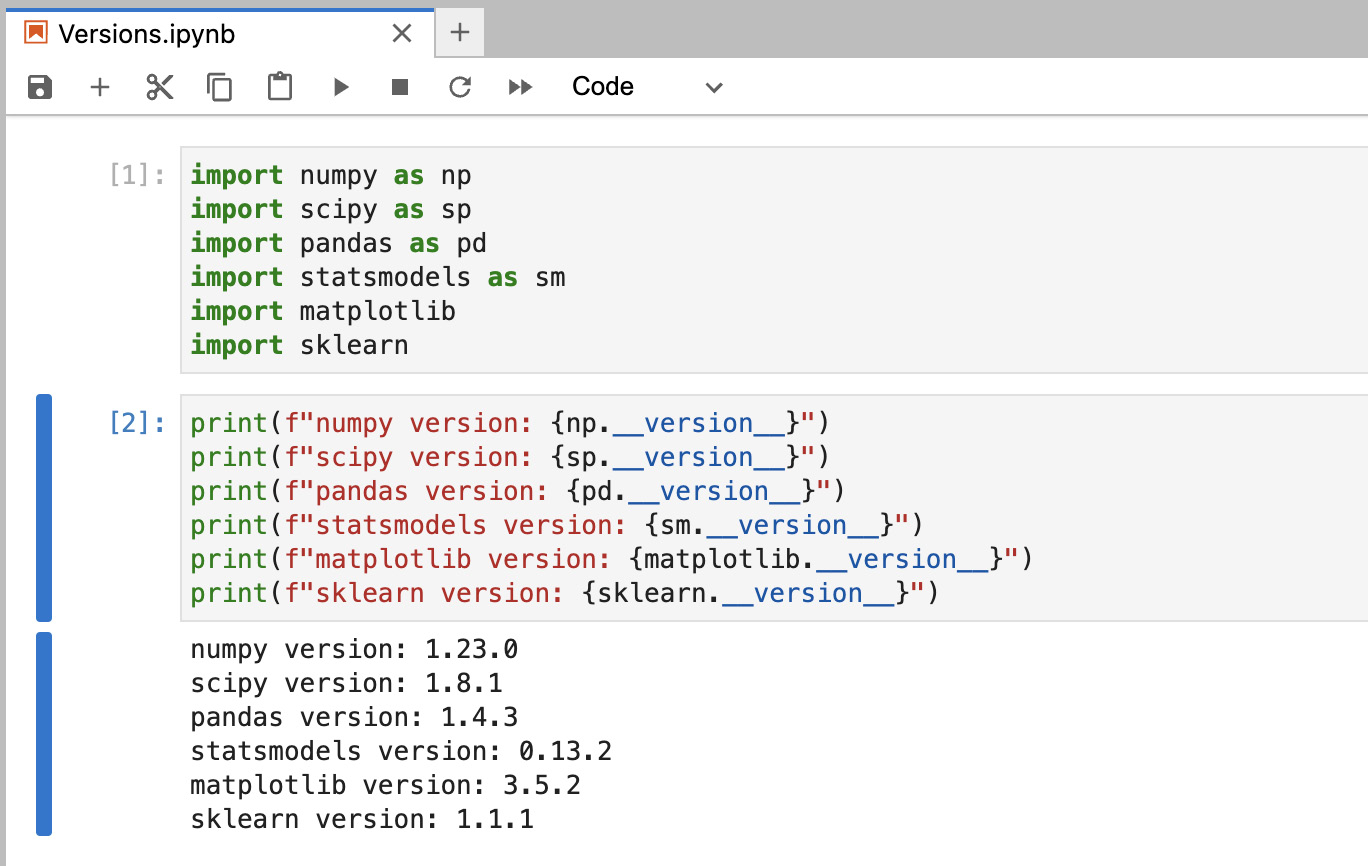
Throughout this book, we will make use of several core libraries in the Python data science ecosystem, such as NumPy for array manipulations, pandas for higher-level data manipulations, and matplotlib for data visualization. The package versions used for this book are contained in the following list. Please ensure that the versions installed in your environment are equal to or greater than the versions listed. This will help ensure that the code examples run correctly:

  • statsmodels 0.13.2
  • Matplotlib 3.5.2
  • NumPy 1.23.0
  • SciPy 1.8.1
  • scikit-learn 1.1.1
  • pandas 1.4.3

The packages used for the code in this book are shown here in Figure 1.1. The __version__ method can be used to print the package version in code.

Figure 1.1 – Package versions used in this book

Figure 1.1 – Package versions used in this book

Having set up the technical environment for the book, let’s get into the statistics. In the next sections, we will discuss the concepts of population and sampling. We will demonstrate sampling strategies with code implementations.

CONTINUE READING
83
Tech Concepts
36
Programming languages
73
Tech Tools
Icon Unlimited access to the largest independent learning library in tech of over 8,000 expert-authored tech books and videos.
Icon Innovative learning tools, including AI book assistants, code context explainers, and text-to-speech.
Icon 50+ new titles added per month and exclusive early access to books as they are being written.
Building Statistical Models in Python
notes
bookmark Notes and Bookmarks search Search in title playlist Add to playlist download Download options font-size Font size

Change the font size

margin-width Margin width

Change margin width

day-mode Day/Sepia/Night Modes

Change background colour

Close icon Search
Country selected

Close icon Your notes and bookmarks

Confirmation

Modal Close icon
claim successful

Buy this book with your credits?

Modal Close icon
Are you sure you want to buy this book with one of your credits?
Close
YES, BUY

Submit Your Feedback

Modal Close icon
Modal Close icon
Modal Close icon