Sign In Start Free Trial
Account

Add to playlist

Create a Playlist

Modal Close icon
You need to login to use this feature.
  • Book Overview & Buying Building Statistical Models in Python
  • Table Of Contents Toc
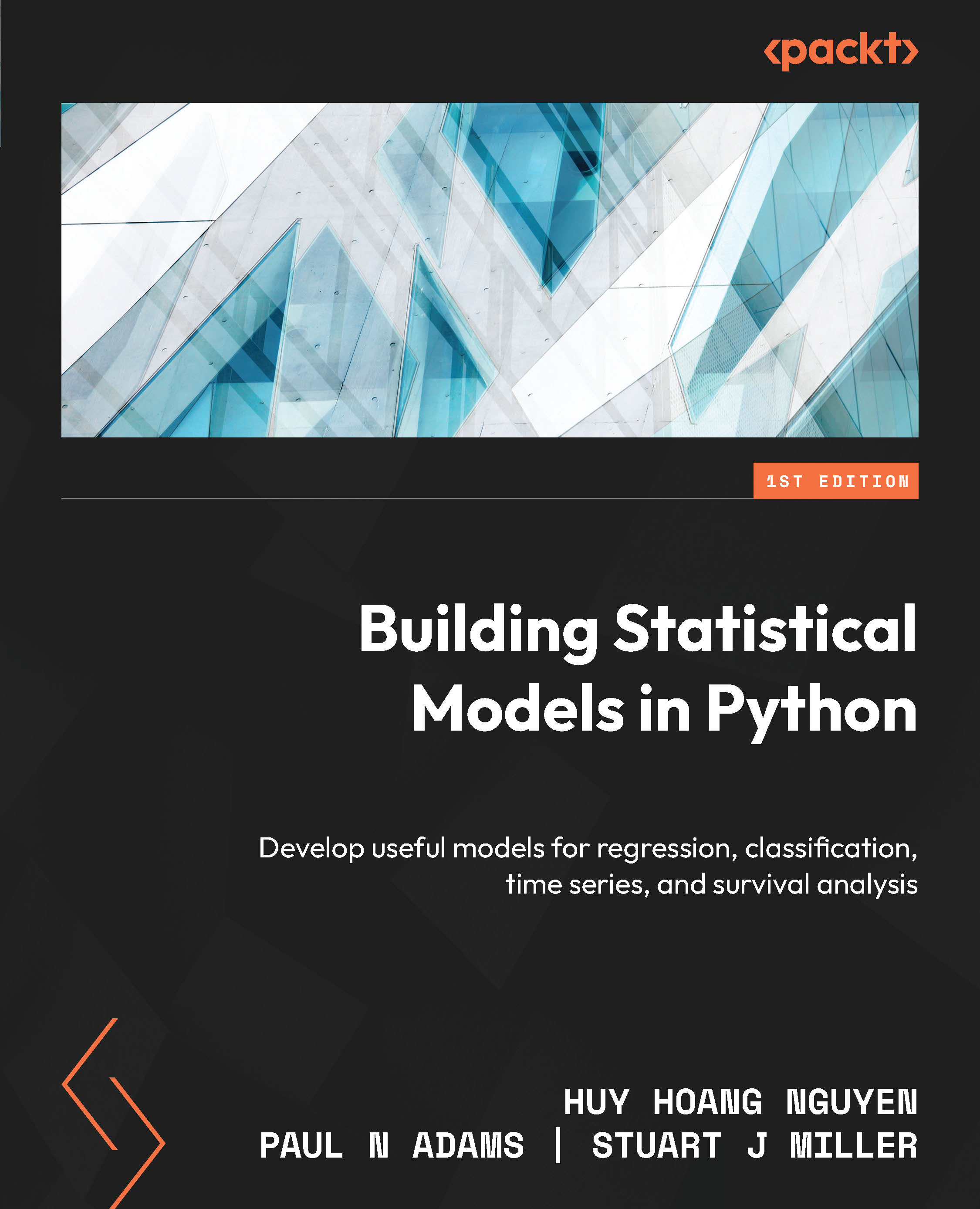
Building Statistical Models in Python

Building Statistical Models in Python

By : Huy Hoang Nguyen, Paul N Adams, Stuart J Miller
4.9 (11)
close
close
Building Statistical Models in Python

Building Statistical Models in Python

4.9 (11)
By: Huy Hoang Nguyen, Paul N Adams, Stuart J Miller

Overview of this book

The ability to proficiently perform statistical modeling is a fundamental skill for data scientists and essential for businesses reliant on data insights. Building Statistical Models with Python is a comprehensive guide that will empower you to leverage mathematical and statistical principles in data assessment, understanding, and inference generation. This book not only equips you with skills to navigate the complexities of statistical modeling, but also provides practical guidance for immediate implementation through illustrative examples. Through emphasis on application and code examples, you’ll understand the concepts while gaining hands-on experience. With the help of Python and its essential libraries, you’ll explore key statistical models, including hypothesis testing, regression, time series analysis, classification, and more. By the end of this book, you’ll gain fluency in statistical modeling while harnessing the full potential of Python's rich ecosystem for data analysis.
Table of Contents (22 chapters)
close
close
1
Part 1:Introduction to Statistics
7
Part 2:Regression Models
10
Part 3:Classification Models
13
Part 4:Time Series Models
17
Part 5:Survival Analysis

Parametric Tests

In the previous chapter, we introduced the concept of a hypothesis test and showed several applications of the z-test. The z-test is a type of hypothesis test in a family of hypothesis tests called parametric tests. Parametric tests are powerful hypothesis tests, but the application of parametric tests requires certain assumptions to be met by the data. While the z-test is a useful test, it is limited by the required assumptions. In this chapter, we will discuss several more parametric tests, which will expand our parametric tool set. More specifically, we will discuss the various applications of the t-test, how to perform tests when more than two subgroups of data are present, and the hypothesis test for Pearson’s correlation coefficient. We will complete the chapter with a discussion on power analysis for parametric tests.

In this chapter, we’re going to cover the following main topics:

  • Assumptions of parametric tests
  • T-test—a...
CONTINUE READING
83
Tech Concepts
36
Programming languages
73
Tech Tools
Icon Unlimited access to the largest independent learning library in tech of over 8,000 expert-authored tech books and videos.
Icon Innovative learning tools, including AI book assistants, code context explainers, and text-to-speech.
Icon 50+ new titles added per month and exclusive early access to books as they are being written.
Building Statistical Models in Python
notes
bookmark Notes and Bookmarks search Search in title playlist Add to playlist download Download options font-size Font size

Change the font size

margin-width Margin width

Change margin width

day-mode Day/Sepia/Night Modes

Change background colour

Close icon Search
Country selected

Close icon Your notes and bookmarks

Confirmation

Modal Close icon
claim successful

Buy this book with your credits?

Modal Close icon
Are you sure you want to buy this book with one of your credits?
Close
YES, BUY

Submit Your Feedback

Modal Close icon
Modal Close icon
Modal Close icon