Sign In Start Free Trial
Account

Add to playlist

Create a Playlist

Modal Close icon
You need to login to use this feature.
  • Book Overview & Buying Polars Cookbook
  • Table Of Contents Toc
Polars Cookbook

Polars Cookbook

By : Yuki Kakegawa
5 (5)
close
close
Polars Cookbook

Polars Cookbook

5 (5)
By: Yuki Kakegawa

Overview of this book

The Polars Cookbook is a comprehensive, hands-on guide to Python Polars, one of the first resources dedicated to this powerful data processing library. Written by Yuki Kakegawa, a seasoned data analytics consultant who has worked with industry leaders like Microsoft and Stanford Health Care, this book offers targeted, real-world solutions to data processing, manipulation, and analysis challenges. The book also includes a foreword by Marco Gorelli, a core contributor to Polars, ensuring expert insights into Polars' applications. From installation to advanced data operations, you’ll be guided through data manipulation, advanced querying, and performance optimization techniques. You’ll learn to work with large datasets, conduct sophisticated transformations, leverage powerful features like chaining, and understand its caveats. This book also shows you how to integrate Polars with other Python libraries such as pandas, numpy, and PyArrow, and explore deployment strategies for both on-premises and cloud environments like AWS, BigQuery, GCS, Snowflake, and S3. With use cases spanning data engineering, time series analysis, statistical analysis, and machine learning, Polars Cookbook provides essential techniques for optimizing and securing your workflows. By the end of this book, you'll possess the skills to design scalable, efficient, and reliable data processing solutions with Polars.
Table of Contents (15 chapters)
close
close

Understanding method chaining

Method chaining is a technique or way of structuring your code. It’s commonly used across DataFrame libraries such as pandas and PySpark. As the name tells you, it means that you chain methods one after another. This makes your code more readable, concise, and maintainable. It follows a natural flow from one operation to another, which makes your code easy to follow. All of that helps you focus on the data transformation logic and problems you’re trying to solve.

The good news is that Polars is a good fit for method chaining. Polars utilizes expressions and other methods that can easily be stacked on each other.

Getting ready

This recipe requires the titanic dataset. Make sure to read it into a DataFrame:

df = pl.read_csv('../data/titanic_dataset.csv')

How to do it...

Let’s say that you’re doing a few operations on the dataset. First, we will predefine the columns that we want to select:

cols = ['Name', 'Sex', 'Age', 'Fare', 'Cabin', 'Pclass', 'Survived']

If you’re not using method chaining, you might want to write code like this:

df = df.select(cols)
df = df.filter(pl.col('Age')>=35)
df = df.sort(by=['Age', 'Name'])

When you use method chaining, it’d look like this:

df = df.select(cols).filter(pl.col('Age')>=35).sort(by=['Age', 'Name'])

To go one step further, let’s stack these methods vertically. This is the preferred way of writing your code with method chaining:

df = (
    df
    .select(cols)
    .filter(pl.col('Age')>=35)
    .sort(by=['Age', 'Name'])
)

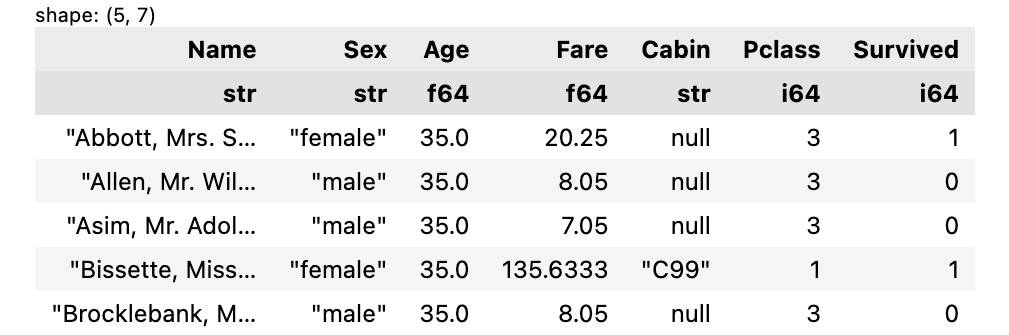
All of the preceding code produces the same output:

Figure 1.35 – The output after column selection, filtering, and sorting

Figure 1.35 – The output after column selection, filtering, and sorting

How it works...

The first example I showed defines each method line by line, storing each result in a variable each time. The last example involved method chaining, aligning the beginning of each method vertically. Some users don’t even know that you can stack your methods on top of each other, especially users who are just getting started. You might have a habit of defining your transformations line by line, like in the first example.

Having looked at a few examples, which pattern do you think is best? I’d say the one using method chaining, stacking each method vertically. Aligning the beginning of each method helps with readability. Having all the logic in the same place makes it easier to maintain the code and figure things out later. It also helps you streamline your workflows by making your code more concise and ensuring that it is organized in a logical way.

How does this help with testing and debugging though? You can comment out or add another method within the parentheses to test the result:

df = (
    df
    .select(cols)
    # .filter(pl.col('Age')>=35)
    .sort(by=['Age', 'Name'])
)
df.head()

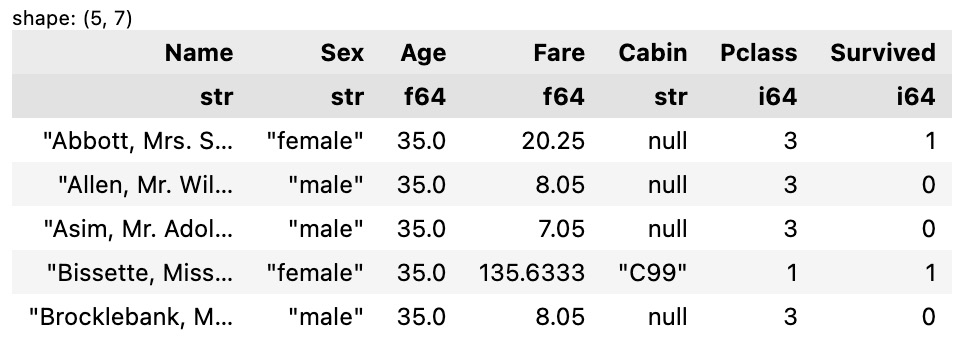
The preceding code will return the following output:

Figure 1.36 – The first five rows without the filtering condition

Figure 1.36 – The first five rows without the filtering condition

We’ll cover testing and debugging in more detail in Chapter 12, Testing and Debugging in Polars.

One caveat is that when your chain is too long, it may make your code hard to read and work with. This increased complexity that comes with a long chain can make your debugging hard, too. It can become challenging to understand each intermediary step in a long chain. In that case, you should break your logic down into smaller pieces to help reduce the complexity and length of your chain. With all of that said, it all comes down to the fact that a balance is needed to make testing your code feasible.

In the interest of full disclosure, remember that you don’t have an obligation to use method chaining. If it feels more comfortable or appropriate to write your code line by line separately, that’s all good and fine. Method chaining is just another practice, and many people find it helpful. I can confidently say that method chaining has done me more good than harm.

There’s more...

When you stack your methods vertically, you can also use backslashes instead of using parentheses:

df = df \
    .select(cols) \
    .filter(pl.col('Age')>=35) \
    .sort(by=['Age', 'Name'])

I have to say that adding a backslash for each method is a little bit of work. Also, if you comment out the last method in the chain for testing and debugging purposes, it messes up the whole chain because you can’t end your code with a backslash. I’d choose using parentheses over backslashes any day.

See also

These are useful resources to learn more about method chaining:

CONTINUE READING
83
Tech Concepts
36
Programming languages
73
Tech Tools
Icon Unlimited access to the largest independent learning library in tech of over 8,000 expert-authored tech books and videos.
Icon Innovative learning tools, including AI book assistants, code context explainers, and text-to-speech.
Icon 50+ new titles added per month and exclusive early access to books as they are being written.
Polars Cookbook
notes
bookmark Notes and Bookmarks search Search in title playlist Add to playlist download Download options font-size Font size

Change the font size

margin-width Margin width

Change margin width

day-mode Day/Sepia/Night Modes

Change background colour

Close icon Search
Country selected

Close icon Your notes and bookmarks

Confirmation

Modal Close icon
claim successful

Buy this book with your credits?

Modal Close icon
Are you sure you want to buy this book with one of your credits?
Close
YES, BUY

Submit Your Feedback

Modal Close icon
Modal Close icon
Modal Close icon