


-
Book Overview & Buying
-
Table Of Contents

Algorithmic Short Selling with Python - Second Edition
By :


Algorithmic Short Selling with Python
By:
Overview of this book
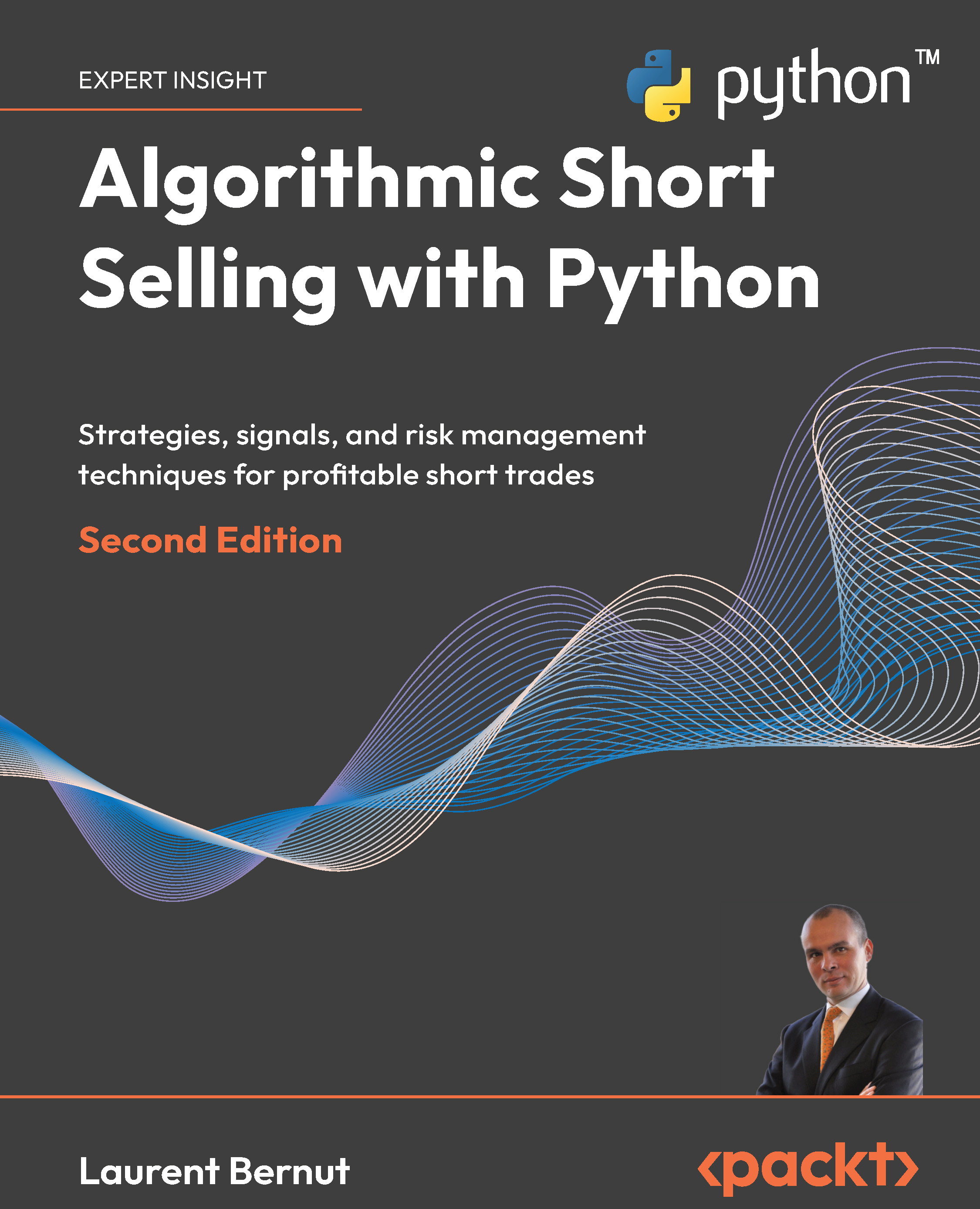
Algorithmic Short Selling with Python, Second Edition is a practical guide to building, testing, and managing systematic short-selling strategies in today's markets. Structured around the core challenges every short seller faces, the book provides a framework for continuously generating long/short ideas, identifying bullish/bearish market regimes, detecting sector rotation ahead of consensus, constructing robust long/short portfolios, and managing the unique risks of the short side.
Through real-world examples and working Python code based on S&P 500 data, readers learn how to develop quantitative strategies that address position sizing, crowded trades, portfolio exposures, and capital allocation across changing market conditions. The book also explores advanced topics such as relative strength analysis, fractals, convexity, long/short portfolio management, asset allocation, and the use of AI-powered trading journals to uncover the behavioral patterns that influence trading decisions.
Every concept is supported by implementation, bridging the gap between theory and execution. Expanding on the first edition, this updated version transforms ideas into fully coded solutions, providing readers with the tools to design, evaluate, and deploy systematic short-selling strategies with confidence, discipline, and consistency.
Table of Contents (16 chapters)
Preface


Chapter 1: The Stock Market Game
Chapter 2: 10 Classic Myths About Short Selling
Chapter 3: Long/Short Methodologies: Absolute and Relative
Part 2: The Outer Game: The Trading Edge
Chapter 4: Regime Definition
Chapter 5: The Trading Edge Is a Number, and Here Is the Formula
Chapter 6: Position Sizing: Money Is Made in the Money Management Module
Chapter 7: Refining the Investment Universe
Part 3: The Long/Short Game: Portfolio Construction
Chapter 8: The Long/Short Toolbox
Chapter 9: Asset Allocation
Chapter 10: The Trading Journal

Chapter 11: Unlock Access to the Code Bundle and the PDF Version
Index


