Sign In Start Free Trial
Account

Add to playlist

Create a Playlist

Modal Close icon
You need to login to use this feature.
  • Book Overview & Buying Building Agents with OpenAI  Agents SDK
  • Table Of Contents Toc
Building Agents with OpenAI  Agents SDK

Building Agents with OpenAI Agents SDK

By : Habib
4 (1)
close
close
Building Agents with OpenAI  Agents SDK

Building Agents with OpenAI Agents SDK

4 (1)
By: Habib

Overview of this book

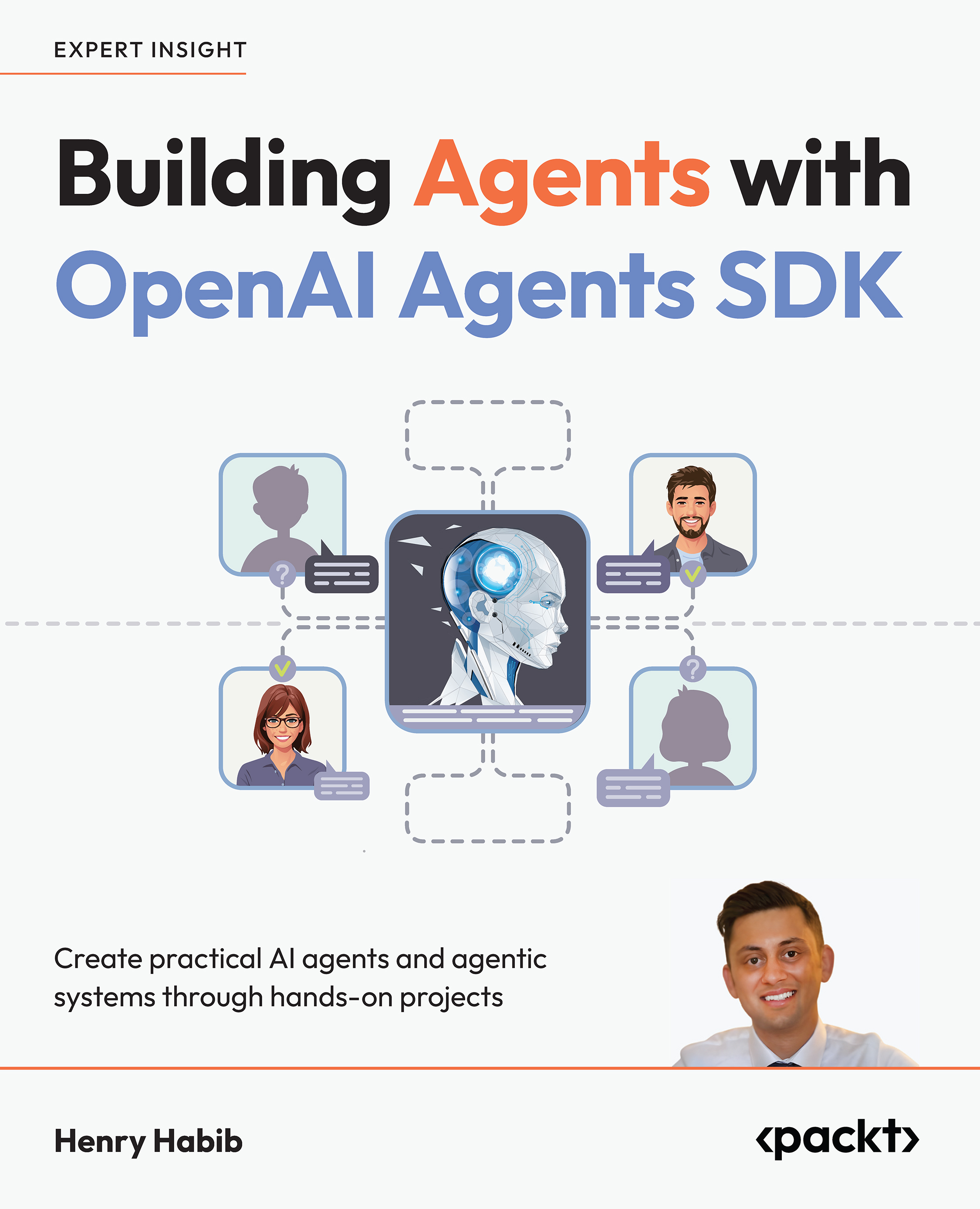
Everyone’s talking about AI agents, but how do you build one that works in the real world? Not a toy demo, but an agent that solves real problems, saves time, and integrates into workflows. With vague frameworks, fragmented tooling, and endless hype, most developers are left without a clear path. The hardest part isn’t technical; it is knowing where to start. This book gives you that starting point. It’s a complete guide to building intelligent AI agents and agentic systems using the official OpenAI Agents SDK. It begins by grounding you in the core concepts, design principles, and architecture of AI agents, how they differ from other traditional systems, their advantages, and why that matters. Through practical step-by-step projects, you’ll master every feature of the SDK—tools, memory, RAG, multi-agent orchestration, tracing, handoffs, and more—while contributing to an end-to-end agent system that grows in complexity. Projects include a custom support agent, invoice and inventory assistant, health advisor, sales trainer, and data analyst, giving you production-ready skills. By the end, you’ll know how to design, build, and deploy agentic systems that interact with APIs, query databases, hand off to external systems, and drive meaningful outcomes. You won’t just understand AI agents; you’ll be ready to ship them.
Table of Contents (15 chapters)
close
close
Lock Free Chapter
1
Part 1: AI Agents
5
Part 2: OpenAI Agents SDK
11
Part 3: Build AI Agents
13
Other Books You May Enjoy
14
Index

Training knowledge

As discussed in Chapter 1, training knowledge refers to information that is inherently stored in the model through its training data. Every LLM begins with a vast repository of inherent knowledge derived from the massive datasets (typically, a large corpus of internet text) on which it was initially trained. The benefit of an LLM having internal knowledge is that the knowledge itself has the following advantages:

  • It is quickly retrievable: Since the inherent knowledge is “baked” into the model weights, the model can retrieve the information very quickly and is typically limited only by the LLM’s compute speed
  • It has a wide coverage: Since the training data is vast (the corpus of the internet), the inherent knowledge can cover lots of topics in fairly great detail

The process of changing the model’s inherent knowledge is called fine-tuning. Unlike prompting or retrieval-based techniques that guide a model’...

CONTINUE READING
83
Tech Concepts
36
Programming languages
73
Tech Tools
Icon Unlimited access to the largest independent learning library in tech of over 8,000 expert-authored tech books and videos.
Icon Innovative learning tools, including AI book assistants, code context explainers, and text-to-speech.
Icon 50+ new titles added per month and exclusive early access to books as they are being written.
Building Agents with OpenAI  Agents SDK
notes
bookmark Notes and Bookmarks search Search in title playlist Add to playlist download Download options font-size Font size

Change the font size

margin-width Margin width

Change margin width

day-mode Day/Sepia/Night Modes

Change background colour

Close icon Search
Country selected

Close icon Your notes and bookmarks

Confirmation

Modal Close icon
claim successful

Buy this book with your credits?

Modal Close icon
Are you sure you want to buy this book with one of your credits?
Close
YES, BUY

Submit Your Feedback

Modal Close icon
Modal Close icon
Modal Close icon