


-
Book Overview & Buying
-
Table Of Contents

Building Agents with OpenAI Agents SDK
By :


Building Agents with OpenAI Agents SDK
By:
Overview of this book
Everyone’s talking about AI agents, but how do you build one that works in the real world? Not a toy demo, but an agent that solves real problems, saves time, and integrates into workflows. With vague frameworks, fragmented tooling, and endless hype, most developers are left without a clear path. The hardest part isn’t technical; it is knowing where to start.
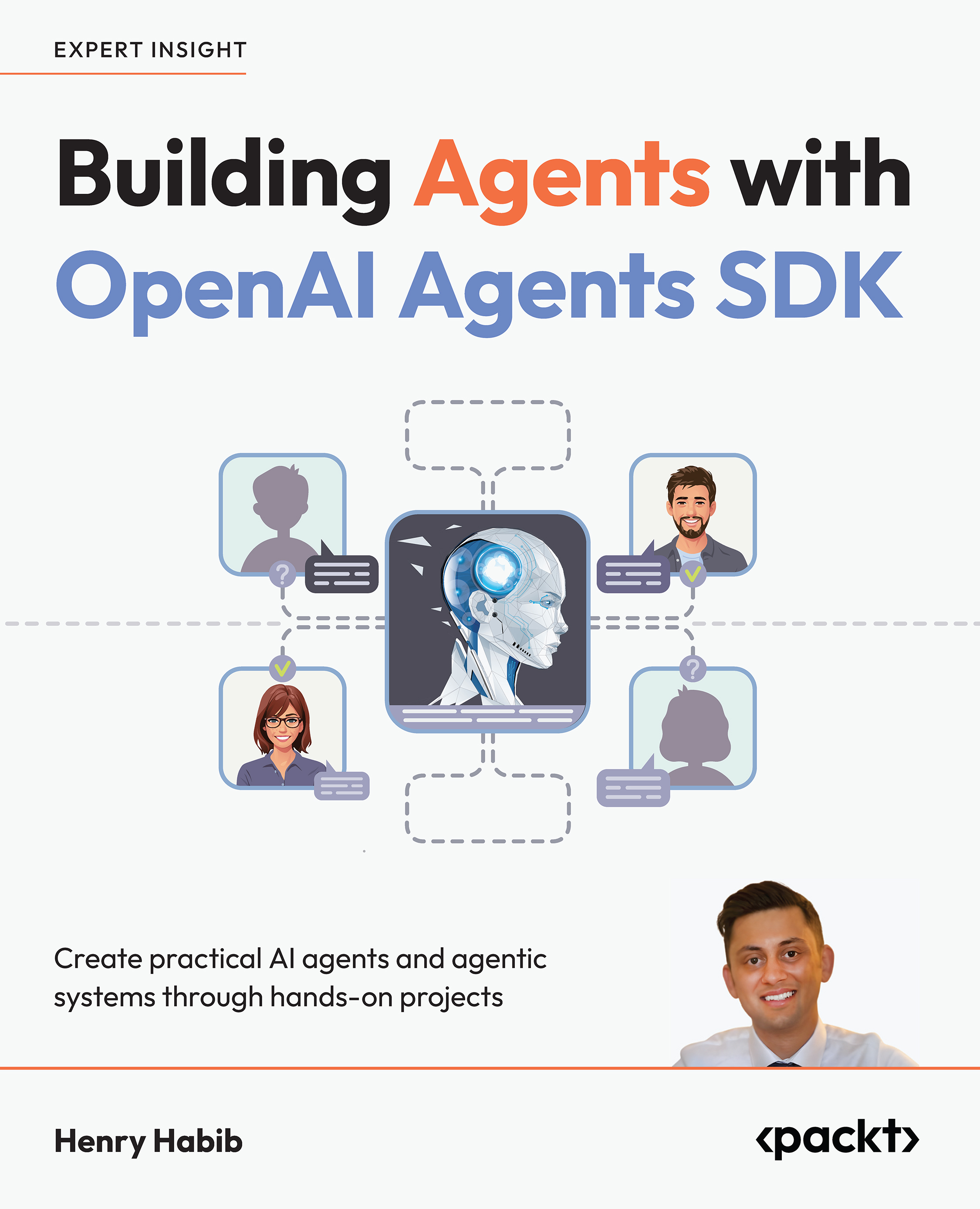
This book gives you that starting point. It’s a complete guide to building intelligent AI agents and agentic systems using the official OpenAI Agents SDK. It begins by grounding you in the core concepts, design principles, and architecture of AI agents, how they differ from other traditional systems, their advantages, and why that matters.
Through practical step-by-step projects, you’ll master every feature of the SDK—tools, memory, RAG, multi-agent orchestration, tracing, handoffs, and more—while contributing to an end-to-end agent system that grows in complexity. Projects include a custom support agent, invoice and inventory assistant, health advisor, sales trainer, and data analyst, giving you production-ready skills.
By the end, you’ll know how to design, build, and deploy agentic systems that interact with APIs, query databases, hand off to external systems, and drive meaningful outcomes. You won’t just understand AI agents; you’ll be ready to ship them.
Table of Contents (15 chapters)
Preface


Introduction to AI Agents

Introduction to OpenAI Agents SDK
Environment Setup and Developing Your First Agent
Part 2: OpenAI Agents SDK
Agent Tools and MCPs
Memory and Knowledge
Multi-Agent Systems and Handoffs
Model and Context Management
Agent System Management
Part 3: Build AI Agents
Building AI Agents and Agentic Systems
Other Books You May Enjoy
Index


