


-
Book Overview & Buying
-
Table Of Contents

Practical MongoDB Aggregations
By :


Practical MongoDB Aggregations
By:
Overview of this book
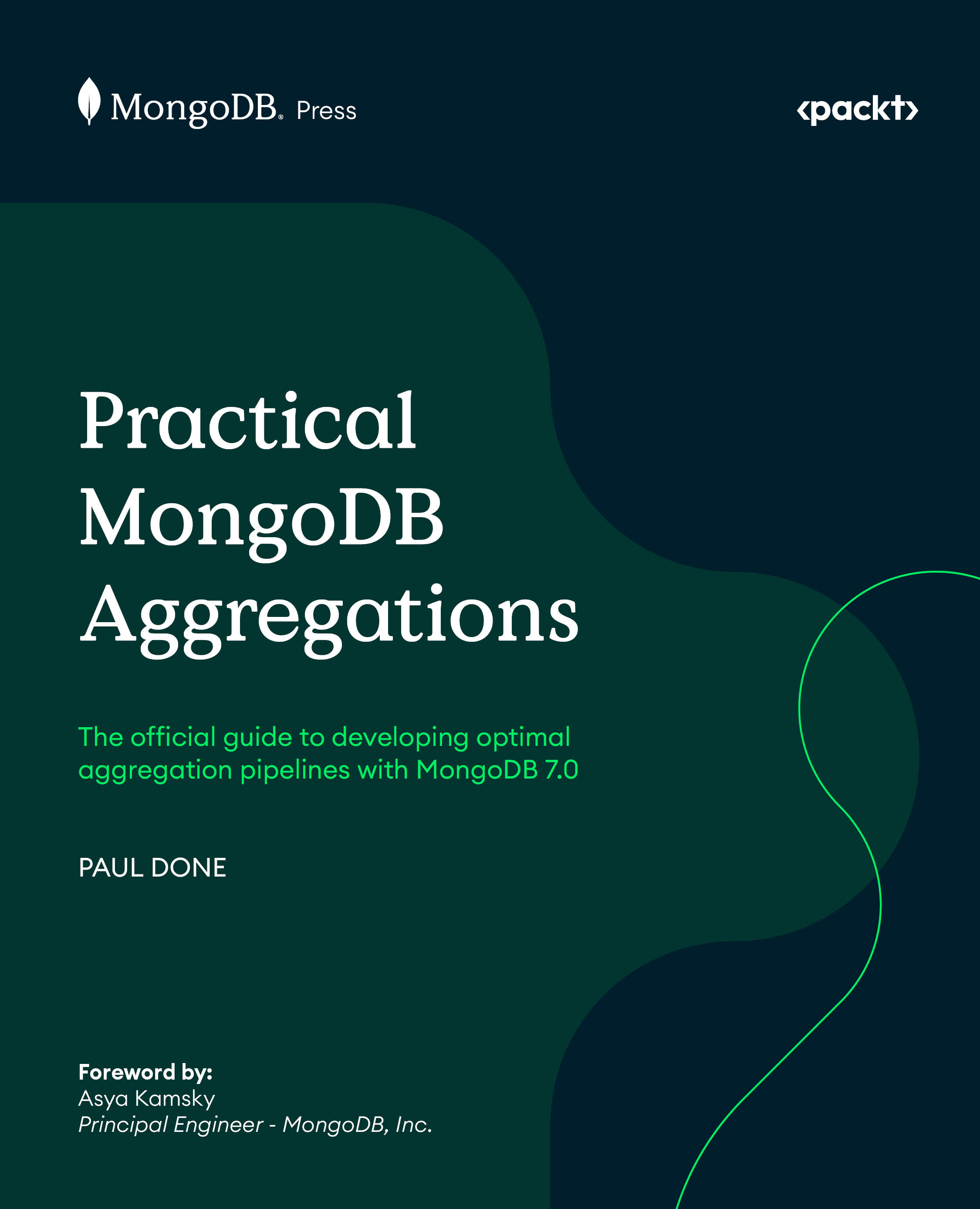
Officially endorsed by MongoDB, Inc., Practical MongoDB Aggregations helps you unlock the full potential of the MongoDB aggregation framework, including the latest features of MongoDB 7.0. This book provides practical, easy-to-digest principles and approaches for increasing your effectiveness in developing aggregation pipelines, supported by examples for building pipelines to solve complex data manipulation and analytical tasks.
This book is customized for developers, architects, data analysts, data engineers, and data scientists with some familiarity with the aggregation framework. It begins by explaining the framework's architecture and then shows you how to build pipelines optimized for productivity and scale.
Given the critical role arrays play in MongoDB's document model, the book delves into best practices for optimally manipulating arrays. The latter part of the book equips you with examples to solve common data processing challenges so you can apply the lessons you've learned to practical situations. By the end of this MongoDB book, you’ll have learned how to utilize the MongoDB aggregation framework to streamline your data analysis and manipulation processes effectively.
Table of Contents (20 chapters)
Preface


 Free Chapter
Chapter 1: MongoDB Aggregations Explained
Part 1: Guiding Tips and Principles
Chapter 2: Optimizing Pipelines for Productivity
Chapter 3: Optimizing Pipelines for Performance
Chapter 4: Harnessing the Power of Expressions

Chapter 5: Optimizing Pipelines for Sharded Clusters
Part 2: Aggregations by Example
Chapter 6: Foundational Examples: Filtering, Grouping, and Unwinding
Chapter 7: Joining Data Examples
Chapter 8: Fixing and Generating Data Examples
Chapter 9: Trend Analysis Examples
Chapter 10: Securing Data Examples
Chapter 11: Time-Series Examples
Chapter 12: Array Manipulation Examples
Chapter 13: Full-Text Search Examples
Afterword
Index
Other books you may enjoy
Appendix


