


-
Book Overview & Buying
-
Table Of Contents

Hands-On Artificial Intelligence for IoT - Second Edition
By :


Hands-On Artificial Intelligence for IoT
By:
Overview of this book
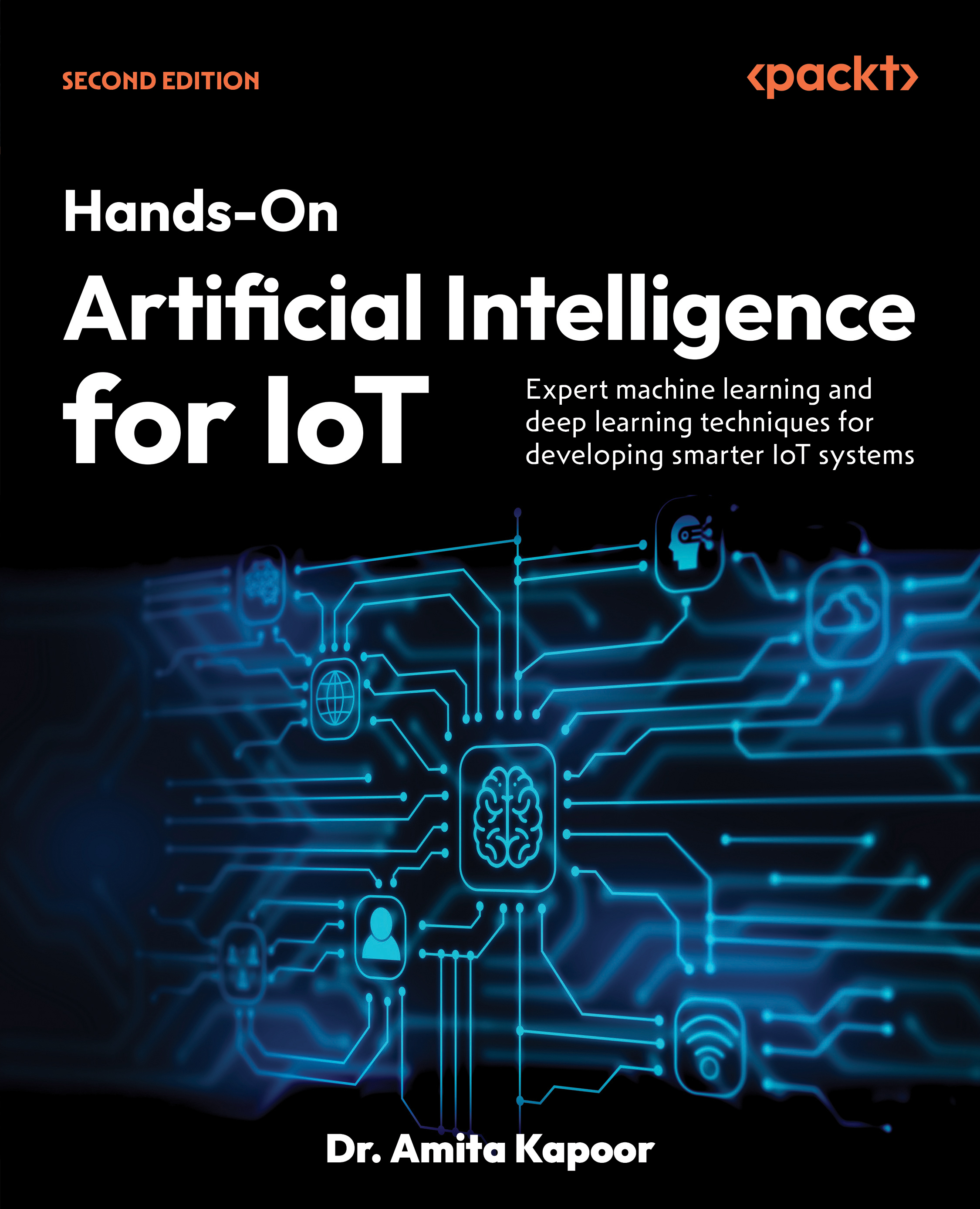
Transform IoT devices into intelligent systems with this comprehensive guide by Amita Kapoor, Chief AI Officer at Tipz AI. Drawing on 25 years of expertise in developing intelligent systems across industries, she demonstrates how to harness the combined power of artificial intelligence and IoT technology. A pioneer in making AI and neuroscience education accessible worldwide, Amita guides you through creating smart, efficient systems that leverage the latest advances in both fields. This new edition is updated with various optimization techniques in IoT used for enhancing efficiency and performance. It introduces you to cloud platforms such as Platform as a Service (PaaS) and Infrastructure as a Service (IaaS) for analyzing data generated using IoT devices. You’ll learn about machine learning algorithms, deep learning techniques, and practical applications in real-world IoT scenarios and advance to creating AI models that work with diverse data types, including time series, images, and audio. You’ll also harness the power of widely used Python libraries, TensorFlow and Keras, to build a variety of smart AI models.
*Email sign-up and proof of purchase required
Table of Contents (23 chapters)
Preface


 Free Chapter
Part 1: Foundations and Basic Integrations of IoT and AI
Chapter 1: Principles and Foundations of IoT and AI
Chapter 2: Data Access and Distributed Processing for IoT
Chapter 3: Machine Learning for IoT
Part 2: Advanced AI Techniques and Their Application in IoT
Chapter 4: Deep Learning for IoT

Chapter 5: Optimization Techniques in IoT
Chapter 6: Reinforcement Learning for IoT
Chapter 7: Generative Models for IoT
Part 3: Implementing Intelligent IoT Solutions in Diverse Domains
Chapter 8: Distributed Learning Using Keras
Chapter 9: AI Cloud Platforms for IoT
Chapter 10: Deep Learning for Time-Series Data from IoT
Chapter 11: Leveraging AI for Visual Data from IoT
Chapter 12: AI for Text, Audio and Speech Data from IoT
Part 4: Applying AI and IoT in Real-World Scenarios
Chapter 13: AI for Personal and Home IoT
Chapter 14: AI for IIoT
Chapter 15: AI for Smart Cities IoT
Chapter 16: Unlock Your Exclusive Benefits
Index
Other Books You May Enjoy




