


-
Book Overview & Buying
-
Table Of Contents

Deep Learning with C++
By :


Deep Learning with C++
By:
Overview of this book
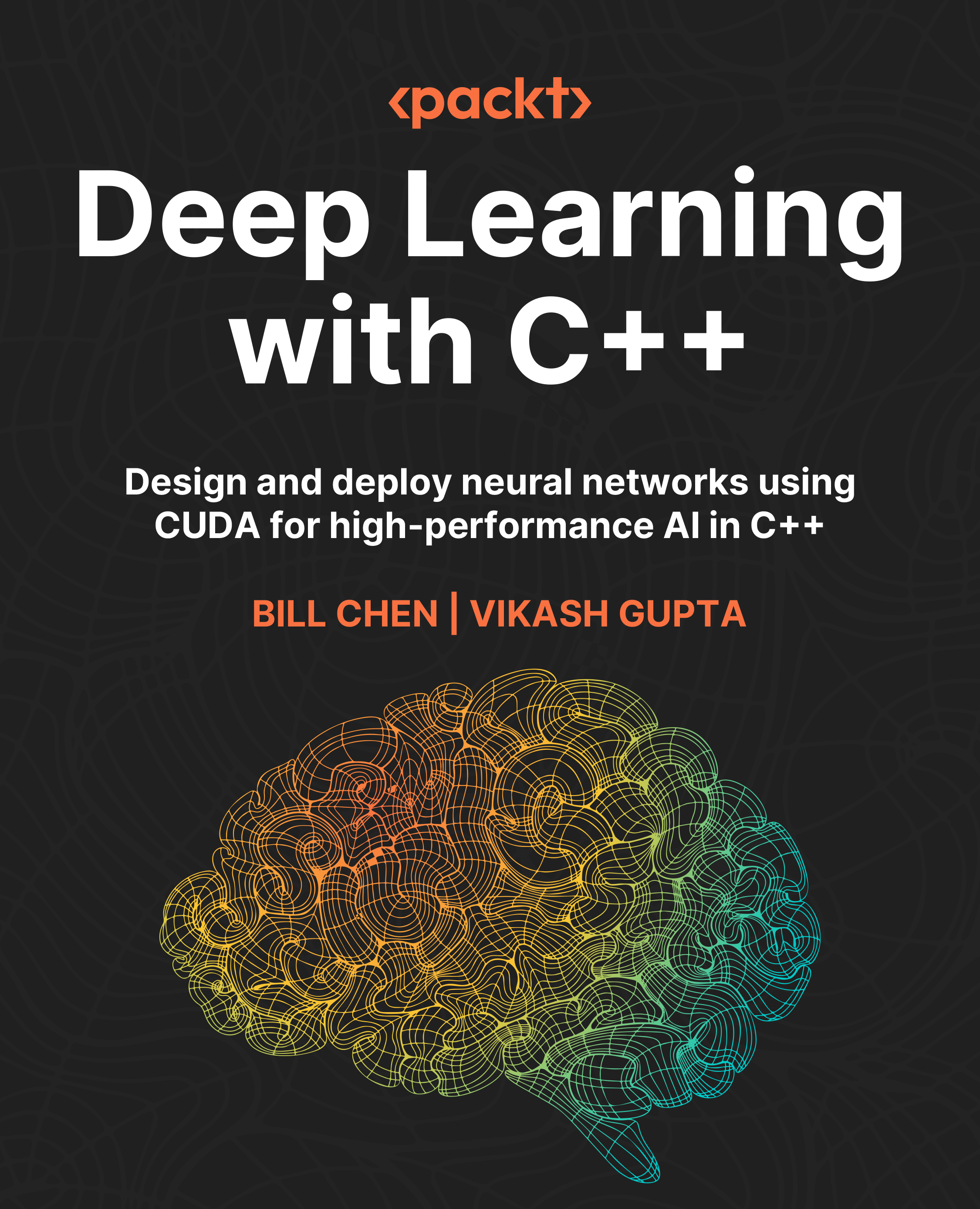
Deep learning systems often struggle to meet performance demands in real-time and production environments. This book shows you how to build high-performance deep learning systems in C++, enabling efficient and scalable artificial intelligence (AI) in resource-constrained environments where performance matters.
You’ll start by setting up a complete C++ deep learning environment and implementing core neural networks from scratch. As you progress, you’ll build advanced architectures, including Convolutional Neural Networks (CNNs), Recurrent Neural Networks (RNNs), Long Short-Term Memory Networks (LSTMs), Generative Adversarial Networks (GANs), and Transformers, using C++, CUDA, and PyTorch’s C++ API. The book then focuses on model quantization and compression. It will guide you through the model deployment process in production with robust monitoring and explainability. You’ll also explore distributed training and techniques for real-time inference in performance-critical domains.
By the end of this book, you’ll be able to design, optimize, and deploy deep learning systems in C++ that are production-ready, scalable, and efficient across multiple industries.
*Email sign-up and proof of purchase required
Table of Contents (20 chapters)
Preface


Introduction to Deep Learning with C++ and Environment Setup
Data Preparation and Preprocessing in C++
CUDA for GPU Acceleration in Deep Learning with C++
Building and Training Neural Networks in C++
Building a Basic Neural Network in C++
Multilayer Perceptron’s in C++
Convolutional Neural Networks in C++
Recurrent Neural Networks and Long Short-Term Memory Networks in C++

Generative Networks, Autoencoders, and Large Language Models in C++
Transformers and Large Language Model Fine-Tuning in C++
Deploying, Monitoring, and Explaining Deep Learning Systems in Production
Deploying and Optimizing Models for Inference
Debugging and Retraining Deployed Models
Monitoring Deployed Models
Explainability and Transparency in Deep Learning Models
Unlock Your Exclusive Benefits
Other Books You May Enjoy
Index


