Sign In Start Free Trial
Account

Add to playlist

Create a Playlist

Modal Close icon
You need to login to use this feature.
  • Book Overview & Buying Generative AI Application Integration Patterns
  • Table Of Contents Toc
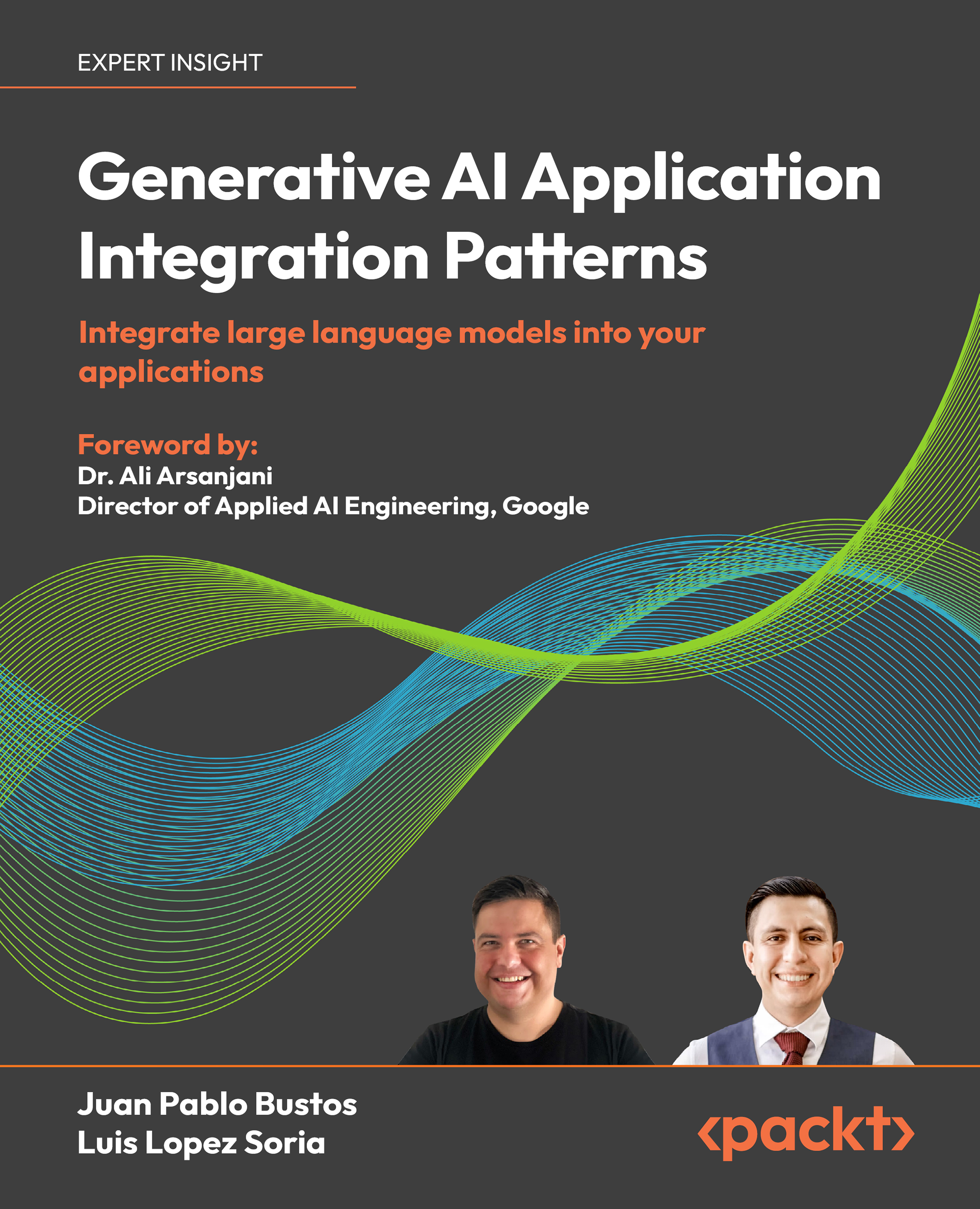
Generative AI Application Integration Patterns

Generative AI Application Integration Patterns

By : Juan Pablo Bustos, Luis Lopez Soria
close
close
Generative AI Application Integration Patterns

Generative AI Application Integration Patterns

By: Juan Pablo Bustos, Luis Lopez Soria

Overview of this book

Explore the transformative potential of GenAI in the application development lifecycle. Through concrete examples, you will go through the process of ideation and integration, understanding the tradeoffs and the decision points when integrating GenAI. With recent advances in models like Google Gemini, Anthropic Claude, DALL-E and GPT-4o, this timely resource will help you harness these technologies through proven design patterns. We then delve into the practical applications of GenAI, identifying common use cases and applying design patterns to address real-world challenges. From summarization and metadata extraction to intent classification and question answering, each chapter offers practical examples and blueprints for leveraging GenAI across diverse domains and tasks. You will learn how to fine-tune models for specific applications, progressing from basic prompting to sophisticated strategies such as retrieval augmented generation (RAG) and chain of thought. Additionally, we provide end-to-end guidance on operationalizing models, including data prep, training, deployment, and monitoring. We also focus on responsible and ethical development techniques for transparency, auditing, and governance as crucial design patterns.
Table of Contents (13 chapters)
close
close
7
Integration Pattern: Real-Time Intent Classification
11
Other Books You May Enjoy
12
Index

Summary

In this chapter, we covered an overview of key concepts, techniques, and integration patterns related to generative AI. You now have a high-level background on prominent generative AI model architectures like transformers and diffusion models, as well as various methods for developing and enhancing these models, covering pre-training, fine-tuning, adapter tuning, distillation, prompt engineering, retrieval augmented generation, and grounding.

We discussed how rapid innovation in generative AI leads to constant evolution, with new models and capabilities emerging at a fast pace. It emphasizes the need to keep pace with progress while ensuring ethical, responsible development.

Finally, we introduced common integration patterns for connecting generative AI to real-world applications, considering real-time use cases like chatbots as well as batch processing for data enrichment. Real examples were provided to demonstrate workflows for integrating generative models into production systems.

Innovation in AI has a very fast pace, demanding constant awareness, swift experimentation, and a responsible approach to harnessing the latest advances. This is particularly evident in the field of generative AI, where we’re witnessing a paradigm shift in AI-powered applications that allows for faster experimentation and development.

A wide array of techniques has emerged to enhance models’ capabilities and efficiency. These include pre-training, adapter tuning, distillation, and prompt engineering, each offering unique advantages in different scenarios. When it comes to integrating these AI models into practical applications, key patterns have emerged for both real-time workflows, such as chatbots, and batch processing tasks like data enrichment.

The art of crafting well-designed prompts has become crucial in constraining and steering model outputs effectively. Additionally, techniques like retrieval augmentation and grounding have proven invaluable in improving the accuracy of AI-generated content. The potential in blending predictive and generative approaches is a very interesting space. This combination leverages the strengths of both methodologies, allowing for custom modeling where sufficient data exists while utilizing generative foundations to enable rapid prototyping and innovation.

These core concepts empower informed decision-making when architecting generative AI systems. The integration patterns offer blueprints for connecting models to practical applications across diverse domains.

Harnessing the power of LLMs begins with identifying the right use cases where they can drive value for your business. In the next chapter, we will present a framework and examples for categorizing LLM use cases based on projected business value.

In the next chapter, we will explore identifying use cases that can be solved with Generative AI.

Join our community on Discord

Join our community’s Discord space for discussions with the authors and other readers:

https://packt.link/genpat

CONTINUE READING
83
Tech Concepts
36
Programming languages
73
Tech Tools
Icon Unlimited access to the largest independent learning library in tech of over 8,000 expert-authored tech books and videos.
Icon Innovative learning tools, including AI book assistants, code context explainers, and text-to-speech.
Icon 50+ new titles added per month and exclusive early access to books as they are being written.
Generative AI Application Integration Patterns
notes
bookmark Notes and Bookmarks search Search in title playlist Add to playlist download Download options font-size Font size

Change the font size

margin-width Margin width

Change margin width

day-mode Day/Sepia/Night Modes

Change background colour

Close icon Search
Country selected

Close icon Your notes and bookmarks

Confirmation

Modal Close icon
claim successful

Buy this book with your credits?

Modal Close icon
Are you sure you want to buy this book with one of your credits?
Close
YES, BUY

Submit Your Feedback

Modal Close icon
Modal Close icon
Modal Close icon