


-
Book Overview & Buying
-
Table Of Contents

Generative AI Application Integration Patterns
By :


Generative AI Application Integration Patterns
By:
Overview of this book
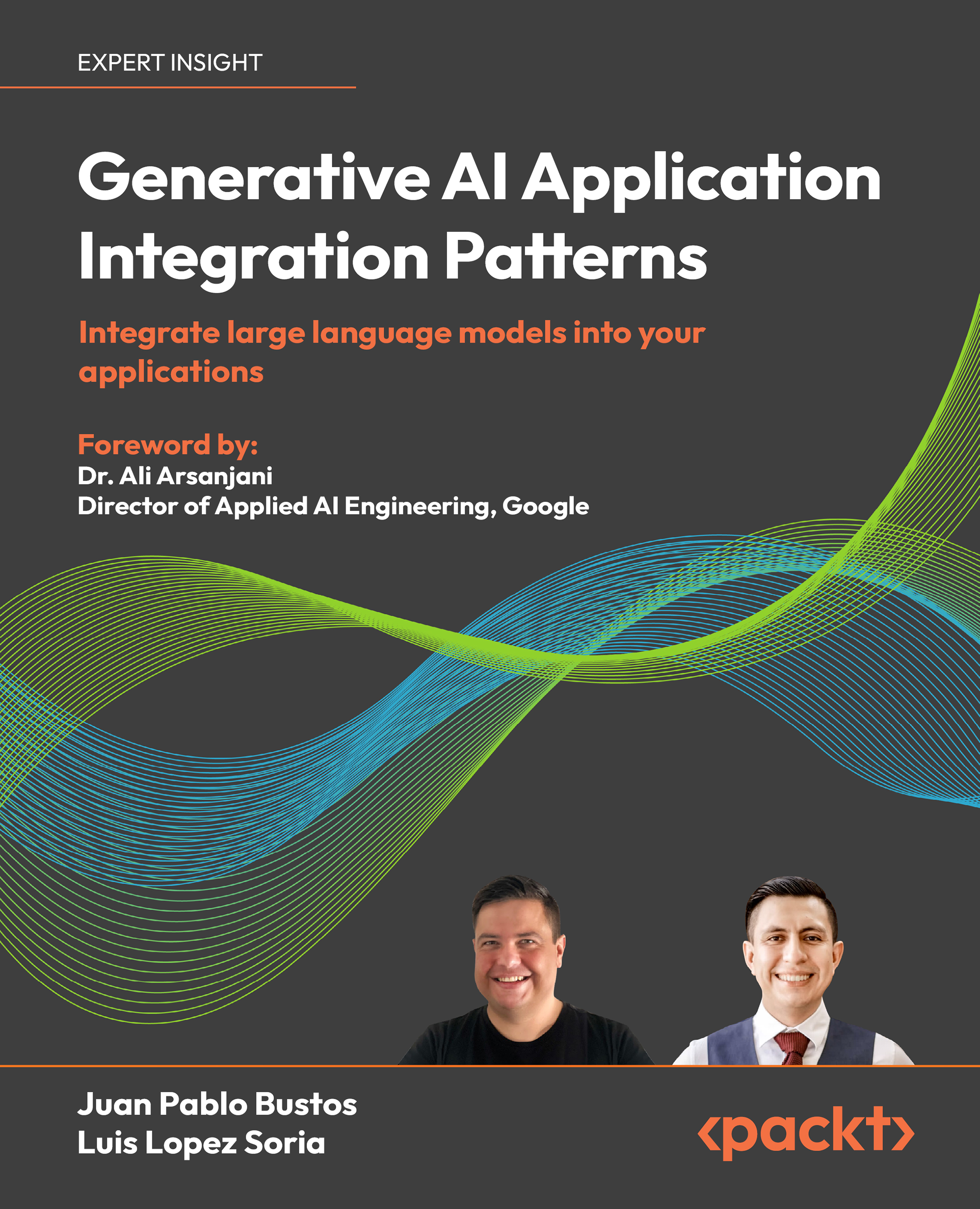
Explore the transformative potential of GenAI in the application development lifecycle. Through concrete examples, you will go through the process of ideation and integration, understanding the tradeoffs and the decision points when integrating GenAI.
With recent advances in models like Google Gemini, Anthropic Claude, DALL-E and GPT-4o, this timely resource will help you harness these technologies through proven design patterns.
We then delve into the practical applications of GenAI, identifying common use cases and applying design patterns to address real-world challenges. From summarization and metadata extraction to intent classification and question answering, each chapter offers practical examples and blueprints for leveraging GenAI across diverse domains and tasks. You will learn how to fine-tune models for specific applications, progressing from basic prompting to sophisticated strategies such as retrieval augmented generation (RAG) and chain of thought.
Additionally, we provide end-to-end guidance on operationalizing models, including data prep, training, deployment, and monitoring. We also focus on responsible and ethical development techniques for transparency, auditing, and governance as crucial design patterns.
Table of Contents (13 chapters)
Preface


 Free Chapter
Introduction to Generative AI Patterns
Identifying Generative AI Use Cases
Designing Patterns for Interacting with Generative AI

Generative AI Batch and Real-Time Integration Patterns
Integration Pattern: Batch Metadata Extraction
Integration Pattern: Batch Summarization
Integration Pattern: Real-Time Intent Classification
Integration Pattern: Real-Time Retrieval Augmented Generation
Operationalizing Generative AI Integration Patterns
Embedding Responsible AI into Your GenAI Applications
Other Books You May Enjoy
Index


