


-
Book Overview & Buying
-
Table Of Contents

LLM Engineer's Handbook
By :


LLM Engineer's Handbook
By:
Overview of this book
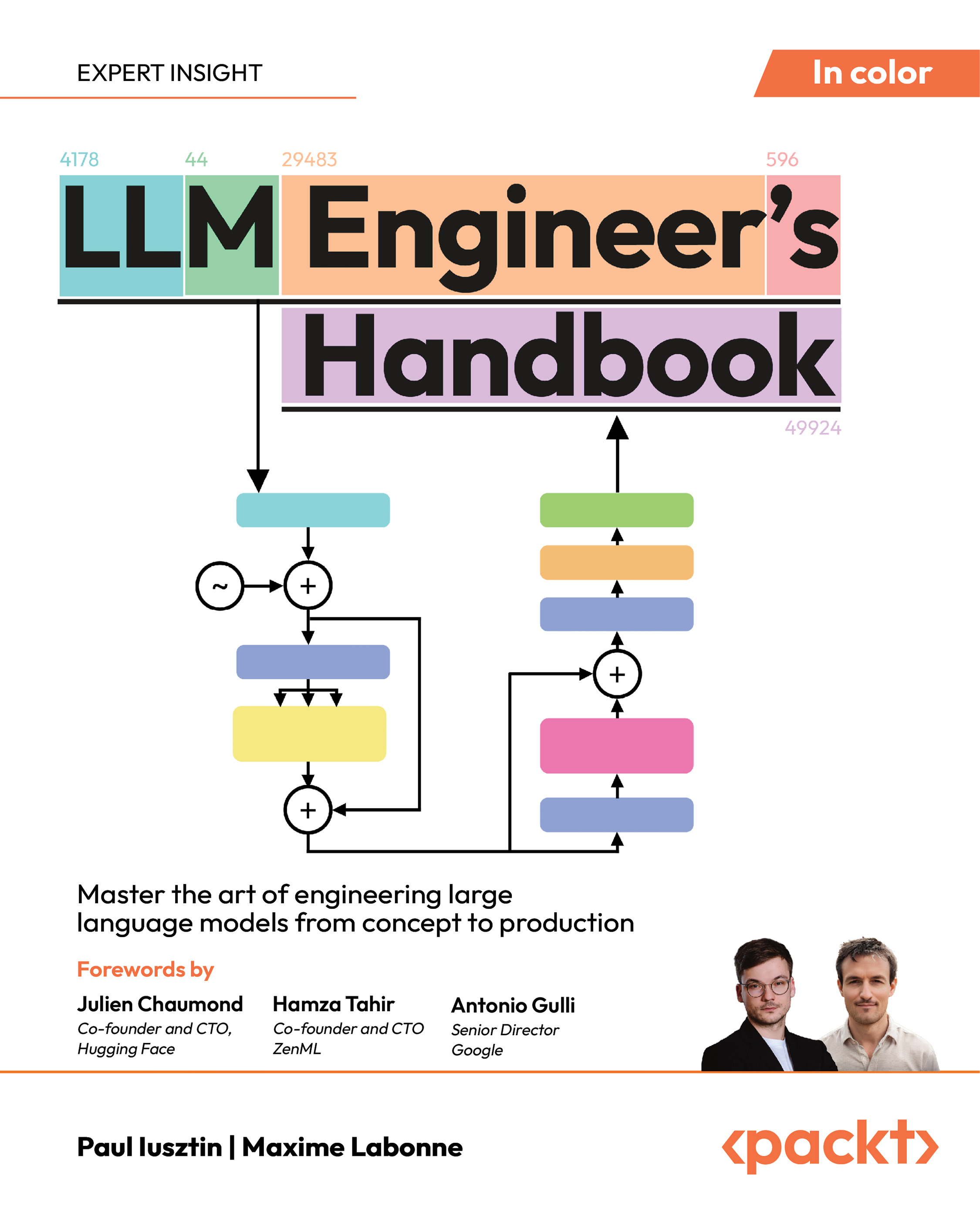
Artificial intelligence has undergone rapid advancements, and Large Language Models (LLMs) are at the forefront of this revolution. This LLM book offers insights into designing, training, and deploying LLMs in real-world scenarios by leveraging MLOps best practices. The guide walks you through building an LLM-powered twin that’s cost-effective, scalable, and modular. It moves beyond isolated Jupyter notebooks, focusing on how to build production-grade end-to-end LLM systems.
Throughout this book, you will learn data engineering, supervised fine-tuning, and deployment. The hands-on approach to building the LLM Twin use case will help you implement MLOps components in your own projects. You will also explore cutting-edge advancements in the field, including inference optimization, preference alignment, and real-time data processing, making this a vital resource for those looking to apply LLMs in their projects.
By the end of this book, you will be proficient in deploying LLMs that solve practical problems while maintaining low-latency and high-availability inference capabilities. Whether you are new to artificial intelligence or an experienced practitioner, this book delivers guidance and practical techniques that will deepen your understanding of LLMs and sharpen your ability to implement them effectively.
*Email sign-up and proof of purchase required
Table of Contents (15 chapters)
Preface


 Free Chapter
Understanding the LLM Twin Concept and Architecture
Tooling and Installation
Data Engineering
RAG Feature Pipeline
Supervised Fine-Tuning
Fine-Tuning with Preference Alignment
Evaluating LLMs
Inference Optimization
RAG Inference Pipeline
Inference Pipeline Deployment

MLOps and LLMOps
MLOps Principles
Other Books You May Enjoy
Index


