Sign In Start Free Trial
Account

Add to playlist

Create a Playlist

Modal Close icon
You need to login to use this feature.
  • Book Overview & Buying Elasticsearch Query Language the Definitive Guide
  • Table Of Contents Toc
Elasticsearch Query Language the Definitive Guide

Elasticsearch Query Language the Definitive Guide

By : Bahaaldine Azarmi, Stephen Brown, Farbod Shirzadian, Alejandro Sanchez, Alexis Charveriat
close
close
Elasticsearch Query Language the Definitive Guide

Elasticsearch Query Language the Definitive Guide

By: Bahaaldine Azarmi, Stephen Brown, Farbod Shirzadian, Alejandro Sanchez, Alexis Charveriat

Overview of this book

Built to simplify high-scale data analytics in Elasticsearch, this practical guide will take you from foundational concepts to advanced applications across search, observability, and security. It will help you overcome common challenges such as efficiently querying large datasets, applying advanced analytics without deep prior knowledge, and resolving for a unique and consolidated query language. Written by senior experts at Elastic with extensive field experience, this book delivers actionable guidance rooted in solving today’s data challenges at scale. After introducing ESQL and its architecture, the chapters explore real-world applications across various domains, including analytics, raw log analysis, observability, and cybersecurity. Advanced topics such as scaling, optimization, and future developments are also covered to help you maximize your ESQL capabilities. By the end of this book, you’ll be able to leverage ESQL for comprehensive data management and analysis, optimizing your workflows and enhancing your productivity with Elasticsearch.
Table of Contents (4 chapters)
close
close

Basic syntax and query structure

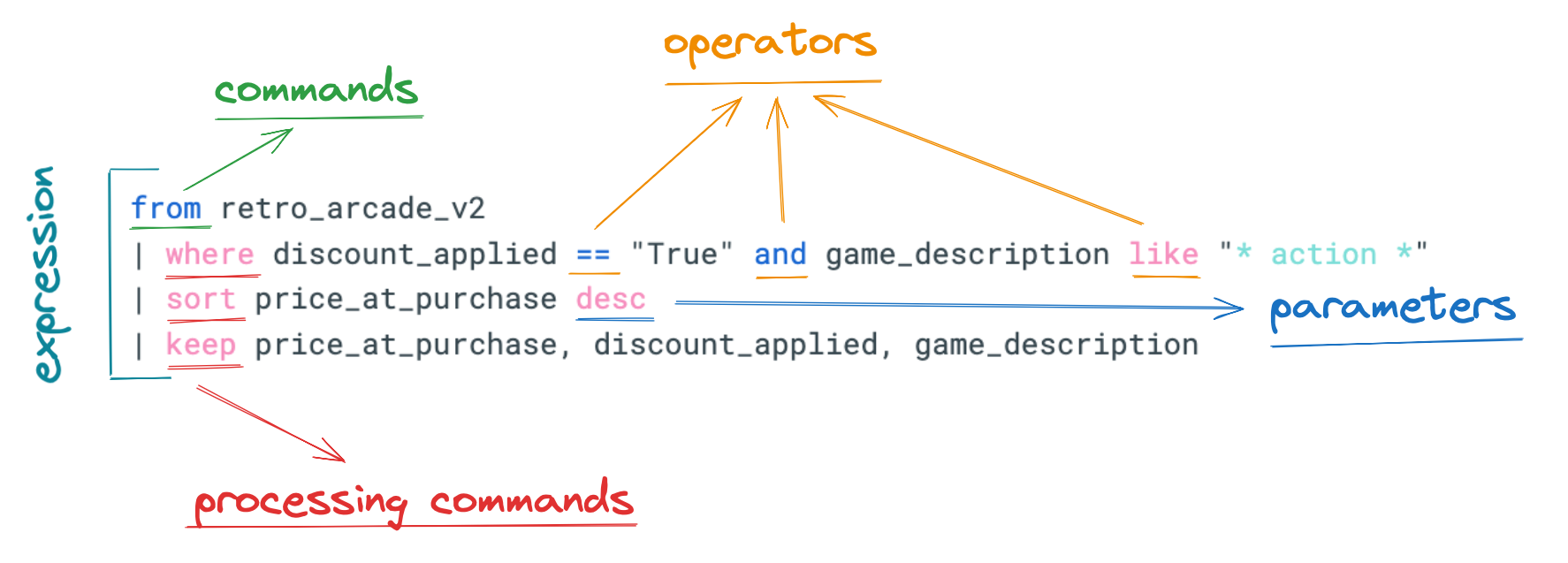
Now that you're comfortable with the ES|QL environment, we can look at how you can interact with and manipulate this data using expressions in ES|QL.An ES|QL query begins with a source command, which specifies the data stream, index, or alias from which to retrieve data. This is followed by one or more processing commands, each separated by a pipe. The final processing command in the sequence determines the output of the query.Here's an example of a source command:

from retro_arcade_purchases_dataset
  | [...]

We can then add our processing commands:

| where discount_applied == "True" and game_description like "* action *"
| sort price_at_purchase desc
| keep price_at_purchase, discount_applied, game_description

Figure 2.5 shows this code with a breakdown of each aspect:

Figure 2.4 – ES|QL query

An expression in ES|QL is a combination of literals, fields, and operators that evaluates to a single value. Expressions...

CONTINUE READING
83
Tech Concepts
36
Programming languages
73
Tech Tools
Icon Unlimited access to the largest independent learning library in tech of over 8,000 expert-authored tech books and videos.
Icon Innovative learning tools, including AI book assistants, code context explainers, and text-to-speech.
Icon 50+ new titles added per month and exclusive early access to books as they are being written.
Elasticsearch Query Language the Definitive Guide
notes
bookmark Notes and Bookmarks search Search in title playlist Add to playlist font-size Font size

Change the font size

margin-width Margin width

Change margin width

day-mode Day/Sepia/Night Modes

Change background colour

Close icon Search
Country selected

Close icon Your notes and bookmarks

Confirmation

Modal Close icon
claim successful

Buy this book with your credits?

Modal Close icon
Are you sure you want to buy this book with one of your credits?
Close
YES, BUY

Submit Your Feedback

Modal Close icon
Modal Close icon
Modal Close icon