Sign In Start Free Trial
Account

Add to playlist

Create a Playlist

Modal Close icon
You need to login to use this feature.
  • Book Overview & Buying Pandas Cookbook
  • Table Of Contents Toc
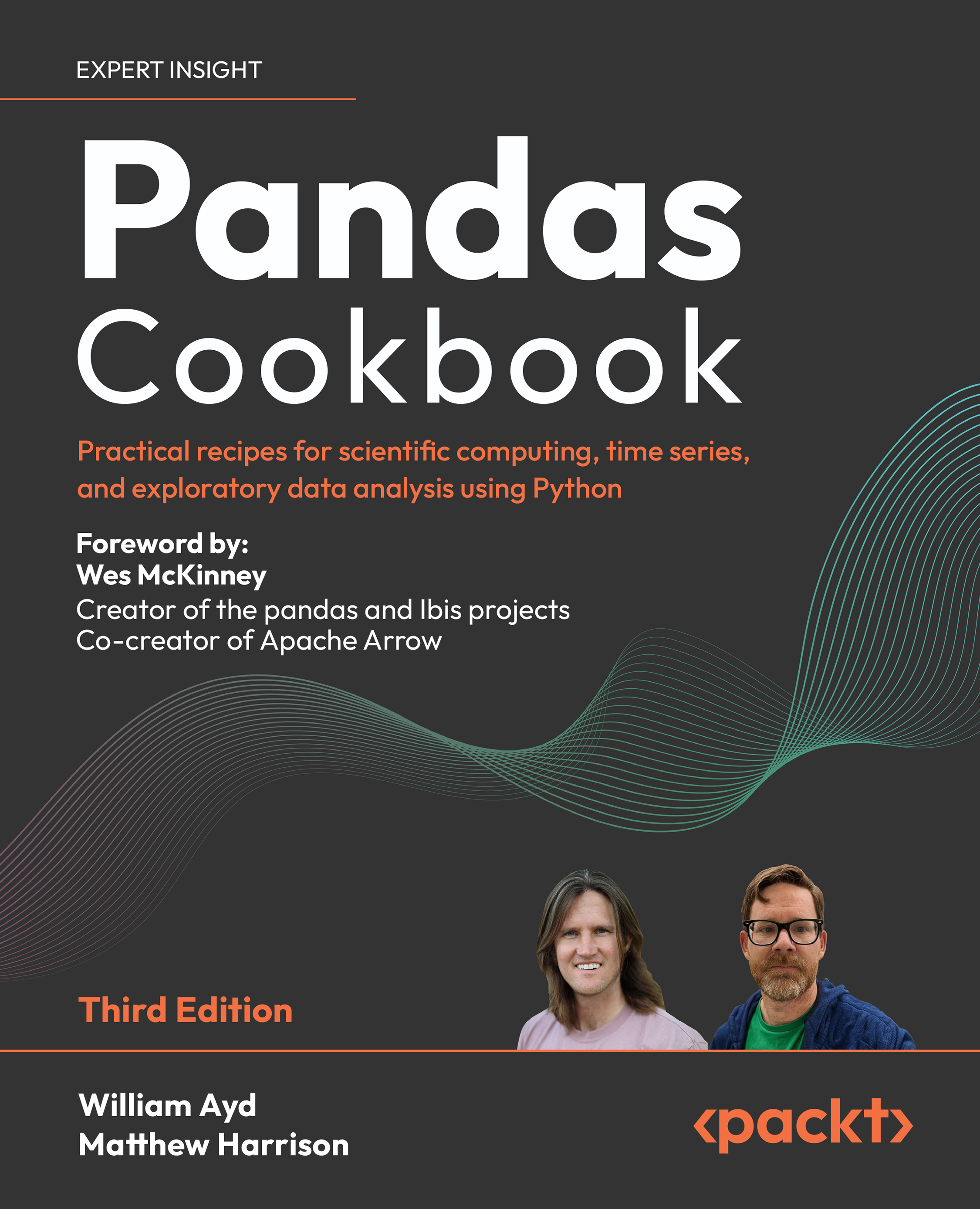
Pandas Cookbook

Pandas Cookbook - Third Edition

By : William Ayd, Matthew Harrison
4.9 (10)
close
close
Pandas Cookbook

Pandas Cookbook

4.9 (10)
By: William Ayd, Matthew Harrison

Overview of this book

Unlock the full power of pandas 2.x with this hands-on cookbook, designed for Python developers, data analysts, and data scientists who need fast, efficient solutions for real-world data challenges. This book provides practical, ready-to-use recipes to streamline your workflow. With step-by-step guidance, you'll master data wrangling, visualization, performance optimization, and scalable data analysis using pandas’ most powerful features. From importing and merging large datasets to advanced time series analysis and SQL-like operations, this cookbook equips you with the tools to analyze, manipulate, and visualize data like a pro. Learn how to boost efficiency, optimize memory usage, and seamlessly integrate pandas with NumPy, PyArrow, and databases. This book will help you transform raw data into actionable insights with ease. *Email sign-up and proof of purchase required
Table of Contents (14 chapters)
close
close
12
Other Books You May Enjoy
13
Index

Map

The .agg and .transform methods we have seen so far apply to an entire sequence of values at once. Generally, in pandas, this is a good thing; it allows pandas to perform vectorized operations that are fast and computationally efficient.

Still, sometimes, you as an end user may decide that you want to trade performance for customization or finer-grained control. This is where the .map methods can come into the picture; .map helps you apply functions individually to each element of your pandas object.

How to do it

Let’s assume we have a pd.Series of data that mixes together both numbers and lists of numbers:

ser = pd.Series([123.45, [100, 113], 142.0, [110, 113, 119]])
ser
0             123.45
1         [100, 113]
2              142.0
3    [110, 113, 119]
dtype: object

.agg or .transform are not suitable here because we do not have a uniform data type – we really have to inspect each element to make a decision on how to handle it.

For...

CONTINUE READING
83
Tech Concepts
36
Programming languages
73
Tech Tools
Icon Unlimited access to the largest independent learning library in tech of over 8,000 expert-authored tech books and videos.
Icon Innovative learning tools, including AI book assistants, code context explainers, and text-to-speech.
Icon 50+ new titles added per month and exclusive early access to books as they are being written.
Pandas Cookbook
notes
bookmark Notes and Bookmarks search Search in title playlist Add to playlist download Download options font-size Font size

Change the font size

margin-width Margin width

Change margin width

day-mode Day/Sepia/Night Modes

Change background colour

Close icon Search
Country selected

Close icon Your notes and bookmarks

Confirmation

Modal Close icon
claim successful

Buy this book with your credits?

Modal Close icon
Are you sure you want to buy this book with one of your credits?
Close
YES, BUY

Submit Your Feedback

Modal Close icon
Modal Close icon
Modal Close icon