This second edition tackles the biggest challenge facing companies in AI today: moving from prototypes to production. Fully updated to reflect the latest developments in the LangChain ecosystem, it captures how modern AI systems are developed, deployed, and scaled in enterprise environments. This edition places a strong focus on multi-agent architectures, robust LangGraph workflows, and advanced retrieval-augmented generation (RAG) pipelines.
You'll explore design patterns for building agentic systems, with practical implementations of multi-agent setups for complex tasks. The book guides you through reasoning techniques such as Tree-of -Thoughts, structured generation, and agent handoffs—complete with error handling examples. Expanded chapters on testing, evaluation, and deployment address the demands of modern LLM applications, showing you how to design secure, compliant AI systems with built-in safeguards and responsible development principles. This edition also expands RAG coverage with guidance on hybrid search, re-ranking, and fact-checking pipelines to enhance output accuracy.
Whether you're extending existing workflows or architecting multi-agent systems from scratch, this book provides the technical depth and practical instruction needed to design LLM applications ready for success in production environments.
LangChain exists as both an open-source framework and a venture-backed company. The framework, introduced in 2022 by Harrison Chase, streamlines the development of LLM-powered applications with support for multiple programming languages including Python, JavaScript/TypeScript, Go, Rust, and Ruby.
The company behind the framework, LangChain, Inc., is based in San Francisco and has secured significant venture funding through multiple rounds, including a Series A in February 2024. With 11-50 employees, the company maintains and expands the framework while offering enterprise solutions for LLM application development.
While the core framework remains open source, the company provides additional enterprise features and support for commercial users. Both share the same mission: accelerating LLM application development by providing robust tools and infrastructure.
Modern LLMs are undeniably powerful, but their practical utility in production applications is constrained by several inherent limitations. Understanding these challenges is essential for appreciating why frameworks like LangChain have become indispensable tools for AI developers.
Challenges with raw LLMs
Despite their impressive capabilities, LLMs face fundamental constraints that create significant hurdles for developers building real-world applications:
Context window limitations: LLMs process text as tokens (subword units), not complete words. For example, “LangChain” might be processed as two tokens: “Lang” and “Chain.” Every LLM has a fixed context window—the maximum number of tokens it can process at once—typically ranging from 2,000 to 128,000 tokens. This creates several practical challenges:
Document processing: Long documents must be chunked effectively to fit within context limits
Conversation history: Maintaining information across extended conversations requires careful memory management
Cost management: Most providers charge based on token count, making efficient token use a business imperative
These constraints directly impact application architecture, making techniques like RAG (which we’ll explore in Chapter 4) essential for production systems.
Limited tool orchestration: While many modern LLMs offer native tool-calling capabilities, they lack the infrastructure to discover appropriate tools, execute complex workflows, and manage tool interactions across multiple turns. Without this orchestration layer, developers must build custom solutions for each integration.
Task coordination challenges: Managing multi-step workflows with LLMs requires structured control mechanisms. Without them, complex processes involving sequential reasoning or decision-making become difficult to implement reliably.
Tools in this context refer to functional capabilities that extend an LLM’s reach: web browsers for searching the internet, calculators for precise mathematics, coding environments for executing programs, or APIs for accessing external services and databases. Without these tools, LLMs remain confined to operating within their training knowledge, unable to perform real-world actions or access current information.
These fundamental limitations create three key challenges for developers working with raw LLM APIs, as demonstrated in the following table.
Challenge
Description
Impact
Reliability
Detecting hallucinations and validating outputs
Inconsistent results that may require human verification
Resource Management
Handling context windows and rate limits
Implementation complexity and potential cost overruns
Integration Complexity
Building connections to external tools and data sources
Extended development time and maintenance burden
Table 1.3: Three key developer challenges
LangChain addresses these challenges by providing a structured framework with tested solutions, simplifying AI application development and enabling more sophisticated use cases.
How LangChain enables agent development
LangChain provides the foundational infrastructure for building sophisticated AI applications through its modular architecture and composable patterns. With the evolution to version 0.3, LangChain has refined its approach to creating intelligent systems:
Composable workflows: The LangChain Expression Language (LCEL) allows developers to break down complex tasks into modular components that can be assembled and reconfigured. This composability enables systematic reasoning through the orchestration of multiple processing steps.
Integration ecosystem: LangChain offers battle-tested abstract interfaces for all generative AI components (LLMs, embeddings, vector databases, document loaders, search engines). This lets you build applications that can easily switch between providers without rewriting core logic.
Unified model access: The framework provides consistent interfaces to diverse language and embedding models, allowing seamless switching between providers while maintaining application logic.
While earlier versions of LangChain handled memory management directly, version 0.3 takes a more specialized approach to application development:
Memory and state management: For applications requiring persistent context across interactions, LangGraph now serves as the recommended solution. LangGraph maintains conversation history and application state with purpose-built persistence mechanisms.
Agent architecture: Though LangChain contains agent implementations, LangGraph has become the preferred framework for building sophisticated agents. It provides:
Graph-based workflow definition for complex decision paths
Persistent state management across multiple interactions
Streaming support for real-time feedback during processing
Human-in-the-loop capabilities for validation and corrections
Together, LangChain and its companion projects like LangGraph and LangSmith form a comprehensive ecosystem that transforms LLMs from simple text generators into systems capable of sophisticated real-world tasks, combining strong abstractions with practical implementation patterns optimized for production use.
Exploring the LangChain architecture
LangChain’s philosophy centers on composability and modularity. Rather than treating LLMs as standalone services, LangChain views them as components that can be combined with other tools and services to create more capable systems. This approach is built on several principles:
Modular architecture: Every component is designed to be reusable and interchangeable, allowing developers to integrate LLMs seamlessly into various applications. This modularity extends beyond LLMs to include numerous building blocks for developing complex generative AI applications.
Support for agentic workflows: LangChain offers best-in-class APIs that allow you to develop sophisticated agents quickly. These agents can make decisions, use tools, and solve problems with minimal development overhead.
Production readiness: The framework provides built-in capabilities for tracing, evaluation, and deployment of generative AI applications, including robust building blocks for managing memory and persistence across interactions.
Broad vendor ecosystem: LangChain offers battle-tested abstract interfaces for all generative AI components (LLMs, embeddings, vector databases, document loaders, search engines, etc.). Vendors develop their own integrations that comply with these interfaces, allowing you to build applications on top of any third-party provider and easily switch between them.
It’s worth noting that there’ve been major changes since LangChain version 0.1 when the first edition of this book was written. While early versions attempted to handle everything, LangChain version 0.3 focuses on excelling at specific functions with companion projects handling specialized needs. LangChain manages model integration and workflows, while LangGraph handles stateful agents and LangSmith provides observability.
LangChain’s memory management, too, has gone through major changes. Memory mechanisms within the base LangChain library have been deprecated in favor of LangGraph for persistence, and while agents are present, LangGraph is the recommended approach for their creation in version 0.3. However, models and tools continue to be fundamental to LangChain’s functionality. In Chapter 3, we’ll explore LangChain and LangGraph’s memory mechanisms.
To translate model design principles into practical tools, LangChain has developed a comprehensive ecosystem of libraries, services, and applications. This ecosystem provides developers with everything they need to build, deploy, and maintain sophisticated AI applications. Let’s examine the components that make up this thriving environment and how they’ve gained adoption across the industry.
Ecosystem
LangChain has achieved impressive ecosystem metrics, demonstrating strong market adoption with over 20 million monthly downloads and powering more than 100,000 applications. Its open-source community is thriving, evidenced by 100,000+ GitHub stars and contributions from over 4,000 developers. This scale of adoption positions LangChain as a leading framework in the AI application development space, particularly for building reasoning-focused LLM applications. The framework’s modular architecture (with components like LangGraph for agent workflows and LangSmith for monitoring) has clearly resonated with developers building production AI systems across various industries.
Core libraries
LangChain (Python): Reusable components for building LLM applications
LangChain.js: JavaScript/TypeScript implementation of the framework
LangGraph (Python): Tools for building LLM agents as orchestrated graphs
LangGraph.js: JavaScript implementation for agent workflows
Platform services
LangSmith: Platform for debugging, testing, evaluating, and monitoring LLM applications
LangGraph: Infrastructure for deploying and scaling LangGraph agents
Applications and extensions
ChatLangChain: Documentation assistant for answering questions about the framework
Open Canvas: Document and chat-based UX for writing code/markdown (TypeScript)
OpenGPTs: Open source implementation of OpenAI’s GPTs API
Email assistant: AI tool for email management (Python)
Social media agent: Agent for content curation and scheduling (TypeScript)
The ecosystem provides a complete solution for building reasoning-focused AI applications: from core building blocks to deployment platforms to reference implementations. This architecture allows developers to use components independently or stack them for fuller and more complete solutions.
From customer testimonials and company partnerships, LangChain is being adopted by enterprises like Rakuten, Elastic, Ally, and Adyen. Organizations report using LangChain and LangSmith to identify optimal approaches for LLM implementation, improve developer productivity, and accelerate development workflows.
LangChain also offers a full stack for AI application development:
Build: with the composable framework
Run: deploy with LangGraph Platform
Manage: debug, test, and monitor with LangSmith
Based on our experience building with LangChain, here are some of its benefits we’ve found especially helpful:
Accelerated development cycles: LangChain dramatically speeds up time-to-market with ready-made building blocks and unified APIs, eliminating weeks of integration work.
Superior observability: The combination of LangChain and LangSmith provides unparalleled visibility into complex agent behavior, making trade-offs between cost, latency, and quality more transparent.
Controlled agency balance: LangGraph’s approach to agentic AI is particularly powerful—allowing developers to give LLMs partial control flow over workflows while maintaining reliability and performance.
Production-ready patterns: Our implementation experience has proven that LangChain’s architecture delivers enterprise-grade solutions that effectively reduce hallucinations and improve system reliability.
Future-proof flexibility: The framework’s vendor-agnostic design creates applications that can adapt as the LLM landscape evolves, preventing technological lock-in.
These advantages stem directly from LangChain’s architectural decisions, which prioritize modularity, observability, and deployment flexibility for real-world applications.
Modular design and dependency management
LangChain evolves rapidly, with approximately 10-40 pull requests merged daily. This fast-paced development, combined with the framework’s extensive integration ecosystem, presents unique challenges. Different integrations often require specific third-party Python packages, which can lead to dependency conflicts.
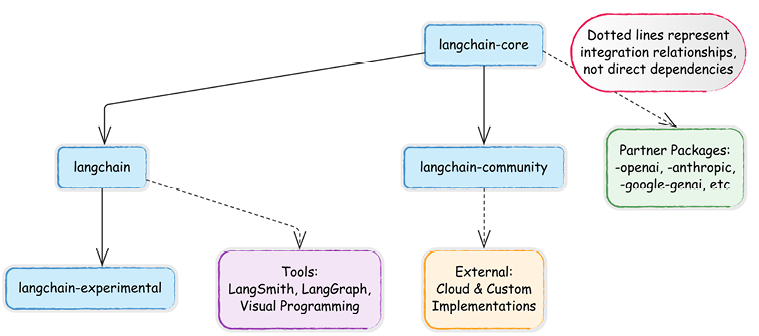
LangChain’s package architecture evolved as a direct response to scaling challenges. As the framework rapidly expanded to support hundreds of integrations, the original monolithic structure became unsustainable—forcing users to install unnecessary dependencies, creating maintenance bottlenecks, and hindering contribution accessibility. By dividing into specialized packages with lazy loading of dependencies, LangChain elegantly solved these issues while preserving a cohesive ecosystem. This architecture allows developers to import only what they need, reduces version conflicts, enables independent release cycles for stable versus experimental features, and dramatically simplifies the contribution path for community developers working on specific integrations.
The LangChain codebase follows a well-organized structure that separates concerns while maintaining a cohesive ecosystem:
Core structure
docs/: Documentation resources for developers
libs/: Contains all library packages in the monorepo
Library organization
langchain-core/: Foundational abstractions and interfaces that define the framework
langchain/: The main implementation library with core components:
vectorstores/: Integrations with vector databases (Pinecone, Chroma, etc.)
chains/: Pre-built chain implementations for common workflows
Other component directories for retrievers, embeddings, etc.
langchain-experimental/: Cutting-edge features still under development
langchain-community: Houses third-party integrations maintained by the LangChain community. This includes most integrations for components like LLMs, vector stores, and retrievers. Dependencies are optional to maintain a lightweight package.
Partner packages: Popular integrations are separated into dedicated packages (e.g., langchain-openai, langchain-anthropic) to enhance independent support. These packages reside outside the LangChain repository but within the GitHub “langchain-ai” organization (see github.com/orgs/langchain-ai). A full list is available atpython.langchain.com/v0.3/docs/integrations/platforms/.
External partner packages: Some partners maintain their integration packages independently. For example, several packages from the Google organization (github.com/orgs/googleapis/repositories?q=langchain), such as the langchain-google-cloud-sql-mssql package, are developed and maintained outside the LangChain ecosystem.
LangChain’s core functionality is extended by the following companion projects:
LangGraph: An orchestration framework for building stateful, multi-actor applications with LLMs. While it integrates smoothly with LangChain, it can also be used independently. LangGraph facilitates complex applications with cyclic data flows and supports streaming and human-in-the-loop interactions. We’ll talk about LangGraph in more detail in Chapter 3.
LangSmith: A platform that complements LangChain by providing robust debugging, testing, and monitoring capabilities. Developers can inspect, monitor, and evaluate their applications, ensuring continuous optimization and confident deployment.
These extensions, along with the core framework, provide a comprehensive ecosystem for developing, managing, and visualizing LLM applications, each with unique capabilities that enhance functionality and user experience.
LangChain also has an extensive array of tool integrations, which we’ll discuss in detail in Chapter 5. New integrations are added regularly, expanding the framework’s capabilities across domains.
Third-party applications and visual tools
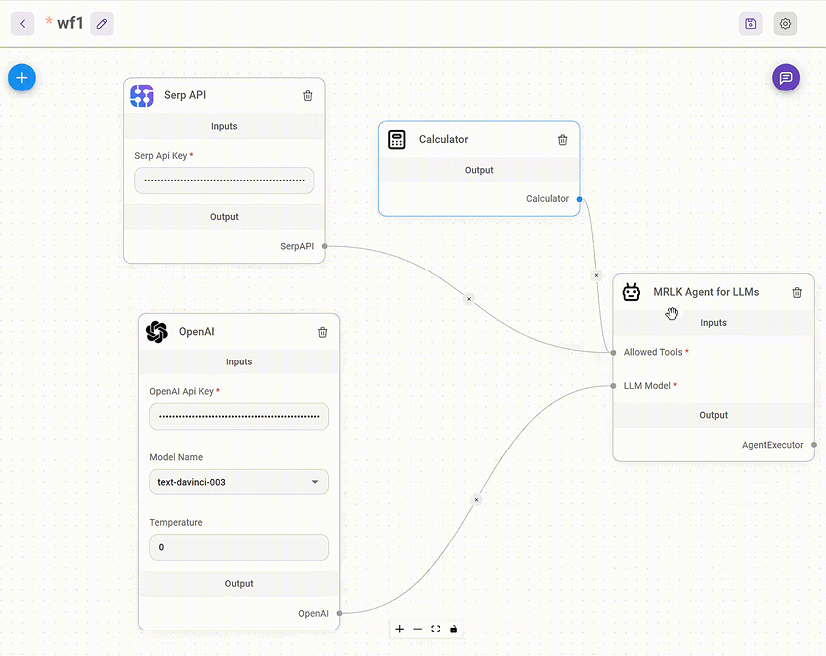
Many third-party applications have been built on top of or around LangChain. For example, LangFlow and Flowise introduce visual interfaces for LLM development, with UIs that allow for the drag-and-drop assembly of LangChain components into executable workflows. This visual approach enables rapid prototyping and experimentation, lowering the barrier to entry for complex pipeline creation, as illustrated in the following screenshot of Flowise:
Figure 1.3: Flowise UI with an agent that uses an LLM, a calculator, and a search tool (Source: https://github.com/FlowiseAI/Flowise)
In the UI above, you can see an agent connected to a search interface (Serp API), an LLM, and a calculator. LangChain and similar tools can be deployed locally using libraries like Chainlit, or on various cloud platforms, including Google Cloud.
In summary, LangChain simplifies the development of LLM applications through its modular design, extensive integrations, and supportive ecosystem. This makes it an invaluable tool for developers looking to build sophisticated AI systems without reinventing fundamental components.
Read this chapter and the full book FREE of cost - No Credit card required!
Plus access over 9,000 other expert tech books and videos just by signing up - No commitment!
CONTINUE READING
83
Tech Concepts
36
Programming languages
73
Tech Tools
Unlimited access to the largest independent learning library in tech of over 8,000 expert-authored tech books and videos.
Innovative learning tools, including AI book assistants, code context explainers, and text-to-speech.
50+ new titles added per month and exclusive early access to books as they are being written.





 Free Chapter