


-
Book Overview & Buying
-
Table Of Contents

-
Feedback & Rating

Generative AI with LangChain - Second Edition
By :


Generative AI with LangChain
By:
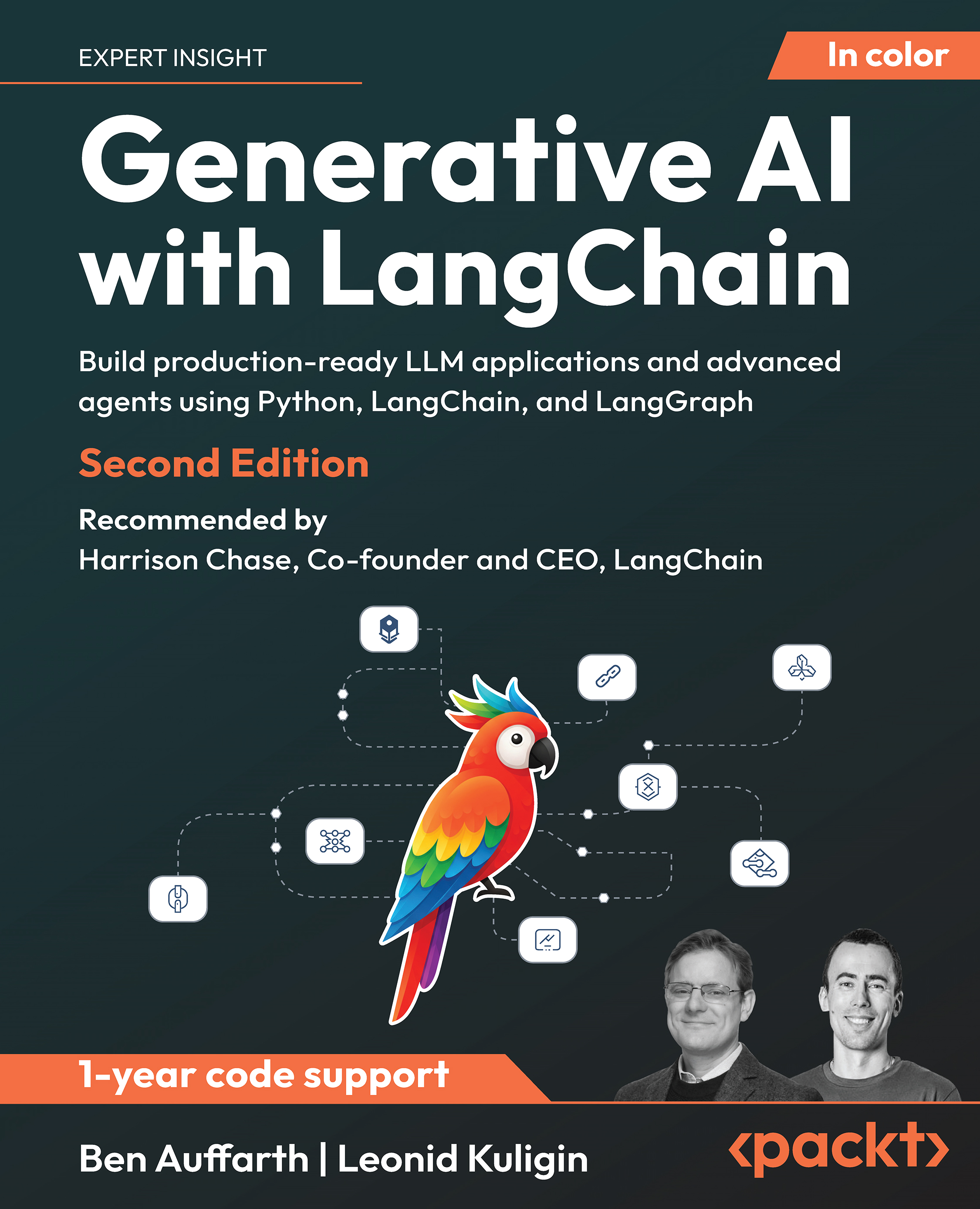
Overview of this book
This second edition tackles the biggest challenge facing companies in AI today: moving from prototypes to production. Fully updated to reflect the latest developments in the LangChain ecosystem, it captures how modern AI systems are developed, deployed, and scaled in enterprise environments. This edition places a strong focus on multi-agent architectures, robust LangGraph workflows, and advanced retrieval-augmented generation (RAG) pipelines.
You'll explore design patterns for building agentic systems, with practical implementations of multi-agent setups for complex tasks. The book guides you through reasoning techniques such as Tree-of -Thoughts, structured generation, and agent handoffs—complete with error handling examples. Expanded chapters on testing, evaluation, and deployment address the demands of modern LLM applications, showing you how to design secure, compliant AI systems with built-in safeguards and responsible development principles. This edition also expands RAG coverage with guidance on hybrid search, re-ranking, and fact-checking pipelines to enhance output accuracy.
Whether you're extending existing workflows or architecting multi-agent systems from scratch, this book provides the technical depth and practical instruction needed to design LLM applications ready for success in production environments.
Table of Contents (15 chapters)
Preface


 Free Chapter
The Rise of Generative AI: From Language Models to Agents
First Steps with LangChain
Building Workflows with LangGraph

Building Intelligent RAG Systems
Building Intelligent Agents
Advanced Applications and Multi-Agent Systems
Software Development and Data Analysis Agents
Evaluation and Testing
Production-Ready LLM Deployment and Observability
The Future of Generative Models: Beyond Scaling
Other Books You May Enjoy
Appendix B: Unlock Your Exclusive Benefits
Customer Reviews



