Sign In Start Free Trial
Account

Add to playlist

Create a Playlist

Modal Close icon
You need to login to use this feature.
  • Book Overview & Buying Data Science for Web3
  • Table Of Contents Toc
Data Science for Web3

Data Science for Web3

By : Gabriela Castillo Areco
5 (3)
close
close
Data Science for Web3

Data Science for Web3

5 (3)
By: Gabriela Castillo Areco

Overview of this book

Data is the new oil and Web3 is generating it at an unprecedented rate. Complete with practical examples, detailed explanations, and ideas for portfolio development, this comprehensive book serves as a step-by-step guide covering the industry best practices, tools, and resources needed to easily navigate the world of data in Web3. You’ll begin by acquiring a solid understanding of key blockchain concepts and the fundamental data science tools essential for Web3 projects. The subsequent chapters will help you explore the main data sources that can help address industry challenges, decode smart contracts, and build DeFi- and NFT-specific datasets. You’ll then tackle the complexities of feature engineering specific to blockchain data and familiarize yourself with diverse machine learning use cases that leverage Web3 data. The book includes interviews with industry leaders providing insights into their professional journeys to drive innovation in the Web 3 environment. Equipped with experience in handling crypto data, you’ll be able to demonstrate your skills in job interviews, academic pursuits, or when engaging potential clients. By the end of this book, you’ll have the essential tools to undertake end-to-end data science projects utilizing blockchain data, empowering you to help shape the next-generation internet.
Table of Contents (23 chapters)
close
close
1
Part 1 Web3 Data Analysis Basics
7
Part 2 Web3 Machine Learning Cases
15
Part 3 Appendix
1
Appendix 1
2
Appendix 2
3
Appendix 3

Data quality challenges

In this section, we will discuss the challenges of data quality, which are not unique to Web3 but relevant to all professionals who make decisions based on data. Data quality challenges range from access to incomplete, inaccurate, or inconsistent data to matters of data security, privacy, or governance. However, one of the most important challenges that a Web3 data analyst will face is the reliability of sources.

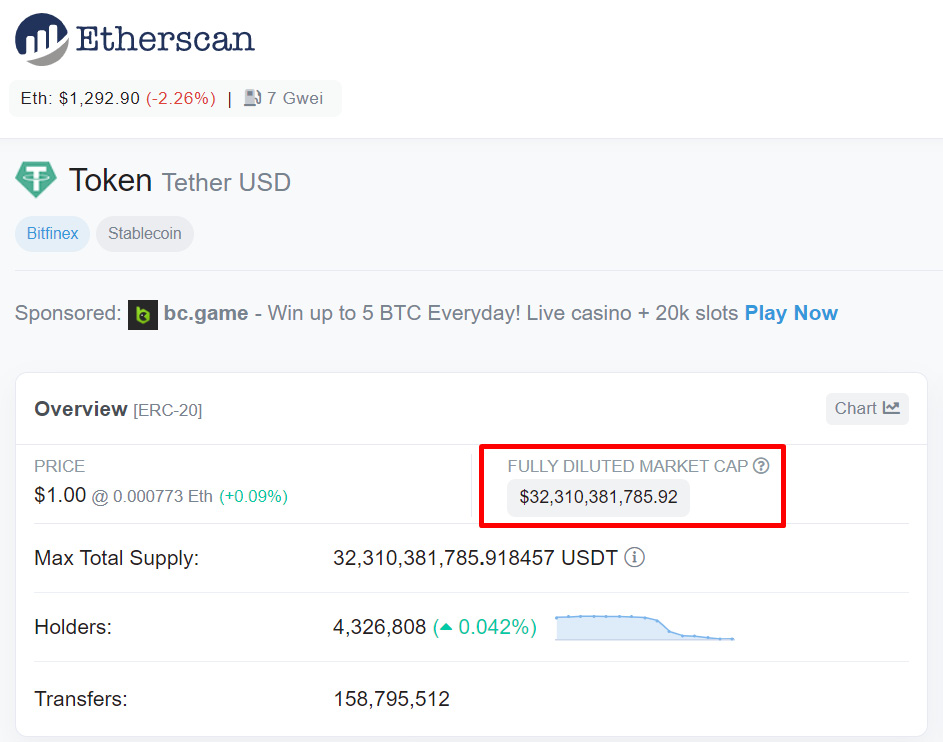
For instance, the market cap is the result of a simple multiplication of two data sources: the blockchain data that informs the total supply of tokens in circulation and the market price. However, the result of such multiplication varies depending on the source. Let’s take an example of the market cap for USDT. In one source, the following information appears:

Figure 1.4 – USDT market cap information (source: https://etherscan.io/token/0xdac17f958d2ee523a2206206994597c13d831ec7)

Figure 1.4 – USDT market cap information (source: https://etherscan.io/token/0xdac17f958d2ee523a2206206994597c13d831ec7)

On the CoinMarketCap website, for the same token, the fully diluted market cap is $70,158,658,274 (https://coinmarketcap.com/currencies/tether/).

As we see from the example, the same concept is shown differently depending on the source we review. So, how do we choose when we have multiple sources of information?

The most trustworthy and comprehensive source of truth regarding blockchain activity is the full copy of a node. Accessing a node ensures that we will always have access to the latest version of the blockchain. Some services index the blockchain to facilitate access and querying, such as Google BigQuery, Covalent, or Dune, continuously updating their copies. These copies are controlled and centralized.

When it comes to prices, there are numerous sources. A common approach to sourcing prices is connecting to an online marketplace for cryptocurrencies, commonly known as exchanges, such as Binance or Kraken, to extract their market prices. However, commercialization in these markets can be halted for various reasons. For example, during the well-known Terra USD (TUSD) de-peg incident, when the stablecoin lost its 1:1 peg to the US dollar, many exchanges ceased commercialization, citing consumer protection concerns. If our workflow relies on such data, it can be disrupted or show inaccurate old prices. To solve this issue, it is advisable to source prices from sources that average the prices from multiple exchanges, providing more robust information.

At this stage, it is crucial to understand what constitutes quality for our company. Do we prioritize fast and readily available information updated by the second, or do we value highly precise information with relatively slower access? While it may not be necessary to consider this for every project, deciding on certain sources and standardizing processes will save us time in the future.

Once we have determined the quality of the information we will consume, we need to agree on the concepts we want to analyze.

CONTINUE READING
83
Tech Concepts
36
Programming languages
73
Tech Tools
Icon Unlimited access to the largest independent learning library in tech of over 8,000 expert-authored tech books and videos.
Icon Innovative learning tools, including AI book assistants, code context explainers, and text-to-speech.
Icon 50+ new titles added per month and exclusive early access to books as they are being written.
Data Science for Web3
notes
bookmark Notes and Bookmarks search Search in title playlist Add to playlist download Download options font-size Font size

Change the font size

margin-width Margin width

Change margin width

day-mode Day/Sepia/Night Modes

Change background colour

Close icon Search
Country selected

Close icon Your notes and bookmarks

Confirmation

Modal Close icon
claim successful

Buy this book with your credits?

Modal Close icon
Are you sure you want to buy this book with one of your credits?
Close
YES, BUY

Submit Your Feedback

Modal Close icon
Modal Close icon
Modal Close icon