Sign In Start Free Trial
Account

Add to playlist

Create a Playlist

Modal Close icon
You need to login to use this feature.
  • Book Overview & Buying Mastering OpenCV with Practical Computer Vision Projects
  • Table Of Contents Toc
  • Feedback & Rating feedback
Mastering OpenCV with Practical Computer Vision Projects

Mastering OpenCV with Practical Computer Vision Projects

4.2 (17)
close
close
Mastering OpenCV with Practical Computer Vision Projects

Mastering OpenCV with Practical Computer Vision Projects

4.2 (17)

Overview of this book

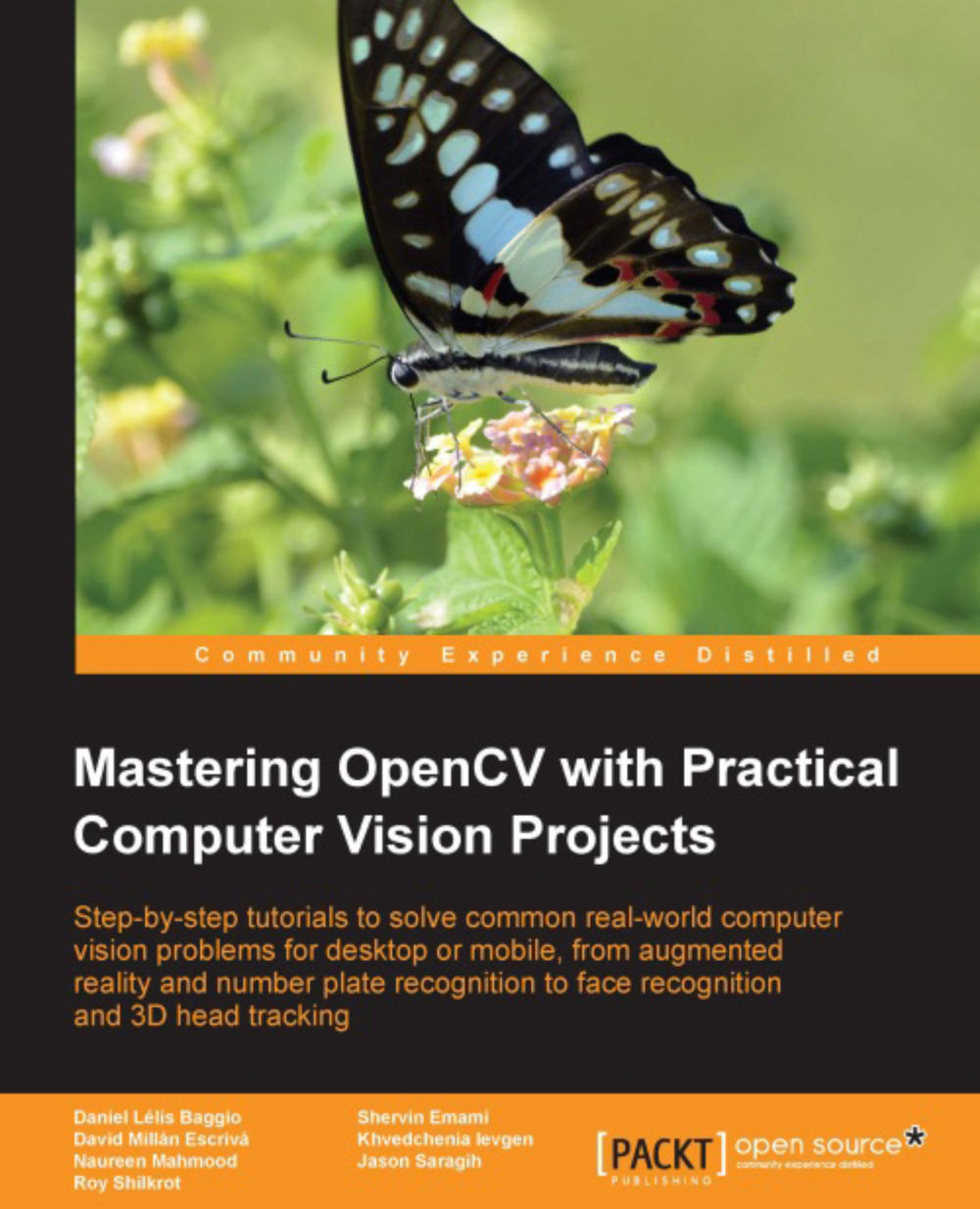
Computer Vision is fast becoming an important technology and is used in Mars robots, national security systems, automated factories, driver-less cars, and medical image analysis to new forms of human-computer interaction. OpenCV is the most common library for computer vision, providing hundreds of complex and fast algorithms. But it has a steep learning curve and limited in-depth tutorials.Mastering OpenCV with Practical Computer Vision Projects is the perfect book for developers with just basic OpenCV skills who want to try practical computer vision projects, as well as the seasoned OpenCV experts who want to add more Computer Vision topics to their skill set or gain more experience with OpenCV's new C++ interface before migrating from the C API to the C++ API.Each chapter is a separate project including the necessary background knowledge, so try them all one-by-one or jump straight to the projects you're most interested in.Create working prototypes from this book including real-time mobile apps, Augmented Reality, 3D shape from video, or track faces & eyes, fluid wall using Kinect, number plate recognition and so on. Mastering OpenCV with Practical Computer Vision Projects gives you rapid training in nine computer vision areas with useful projects.
Table of Contents (15 chapters)
close
close
Mastering OpenCV with Practical Computer Vision Projects
Credits
About the Authors
About the Reviewers
www.PacktPub.com
Preface
1
Index

Summary


In this chapter, we have discussed how active appearance models can be combined with the POSIT algorithm in order to obtain a 3D head pose. An overview on how to create, train, and manipulate AAMs has been given and the reader can use this background for any other field, such as medical, imaging, or industry. Besides dealing with AAMs, we got familiar to Delaunay subdivisions and learned how to use such an interesting structure as a triangulated mesh. We also showed how to perform texture mapping in the triangles using OpenCV functions. Another interesting topic was approached in AAM fitting. Although only the inverse compositional project-out algorithm was described, we could easily obtain the results of years of research by simply using its output.

After enough theory and practice of AAMs, we dived into the details of POSIT in order to couple 2D measurements to 3D ones explaining how to fit a 3D model using matchings between model points. We concluded the chapter by showing how...

Visually different images
CONTINUE READING
83
Tech Concepts
36
Programming languages
73
Tech Tools
Icon Unlimited access to the largest independent learning library in tech of over 8,000 expert-authored tech books and videos.
Icon Innovative learning tools, including AI book assistants, code context explainers, and text-to-speech.
Icon 50+ new titles added per month and exclusive early access to books as they are being written.
Mastering OpenCV with Practical Computer Vision Projects
notes
bookmark Notes and Bookmarks search Search in title playlist Add to playlist font-size Font size

Change the font size

margin-width Margin width

Change margin width

day-mode Day/Sepia/Night Modes

Change background colour

Close icon Search
Country selected

Close icon Your notes and bookmarks

Confirmation

Modal Close icon
claim successful

Buy this book with your credits?

Modal Close icon
Are you sure you want to buy this book with one of your credits?
Close
YES, BUY

Submit Your Feedback

Modal Close icon
Modal Close icon
Modal Close icon