Sign In Start Free Trial
Account

Add to playlist

Create a Playlist

Modal Close icon
You need to login to use this feature.
  • Book Overview & Buying Game Physics Cookbook
  • Table Of Contents Toc
  • Feedback & Rating feedback
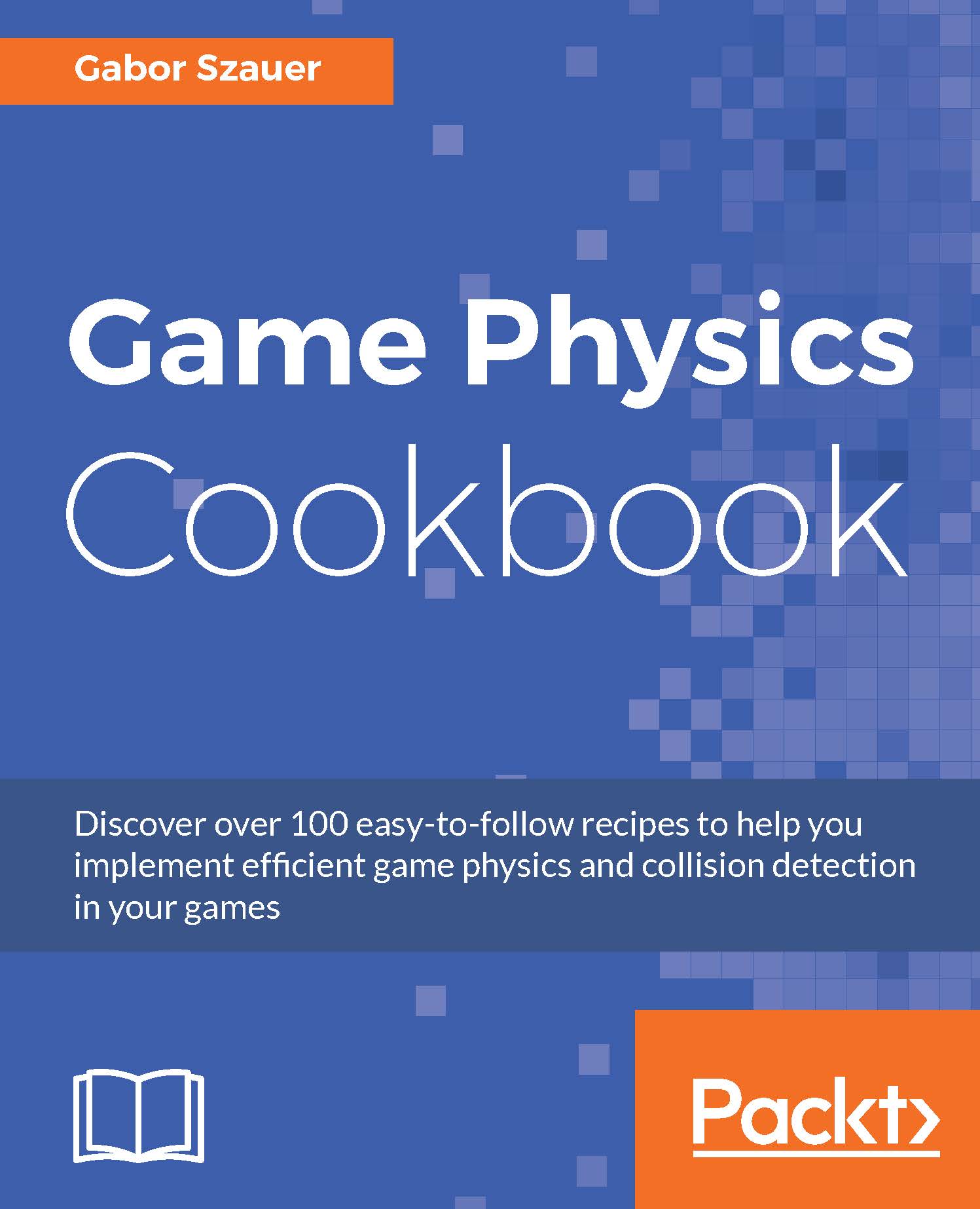
Game Physics Cookbook

Game Physics Cookbook

By : Gabor Szauer
4.3 (4)
close
close
Game Physics Cookbook

Game Physics Cookbook

4.3 (4)
By: Gabor Szauer

Overview of this book

Physics is really important for game programmers who want to add realism and functionality to their games. Collision detection in particular is a problem that affects all game developers, regardless of the platform, engine, or toolkit they use. This book will teach you the concepts and formulas behind collision detection. You will also be taught how to build a simple physics engine, where Rigid Body physics is the main focus, and learn about intersection algorithms for primitive shapes. You’ll begin by building a strong foundation in mathematics that will be used throughout the book. We’ll guide you through implementing 2D and 3D primitives and show you how to perform effective collision tests for them. We then pivot to one of the harder areas of game development—collision detection and resolution. Further on, you will learn what a Physics engine is, how to set up a game window, and how to implement rendering. We’ll explore advanced physics topics such as constraint solving. You’ll also find out how to implement a rudimentary physics engine, which you can use to build an Angry Birds type of game or a more advanced game. By the end of the book, you will have implemented all primitive and some advanced collision tests, and you will be able to read on geometry and linear Algebra formulas to take forward to your own games!
Table of Contents (19 chapters)
close
close
18
Index

Preface

At some point in your game development career, you might need to build a physics engine, modify the source code of an existing physics engine, or even just model some interaction using an existing physics engine. Each of these tasks is a real challenge. Knowing how a physics engine is implemented under the hood will make all of these scenarios a lot simpler.

Building a physics engine from scratch might seem like a large, complex and confusing project, but it doesn't have to be. Behind every physics engine are the same three core components: a solid math library, accurate intersection testing, and usually impulse-based collision resolution. The collision resolution does not have to use an impulse-based solver; other resolution strategies exist as well.

This book covers the three core components of a physics engine in great detail. By the end of the book you will have implemented particle-based physics, rigid body physics, and even soft body physics through cloth simulation. This cookbook aims to break the components of a physics engine down into bite-sized, independent recipes.

Visually different images
CONTINUE READING
83
Tech Concepts
36
Programming languages
73
Tech Tools
Icon Unlimited access to the largest independent learning library in tech of over 8,000 expert-authored tech books and videos.
Icon Innovative learning tools, including AI book assistants, code context explainers, and text-to-speech.
Icon 50+ new titles added per month and exclusive early access to books as they are being written.
Game Physics Cookbook
notes
bookmark Notes and Bookmarks search Search in title playlist Add to playlist download Download options font-size Font size

Change the font size

margin-width Margin width

Change margin width

day-mode Day/Sepia/Night Modes

Change background colour

Close icon Search
Country selected

Close icon Your notes and bookmarks

Confirmation

Modal Close icon
claim successful

Buy this book with your credits?

Modal Close icon
Are you sure you want to buy this book with one of your credits?
Close
YES, BUY

Submit Your Feedback

Modal Close icon
Modal Close icon
Modal Close icon