
Sign In Start Free Trial
Account

Add to playlist

Create a Playlist

Modal Close icon
You need to login to use this feature.
  • Book Overview & Buying OpenGL 4 Shading Language Cookbook
  • Table Of Contents Toc
OpenGL 4 Shading Language Cookbook

OpenGL 4 Shading Language Cookbook - Third Edition

By : David Wolff
3.7 (10)
close
close
OpenGL 4 Shading Language Cookbook

OpenGL 4 Shading Language Cookbook

3.7 (10)
By: David Wolff

Overview of this book

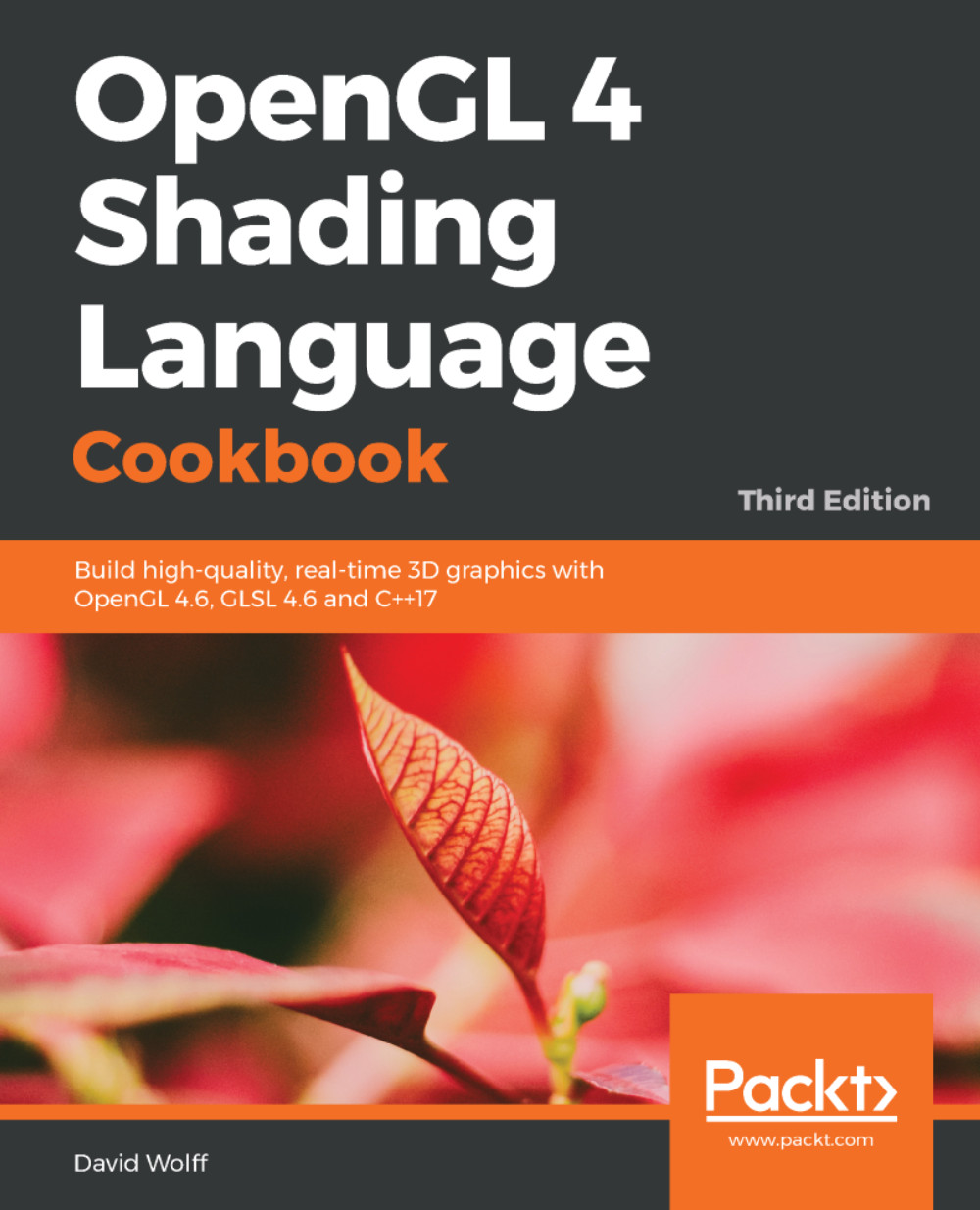
OpenGL 4 Shading Language Cookbook, Third Edition provides easy-to-follow recipes that first walk you through the theory and background behind each technique, and then proceed to showcase and explain the GLSL and OpenGL code needed to implement them. The book begins by familiarizing you with beginner-level topics such as compiling and linking shader programs, saving and loading shader binaries (including SPIR-V), and using an OpenGL function loader library. We then proceed to cover basic lighting and shading effects. After that, you'll learn to use textures, produce shadows, and use geometry and tessellation shaders. Topics such as particle systems, screen-space ambient occlusion, deferred rendering, depth-based tessellation, and physically based rendering will help you tackle advanced topics. OpenGL 4 Shading Language Cookbook, Third Edition also covers advanced topics such as shadow techniques (including the two of the most common techniques: shadow maps and shadow volumes). You will learn how to use noise in shaders and how to use compute shaders. The book provides examples of modern shading techniques that can be used as a starting point for programmers to expand upon to produce modern, interactive, 3D computer-graphics applications.
Table of Contents (13 chapters)
close
close

Introduction

Textures are an important and fundamental aspect of real-time rendering in general, and OpenGL in particular. The use of textures within a shader opens up a huge range of possibilities. Beyond just using textures as sources of color information, they can be used for things like depth information, shading parameters, displacement maps, normal vectors, and other vertex data. The list is virtually endless. Textures are among the most widely used tools for advanced effects in OpenGL programs, and that isn't likely to change any time soon.

In OpenGL 4, we now have the ability to read and write to memory via buffer textures, shader storage buffer objects, and image textures (image load/store). This further muddies the waters of what exactly defines a texture. In general, we might just think of it as a buffer of data that may or may not contain an image.

OpenGL 4.2...

CONTINUE READING
83
Tech Concepts
36
Programming languages
73
Tech Tools
Icon Unlimited access to the largest independent learning library in tech of over 8,000 expert-authored tech books and videos.
Icon Innovative learning tools, including AI book assistants, code context explainers, and text-to-speech.
Icon 50+ new titles added per month and exclusive early access to books as they are being written.
OpenGL 4 Shading Language Cookbook
notes
bookmark Notes and Bookmarks search Search in title playlist Add to playlist font-size Font size

Change the font size

margin-width Margin width

Change margin width

day-mode Day/Sepia/Night Modes

Change background colour

Close icon Search
Country selected

Close icon Your notes and bookmarks

Confirmation

Modal Close icon
claim successful

Buy this book with your credits?

Modal Close icon
Are you sure you want to buy this book with one of your credits?
Close
YES, BUY

Submit Your Feedback

Modal Close icon
Modal Close icon
Modal Close icon