Sign In Start Free Trial
Account

Add to playlist

Create a Playlist

Modal Close icon
You need to login to use this feature.
  • Book Overview & Buying IoT and Edge Computing for Architects
  • Table Of Contents Toc
IoT and Edge Computing for Architects

IoT and Edge Computing for Architects - Second Edition

By : Perry Lea
4.8 (19)
close
close
IoT and Edge Computing for Architects

IoT and Edge Computing for Architects

4.8 (19)
By: Perry Lea

Overview of this book

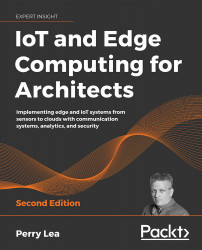
Industries are embracing IoT technologies to improve operational expenses, product life, and people's well-being. An architectural guide is needed if you want to traverse the spectrum of technologies needed to build a successful IoT system, whether that's a single device or millions of IoT devices. IoT and Edge Computing for Architects, 2E encompasses the entire spectrum of IoT solutions, from IoT sensors to the cloud. It examines modern sensor systems, focusing on their power and functionality. It also looks at communication theory, paying close attention to near-range PAN, including the new Bluetooth® 5.0 specification and mesh networks. Then, the book explores IP-based communication in LAN and WAN, including 802.11ah, 5G LTE cellular, Sigfox, and LoRaWAN. It also explains edge computing, routing and gateways, and their role in fog computing, as well as the messaging protocols of MQTT 5.0 and CoAP. With the data now in internet form, you'll get an understanding of cloud and fog architectures, including the OpenFog standards. The book wraps up the analytics portion with the application of statistical analysis, complex event processing, and deep learning models. The book then concludes by providing a holistic view of IoT security, cryptography, and shell security in addition to software-defined perimeters and blockchains.
Table of Contents (17 chapters)
close
close
15
Other Books You May Enjoy
16
Index

Blockchains and cryptocurrencies in IoT

Blockchains exist to solve a trust model (not necessarily a security issue). Blockchains are public, digital, and decentralized ledgers or cryptocurrency transactions. The original cryptocurrency blockchain was Bitcoin, but there are over 2000 new currencies on the market, such as Ethereum, Ripple, and Dash. The power of a blockchain is that there is no single entity controlling the state of transactions. It also forces redundancy in the system by ensuring everyone using a blockchain also maintains a copy of the ledger.

Assuming there is no inherent trust in blockchain participants, the system must live in consensus.

A good question to ask is if we have solved identity management and security with asymmetric cryptography and key exchanges, why are blockchains needed to exchange data or currency? This is not enough for the exchange of money or data of value. One thing to note is that since the inception of...

CONTINUE READING
83
Tech Concepts
36
Programming languages
73
Tech Tools
Icon Unlimited access to the largest independent learning library in tech of over 8,000 expert-authored tech books and videos.
Icon Innovative learning tools, including AI book assistants, code context explainers, and text-to-speech.
Icon 50+ new titles added per month and exclusive early access to books as they are being written.
IoT and Edge Computing for Architects
notes
bookmark Notes and Bookmarks search Search in title playlist Add to playlist font-size Font size

Change the font size

margin-width Margin width

Change margin width

day-mode Day/Sepia/Night Modes

Change background colour

Close icon Search
Country selected

Close icon Your notes and bookmarks

Confirmation

Modal Close icon
claim successful

Buy this book with your credits?

Modal Close icon
Are you sure you want to buy this book with one of your credits?
Close
YES, BUY

Submit Your Feedback

Modal Close icon
Modal Close icon
Modal Close icon