Sign In Start Free Trial
Account

Add to playlist

Create a Playlist

Modal Close icon
You need to login to use this feature.
  • Book Overview & Buying .NET MAUI Cross-Platform Application Development
  • Table Of Contents Toc
.NET MAUI Cross-Platform Application Development

.NET MAUI Cross-Platform Application Development

By : Roger Ye
4.6 (14)
close
close
.NET MAUI Cross-Platform Application Development

.NET MAUI Cross-Platform Application Development

4.6 (14)
By: Roger Ye

Overview of this book

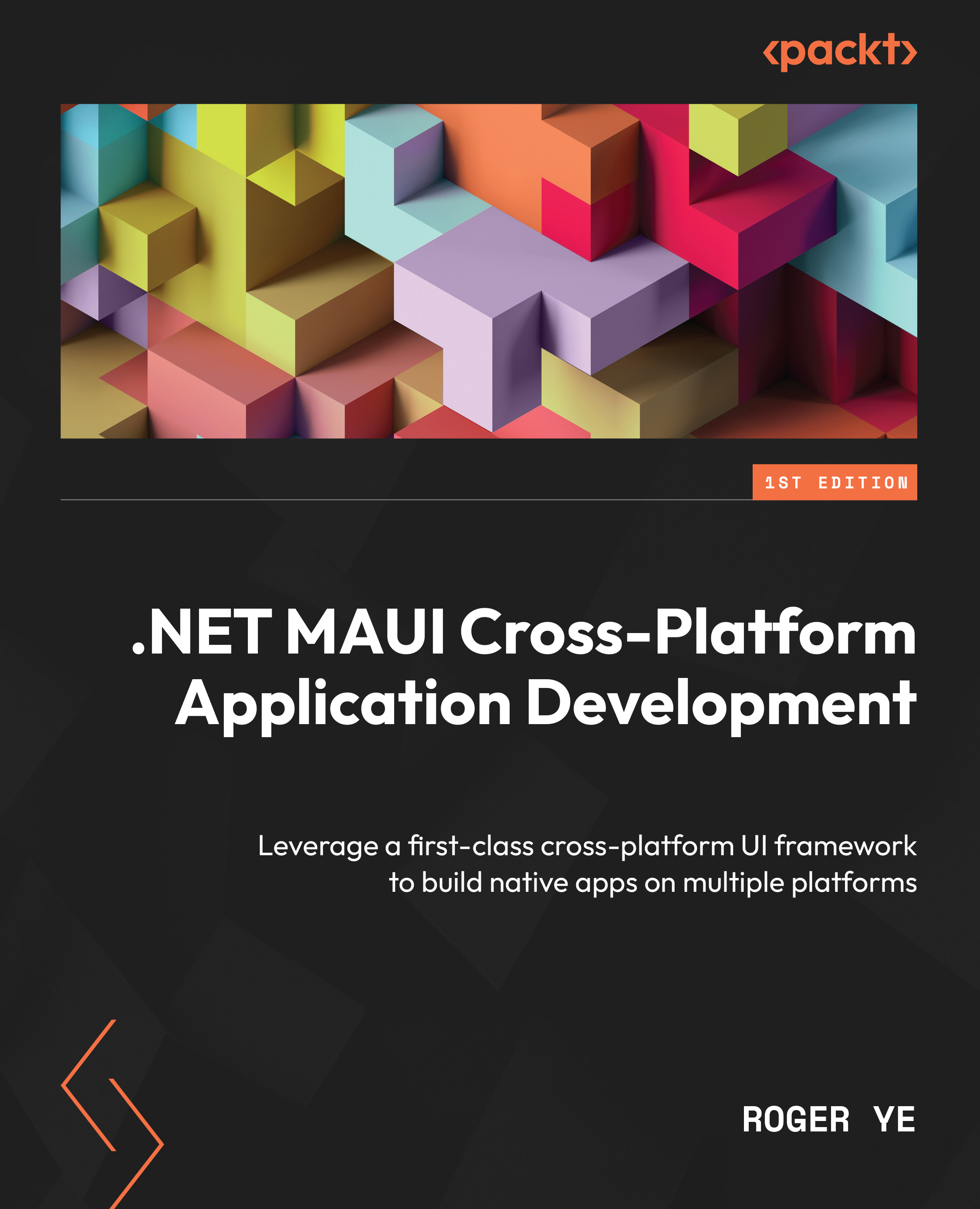
An evolution of Xamarin.Forms, .NET Multi-platform App UI (.NET MAUI) is a cross-platform framework for creating native mobile and desktop apps with C# and XAML. Using .NET MAUI, you can develop apps that’ll run on Android, iOS, macOS, and Windows from a single shared code-base. This step-by-step guide provides a comprehensive introduction to those who are new to .NET MAUI that will have you up to speed with app development using .NET MAUI in no time. The book begins by showing you how to develop a cross-platform application using .NET MAUI and then helps you build an app throughout the chapters. You’ll gain all the knowledge needed to create a cross-platform application for Android, iOS, the mac OS, and Windows from a single shared code-base using .NET MAUI. As you advance, you’ll get to grips with the entire application development lifecycle, from design and implementation through to deployment to the app store through the development of a password manager app using KeePassLib. The concluding chapters will teach you how to integrate the latest frontend technology into your app through .NET MAUI Blazor. By the end of this book, you’ll have learned how to develop your own cross-platform applications using .NET MAUI.
Table of Contents (18 chapters)
close
close
1
Part 1: Exploring .NET MAUI
8
Part 2: Implementing .NET MAUI Blazor
13
Part 3: Testing and Deployment

Preface

In 2017, when we hit performance issues in one of our projects using Cordova, I started to look for an alternative cross platform programming solution. Xamarin was one of the solutions that I investigated at that time. From then until now, I have spent many years on the development of Xamarin and its descendant .NET MAUI. It’s one of the technologies that I love.

Even though we have more cross platform programming options today, such as Flutter or React Native, .NET MAUI has some particularly unique features that we may consider when we are looking for a cross-platform solution.

.NET MAUI uses a single project structure, which is a major improvement compared to Xamarin.Forms. With a single project, we can see the improvement in the following areas:

  • Better debug and test experience – We can select and debug multiple targets in one project. We don’t have switch to different projects to debug or test different targets.
  • Sharing resources – In Xamarin, we have to manage resources in each platform individually. With the improvement of .NET MAUI, we can share most resources cross-platform, such as fonts, images, icons, and so on.
  • Simplified configuration – We can use a single app manifest most of time, so we don’t need to manage platform configuration files separately, such as AndroidManifest.xml, Info.plist, or Package.appxmanifest.

In Flutter or React Native, you can use the Flutter plugin or React Native module to access native device features. To use plugins or native modules, you have to rely on the developer community, or you have to develop your own. These interfaces are designed by developers, so they are not standardized. In .NET MAUI, Microsoft has done the job of standardizing APIs for the most frequently used native device features as part of the .NET MAUI release.

In .NET MAUI, we not only can develop apps using the traditional XAML-based UI, but we also can develop Blazor-based UIs as Blazor Hybrid apps. This opens a door for a higher-level reuse of source code. If you are working on a project that includes a web and mobile app, you can even share the user interface (UI) design and source code between the web and mobile app.

Since .NET MAUI is part of the .NET platform release now, we can always use the latest .NET platform and C# language features with each release of .NET. We can use advanced features, such as .NET generic hosting, dependency injection, or the MVVM Toolkit from the latest .NET release.

In this book, I will share my journey in .NET MAUI development with you using the open source app that I have developed. Both .NET MAUI and .NET platform features will be covered in this book.

CONTINUE READING
83
Tech Concepts
36
Programming languages
73
Tech Tools
Icon Unlimited access to the largest independent learning library in tech of over 8,000 expert-authored tech books and videos.
Icon Innovative learning tools, including AI book assistants, code context explainers, and text-to-speech.
Icon 50+ new titles added per month and exclusive early access to books as they are being written.
.NET MAUI Cross-Platform Application Development
notes
bookmark Notes and Bookmarks search Search in title playlist Add to playlist download Download options font-size Font size

Change the font size

margin-width Margin width

Change margin width

day-mode Day/Sepia/Night Modes

Change background colour

Close icon Search
Country selected

Close icon Your notes and bookmarks

Confirmation

Modal Close icon
claim successful

Buy this book with your credits?

Modal Close icon
Are you sure you want to buy this book with one of your credits?
Close
YES, BUY

Submit Your Feedback

Modal Close icon
Modal Close icon
Modal Close icon