Sign In Start Free Trial
Account

Add to playlist

Create a Playlist

Modal Close icon
You need to login to use this feature.
  • Book Overview & Buying Model Context Protocol for LLMs
  • Table Of Contents Toc
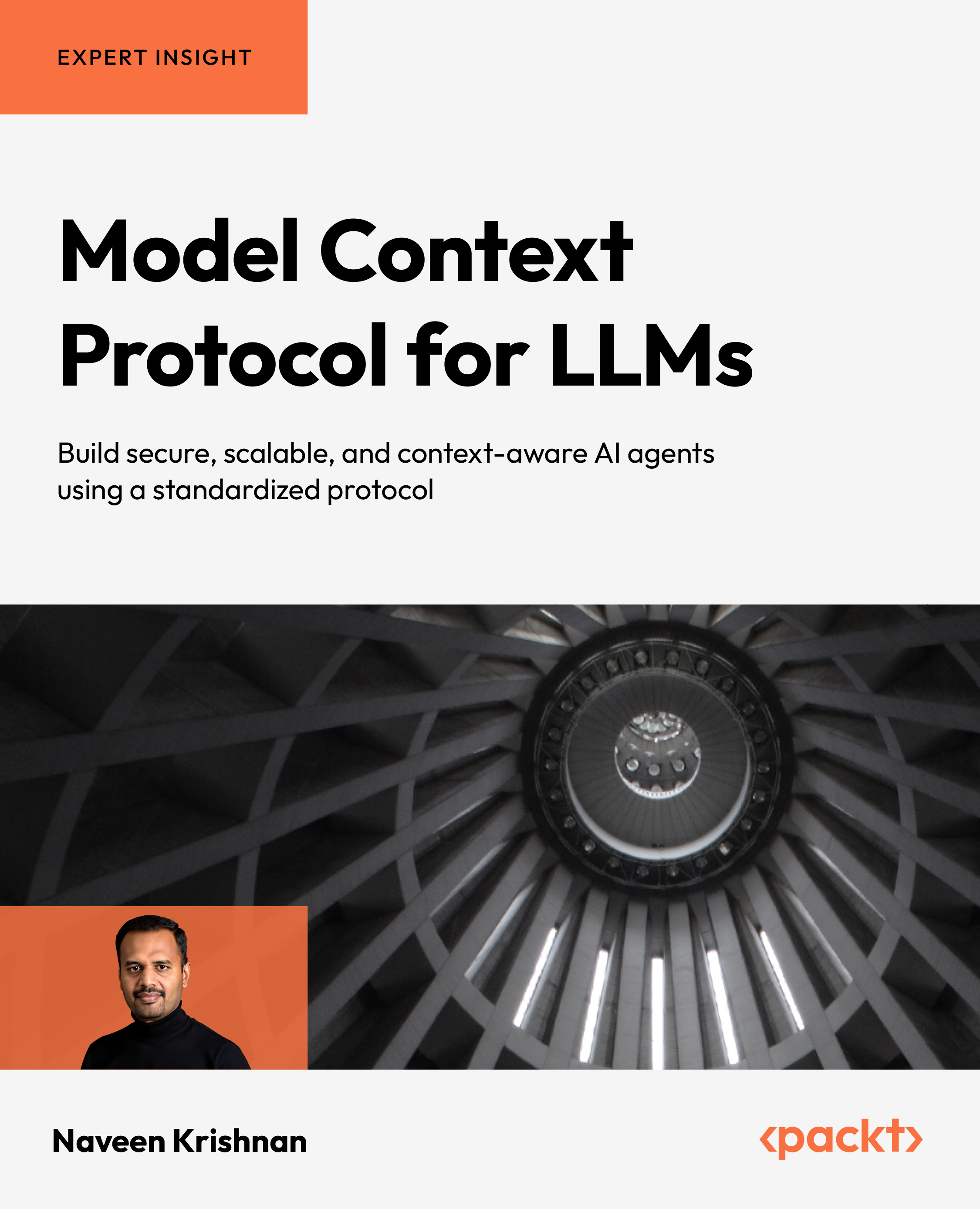
Model Context Protocol for LLMs

Model Context Protocol for LLMs

By : Naveen Krishnan
5 (1)
close
close
Model Context Protocol for LLMs

Model Context Protocol for LLMs

5 (1)
By: Naveen Krishnan

Overview of this book

Modern LLM applications often fail due to weak context management, fragile tool integration, and poorly coordinated agents. To address these challenges, this book provides a practical blueprint for building reliable, scalable AI systems using the Model Context Protocol (MCP), an open standard for interoperable AI architectures. You'll explore why context is the missing layer in many AI deployments and how MCP formalizes it. Through clear explanations and practical examples, you'll design modular components such as resource providers, tool providers, gateways, and standardized interfaces. You'll also integrate MCP with LangChain, AutoGen, and RAG pipelines to build collaborative, context-aware multi-agent systems. You'll learn how to apply MCP to multimodal applications, personalization engines, and enterprise knowledge management solutions, while evaluating and benchmarking implementations for production readiness and implementing authentication, authorization, and scaling strategies for secure cloud deployments. Written by a data and AI solutions engineer with over 17 years of experience at Microsoft and Fortune 500 organizations, this guide combines architectural depth with hands-on implementation. By the end, you'll be able to design, build, and deploy secure, reusable MCP-based LLM systems that scale confidently in production. *Email sign-up and proof of purchase required
Table of Contents (29 chapters)
close
close
Lock Free Chapter
1
Part 1: Foundations and Concepts
5
Part 2: Architecture and Core Implementation
10
Part 3: Security and Performance
13
Part 4: Multi-Agent Systems and Framework Integration
18
Part 5: Real-World Applications
22
Part 6: Evaluation, Optimization, and the Future
28
Index

Preface

Large language models (LLMs) have reshaped what is possible in software engineering, from automated code generation and intelligent assistants to autonomous decision-making agents. Yet as organizations move beyond prototypes and into production, a critical gap has emerged: LLMs operate in isolation, disconnected from the tools, data sources, and contextual signals that they need to deliver reliable, grounded responses. Every team ends up building custom integrations from scratch, resulting in brittle architectures that are difficult to secure, scale, or maintain.

The Model Context Protocol (MCP) was created to solve this problem. Introduced as an open standard for connecting AI models to external context, MCP provides a unified, modular framework for resource discovery, tool invocation, prompt management, and multi-agent coordination. Rather than reinventing integrations for every application, MCP gives engineers a standardized way to build interoperable, context-aware AI systems that can be composed, extended, and governed with confidence.

This book is a comprehensive, hands-on guide to designing, building, and deploying MCP-based systems. It begins with the foundational concepts and architecture, walks you through server-side and client-side implementation in Python, and then progressively tackles security, performance optimization, multi-agent orchestration, and framework integration with LangChain and AutoGen. The later chapters apply MCP to real-world domains, including retrieval-augmented generation, enterprise knowledge management, personalization, and multimodal applications, before addressing evaluation methodologies, benchmarking, and performance tuning. The book closes with a forward-looking discussion of emerging trends and the future of the protocol.

Whether you are building your first MCP server or designing enterprise-scale multi-agent architectures, this book provides the architectural patterns, production-ready code examples, and design principles you need to move from concept to deployment.

Who this book is for

This book is for AI/ML engineers, software engineers, and solution architects who are building LLM-powered applications and want a standardized, modular approach to managing context across agents and tools. Cloud architects and platform engineers designing AI infrastructure will also find the architectural patterns and deployment strategies directly applicable. Intermediate Python proficiency, working knowledge of LLM concepts and REST APIs, and familiarity with system design patterns are expected.

What this book covers

Chapter 1, Introduction to the Model Context Protocol, introduces the evolution of AI systems, explains the disconnected model problem that plagues modern LLM deployments, and presents MCP as the solution. You will set up your development environment and understand the historical context behind the protocol.

Chapter 2, Theoretical Foundations of Multi-Agent Systems, explores the concept of agency in AI, traces the evolution from single-agent to multi-agent architectures, and examines the coordination challenges that MCP is designed to address.

Chapter 3, The MCP for Non-Technical Readers, provides an accessible, jargon-free overview of what MCP is and why it matters. It uses everyday scenarios to explain the protocol and prepare you for the technical depth that follows.

Chapter 4, MCP Components and Interfaces, examines the building blocks of MCP, including resource providers, tool providers, prompt providers, and the standardized interfaces that connect them.

Chapter 5, MCP Architecture Overview, covers the client-server architecture, core component relationships, standardized primitives, communication mechanisms, message formats, and the security and authentication framework.

Chapter 6, Server-Side Implementation, walks you through building MCP servers in Python, including implementing resource providers, tool providers, and prompt providers, with attention to authentication, authorization, and scalability.

Chapter 7, Client-Side Integration, focuses on the client layer, covering context retrieval, tool execution orchestration, security handling, session management, and integration with AI models and frameworks.

Chapter 8, MCP Security Model, provides a thorough treatment of authentication mechanisms, authorization and access control, transport layer security, data privacy, auditing, and advanced security topics for MCP deployments.

Chapter 9, MCP Performance Optimization, addresses performance profiling, server-side and client-side optimization strategies, protocol-level optimizations, and monitoring for continuous improvement. It includes a case study on scaling an MCP deployment.

Chapter 10, MCP and Multi-Agent Systems, demonstrates how MCP facilitates multi-agent coordination, collaborative task execution, and integration with agent frameworks. It covers security and trust patterns for multi-agent environments.

Chapter 11, MCP for Retrieval-Augmented Generation, shows how MCP standardizes and simplifies RAG architectures. You will build a basic RAG system with MCP, implement advanced RAG techniques, and learn about evaluation and best practices.

Chapter 12, Integrating MCP with LangChain, covers how to use MCP as a document store, tool provider, and memory backend for LangChain applications. You will build a complete LangChain application powered by MCP.

Chapter 13, Integrating MCP with AutoGen, explains how to connect MCP with Microsoft AutoGen to build sophisticated multi-agent collaboration workflows with shared context and coordinated task execution.

Chapter 14, MCP for Enterprise Knowledge Management, applies MCP to enterprise knowledge management challenges, including knowledge silos, search and discovery, and compliance. It presents architectural patterns such as federated search and knowledge graphs.

Chapter 15, MCP for Personalization and Recommendation Systems, demonstrates how MCP solves data integration, real-time adaptation, and cross-platform consistency challenges in personalization engines. It covers privacy and ethical considerations.

Chapter 16, MCP for Multimodal Applications, shows how MCP enables coordinated processing across text, image, audio, and video modalities using an orchestrated pipeline, collaborative processing, and adaptive routing patterns.

Chapter 17, MCP Evaluation Methodologies, introduces a structured evaluation framework covering functional evaluation, performance evaluation, and continuous monitoring for MCP-based systems.

Chapter 18, Performance Benchmarks and Testing, teaches you how to design effective benchmarks, define core performance metrics, implement a comprehensive benchmarking suite, and perform comparative analysis across MCP configurations.

Chapter 19, Optimization Strategies and Performance Tuning, provides server-side, client-side, and protocol-level optimization strategies, along with a performance optimization framework and continuous monitoring approach.

Chapter 20, Future Directions and Emerging Trends, explores the evolution of MCP standards, integration with emerging AI technologies, advanced multi-agent coordination, enterprise adoption challenges, and the societal and ethical implications of the protocol.

To get the most out of this book

To follow the examples in this book, you will need intermediate proficiency in Python and a working understanding of LLM concepts such as prompts, tokens, and embeddings. Familiarity with REST APIs and basic system design patterns will help you absorb the architectural discussions more quickly.

For chapters that include code examples, you will need the following:

  • Python 3.10 or later installed on your machine
  • A code editor such as Visual Studio Code
  • Access to an LLM API (OpenAI, Azure OpenAI, or equivalent)
  • Git for cloning the example code repository
  • Basic familiarity with virtual environments and pip
  • Optional: Docker for containerized deployment examples

All code examples in this book are written in Python and have been tested on Windows, macOS, and Linux.

Download the example code files

This book includes a complete downloadable code bundle containing all the example projects and files used throughout the chapters. We recommend downloading the bundle so you can follow along smoothly and experiment with the examples.

Use the bundle as a practical starting point. Modify it, extend it, and apply what you learn by creating your own variations as you progress through the chapters.

Get the code bundle

If you bought the book directly from Packt:

  1. Go to packtpub.com
  2. Click your profile picture and select Your Orders
  3. Find this book and click Download Code

If you bought this book from Amazon or any other channel partner:

  1. Go to packtpub.com/unlock or scan the following QR code:

    Image

  2. Search for this book
  3. Sign up or log in to your free Packt account
  4. Upload your proof of purchase and download the code bundle locally

Usage note: You're free to use and modify this code for personal learning and non-commercial projects.

Conventions used

There are a number of text conventions used throughout this book.

CodeInText: Indicates code words in text, database table names, folder names, filenames, file extensions, pathnames, dummy URLs, user input, and Twitter handles. For example: "Create an MCPServer instance and register your resource providers."

A block of code is set as follows:

server = MCPServer(config=server_config)
server.register_resource_provider(DocumentProvider())
server.start()

Any command-line input or output is written as follows:

pip install mcp-sdk langchain autogen

Bold: Indicates a new term, an important word, or words that you see on the screen. For instance, words in menus or dialog boxes appear in the text like this. For example: "It's worth noting that the official MCP specification defines three core server features (resources, prompts, and tools) and three client features (sampling, roots, and elicitation)."

Warnings or important notes appear like this.

Tips and tricks appear like this.

Get in touch

Feedback from our readers is always welcome.

General feedback: If you have questions about any aspect of this book or have any general feedback, please email us at customercare@packt.com and mention the book's title in the subject of your message.

Errata: Although we have taken every care to ensure the accuracy of our content, mistakes do happen. If you have found a mistake in this book, we would be grateful if you reported this to us. Please visit http://www.packt.com/submit-errata, click Submit Errata, and fill in the form.

Piracy: If you come across any illegal copies of our works in any form on the internet, we would be grateful if you would provide us with the location address or website name. Please contact us at [email protected] with a link to the material.

If you are interested in becoming an author: If there is a topic that you have expertise in and you are interested in either writing or contributing to a book, please visit http://authors.packt.com/.

CONTINUE READING
83
Tech Concepts
36
Programming languages
73
Tech Tools
Icon Unlimited access to the largest independent learning library in tech of over 8,000 expert-authored tech books and videos.
Icon Innovative learning tools, including AI book assistants, code context explainers, and text-to-speech.
Icon 50+ new titles added per month and exclusive early access to books as they are being written.
Model Context Protocol for LLMs
notes
bookmark Notes and Bookmarks search Search in title playlist Add to playlist download Download options font-size Font size

Change the font size

margin-width Margin width

Change margin width

day-mode Day/Sepia/Night Modes

Change background colour

Close icon Search
Country selected

Close icon Your notes and bookmarks

Confirmation

Modal Close icon
claim successful

Buy this book with your credits?

Modal Close icon
Are you sure you want to buy this book with one of your credits?
Close
YES, BUY

Submit Your Feedback

Modal Close icon
Modal Close icon
Modal Close icon