Sign In Start Free Trial
Account

Add to playlist

Create a Playlist

Modal Close icon
You need to login to use this feature.
  • Book Overview & Buying Parallel Programming with Python
  • Table Of Contents Toc
  • Feedback & Rating feedback
Parallel Programming with Python

Parallel Programming with Python

By : Palach
3 (9)
close
close
Parallel Programming with Python

Parallel Programming with Python

3 (9)
By: Palach

Overview of this book

Starting with the basics of parallel programming, you will proceed to learn about how to build parallel algorithms and their implementation. You will then gain the expertise to evaluate problem domains, identify if a particular problem can be parallelized, and how to use the Threading and Multiprocessor modules in Python. The Python Parallel (PP) module, which is another mechanism for parallel programming, is covered in depth to help you optimize the usage of PP. You will also delve into using Celery to perform distributed tasks efficiently and easily. Furthermore, you will learn about asynchronous I/O using the asyncio module. Finally, by the end of this book you will acquire an in-depth understanding about what the Python language has to offer in terms of built-in and external modules for an effective implementation of Parallel Programming. This is a definitive guide that will teach you everything you need to know to develop and maintain high-performance parallel computing systems using the feature-rich Python.
Table of Contents (10 chapters)
close
close
9
Index

Exploring common forms of parallelization

There is a certain confusion when we try to define the main forms of paralleling systems. It is common to find quotations on parallel and concurrent systems as if both meant the same thing. Nevertheless, there are slight differences between them.

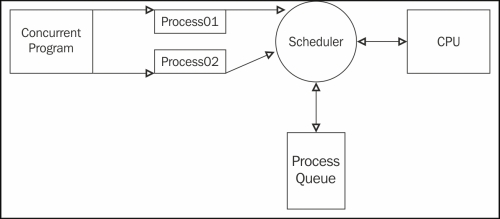
Within concurrent programming, we have a scenario in which a program dispatches several workers and these workers dispute to use the CPU to run a task. The stage at which the dispute takes place is controlled by the CPU scheduler, whose function is to define which worker is apt for using the resource at a specific moment. In most cases, the CPU scheduler runs the task of raking processes so fast that we might get the impression of pseudo-parallelism. Therefore, concurrent programming is an abstraction from parallel programming.

Note

Concurrent systems dispute over the same CPU to run tasks.

The following diagram shows a concurrent program scheme:

Exploring common forms of parallelization

Concurrent programming scheme.

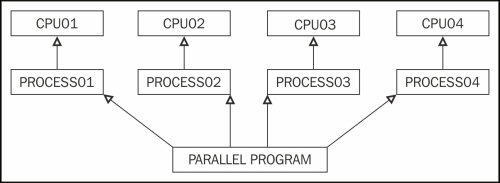
Parallel programming can be defined as an approach in which program data creates workers to run specific tasks simultaneously in a multicore environment without the need for concurrency amongst them to access a CPU.

Note

Parallel systems run tasks simultaneously.

The following figure shows the concept of parallel systems:

Exploring common forms of parallelization

Parallel programming scheme.

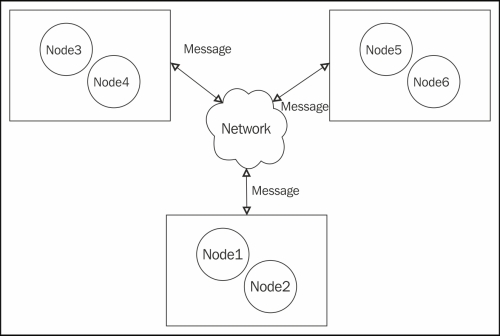
Distributed programming aims at the possibility of sharing the processing by exchanging data through messages between machines (nodes) of computing, which are physically separated.

Distributed programming is becoming more and more popular for many reasons; they are explored as follows:

  • Fault-tolerance: As the system is decentralized, we can distribute the processing to different machines in a network, and thus perform individual maintenance of specific machines without affecting the functioning of the system as a whole.
  • Horizontal scalability: We can increase the capacity of processing in distributed systems in general. We can link new equipment with no need to abort applications being executed. We can say that it is cheaper and simpler compared to vertical scalability.
  • Cloud computing: With the reduction in hardware costs, we need the growth of this type of business where we can obtaining huge machine parks acting in a cooperative way and running programs in a transparent way for their users.

Note

Distributed systems run tasks within physically-separated nodes.

The following figure shows a distributed system scheme:

Exploring common forms of parallelization

Distributed programming scheme.

Visually different images
CONTINUE READING
83
Tech Concepts
36
Programming languages
73
Tech Tools
Icon Unlimited access to the largest independent learning library in tech of over 8,000 expert-authored tech books and videos.
Icon Innovative learning tools, including AI book assistants, code context explainers, and text-to-speech.
Icon 50+ new titles added per month and exclusive early access to books as they are being written.
Parallel Programming with Python
notes
bookmark Notes and Bookmarks search Search in title playlist Add to playlist font-size Font size

Change the font size

margin-width Margin width

Change margin width

day-mode Day/Sepia/Night Modes

Change background colour

Close icon Search
Country selected

Close icon Your notes and bookmarks

Confirmation

Modal Close icon
claim successful

Buy this book with your credits?

Modal Close icon
Are you sure you want to buy this book with one of your credits?
Close
YES, BUY

Submit Your Feedback

Modal Close icon
Modal Close icon
Modal Close icon