Sign In Start Free Trial
Account

Add to playlist

Create a Playlist

Modal Close icon
You need to login to use this feature.
  • Book Overview & Buying Parallel Programming with Python
  • Table Of Contents Toc
  • Feedback & Rating feedback
Parallel Programming with Python

Parallel Programming with Python

By : Palach
3 (9)
close
close
Parallel Programming with Python

Parallel Programming with Python

3 (9)
By: Palach

Overview of this book

Starting with the basics of parallel programming, you will proceed to learn about how to build parallel algorithms and their implementation. You will then gain the expertise to evaluate problem domains, identify if a particular problem can be parallelized, and how to use the Threading and Multiprocessor modules in Python. The Python Parallel (PP) module, which is another mechanism for parallel programming, is covered in depth to help you optimize the usage of PP. You will also delve into using Celery to perform distributed tasks efficiently and easily. Furthermore, you will learn about asynchronous I/O using the asyncio module. Finally, by the end of this book you will acquire an in-depth understanding about what the Python language has to offer in terms of built-in and external modules for an effective implementation of Parallel Programming. This is a definitive guide that will teach you everything you need to know to develop and maintain high-performance parallel computing systems using the feature-rich Python.
Table of Contents (10 chapters)
close
close
9
Index

Understanding Celery's architecture

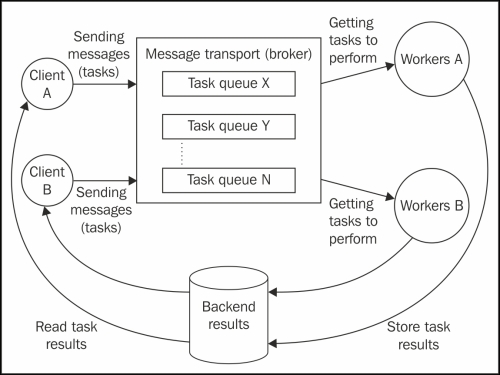
Celery has an architecture based on pluggable components and a mechanism of message exchange that uses a protocol according to a selected message transport (broker). This is illustrated in the following diagram:

Understanding Celery's architecture

The Celery architecture

Now, let us go through each item within Celery's architecture in detail.

Working with tasks

The client components, as presented in the previous diagram, have the function of creating and dispatching tasks to the brokers.

We will now analyze a code example that demonstrates the definition of a task by using the @app.task decorator, which is accessible through an instance of Celery application that, for now, will be called app. The following code example demonstrates a simple Hello World app:

@app.task
def hello_world():
    return "Hello I'm a celery task"

Tip

Any callable can be a task.

As we mentioned earlier, there are several types of tasks: synchronous, asynchronous, periodic, and scheduled. When we...

Visually different images
CONTINUE READING
83
Tech Concepts
36
Programming languages
73
Tech Tools
Icon Unlimited access to the largest independent learning library in tech of over 8,000 expert-authored tech books and videos.
Icon Innovative learning tools, including AI book assistants, code context explainers, and text-to-speech.
Icon 50+ new titles added per month and exclusive early access to books as they are being written.
Parallel Programming with Python
notes
bookmark Notes and Bookmarks search Search in title playlist Add to playlist font-size Font size

Change the font size

margin-width Margin width

Change margin width

day-mode Day/Sepia/Night Modes

Change background colour

Close icon Search
Country selected

Close icon Your notes and bookmarks

Confirmation

Modal Close icon
claim successful

Buy this book with your credits?

Modal Close icon
Are you sure you want to buy this book with one of your credits?
Close
YES, BUY

Submit Your Feedback

Modal Close icon
Modal Close icon
Modal Close icon