Sign In Start Free Trial
Account

Add to playlist

Create a Playlist

Modal Close icon
You need to login to use this feature.
  • Book Overview & Buying Learning F# Functional Data Structures and Algorithms
  • Table Of Contents Toc
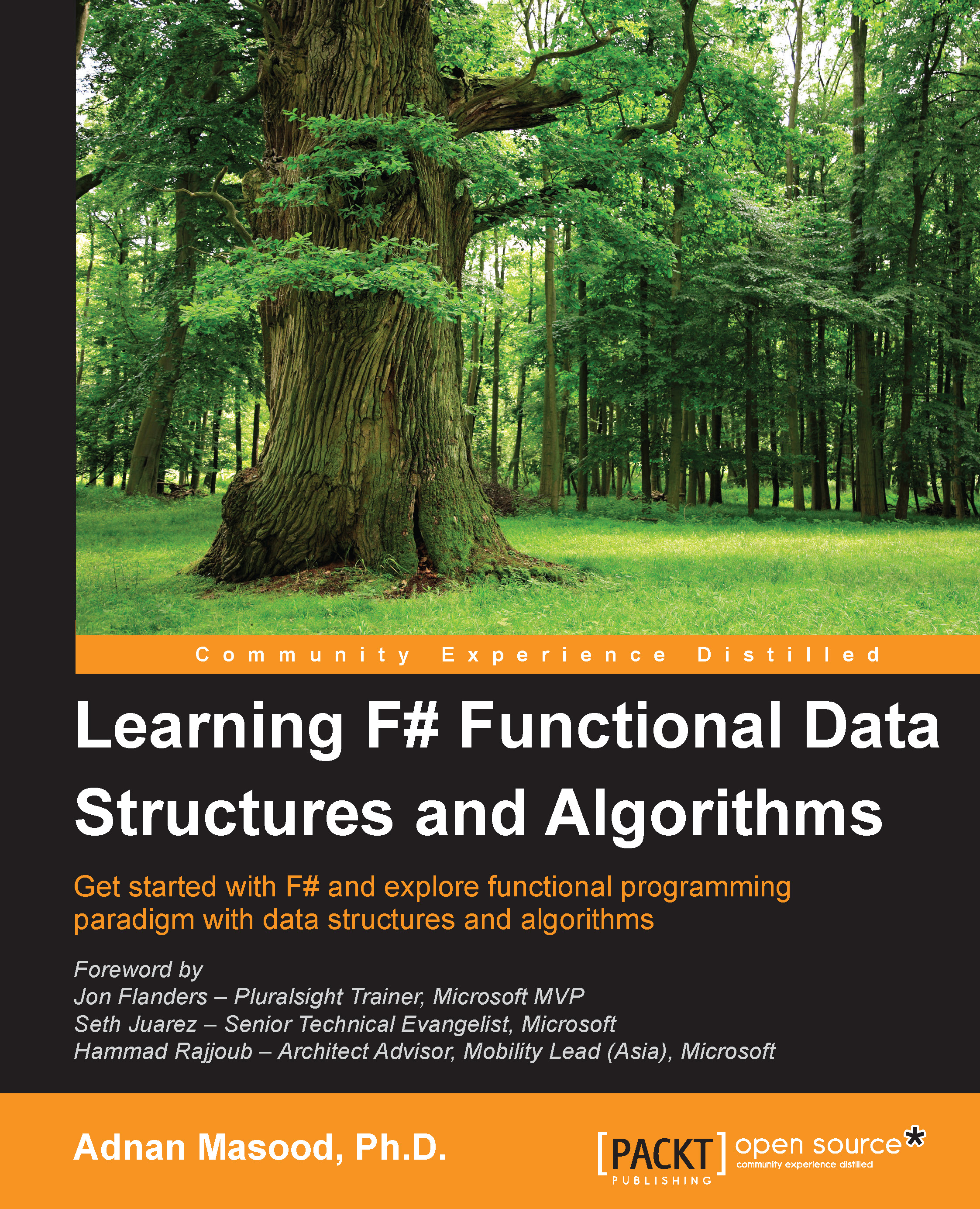
Learning F# Functional Data Structures and Algorithms

Learning F# Functional Data Structures and Algorithms

By : Adnan Masood
4 (9)
close
close
Learning F# Functional Data Structures and Algorithms

Learning F# Functional Data Structures and Algorithms

4 (9)
By: Adnan Masood

Overview of this book

If you have just started your adventure with F#, then this book will help you take the right steps to become a successful F# coder. An intermediate knowledge of imperative programming concepts, and a basic understanding of the algorithms and data structures in .NET environments using the C# language and BCL (Base Class Library), would be helpful.
Table of Contents (12 chapters)
close
close
11
Index

Chapter 1. Embrace the Truth


"Object oriented programming makes code understandable by encapsulating moving parts. Functional programming makes code understandable by minimizing moving parts."

 
 -- Michael Feathers

The history of functional programming can be traced back to the Church and Rosser's original work on Lambda Calculus in 1936 and yet, the concepts and implementation of this important programming paradigm are somehow limited to academia while its object-oriented and imperative counterpart dominates the industry. Good news is, this trend is changing fast! With the functional paradigm support in modern programming languages, such as Scala, Clojure, F#, Ruby, and to some extent, the omnipresent JavaScript, the benefits of functional programming are being realized. The increased use of some classical functional languages, such as OCaml, Erlang, Scheme, and Lisp in high-concurrency environments has led to realization of the functional advantages of brevity, terseness, scalability and performance.

In this chapter, we will cover everything that a hobbyist F# developer, who is just starting his/her adventure in functional programming, needs to know in order to be able to follow the discussion through rest of the book. We will begin with a short explanation of F# language's rather special role in the functional programming world, and will explain why it isn't strictly a functional programming language. Throughout the book, and in this chapter particularly, we will address the historic sketches of functional languages and their predecessors. We will discuss F# language's roots in ML, the context in which F# works, that is, running on top of .NET stack, compiled to IL, utilizing BCL, and the hybrid nature of the languages. You will see several new terms used in this and the following chapters; these terms will have a cursory definition, but will be elaborated on as we discuss these topics in detail during subsequent chapters.

By the end of this chapter, you will be familiar with a brief history of functional programming. With comparative code examples, we will analyze code samples using mutable, and immulatable data structures as well as imperative control flow syntax that will allow you, the reader, to fully understand and embrace the hybrid nature of F#.

In this chapter, we will cover the following topics:

  • A brief overview of Functional Programming Paradigm
  • Thinking functional—why functional programming matters
  • The F# language primer
  • Benefits of functional programming and functional data structures
  • Code samples comparing imperative and functional styles
Visually different images
CONTINUE READING
83
Tech Concepts
36
Programming languages
73
Tech Tools
Icon Unlimited access to the largest independent learning library in tech of over 8,000 expert-authored tech books and videos.
Icon Innovative learning tools, including AI book assistants, code context explainers, and text-to-speech.
Icon 50+ new titles added per month and exclusive early access to books as they are being written.
Learning F# Functional Data Structures and Algorithms
notes
bookmark Notes and Bookmarks search Search in title playlist Add to playlist download Download options font-size Font size

Change the font size

margin-width Margin width

Change margin width

day-mode Day/Sepia/Night Modes

Change background colour

Close icon Search
Country selected

Close icon Your notes and bookmarks

Confirmation

Modal Close icon
claim successful

Buy this book with your credits?

Modal Close icon
Are you sure you want to buy this book with one of your credits?
Close
YES, BUY

Submit Your Feedback

Modal Close icon
Modal Close icon
Modal Close icon