Sign In Start Free Trial
Account

Add to playlist

Create a Playlist

Modal Close icon
You need to login to use this feature.
  • Book Overview & Buying Learning F# Functional Data Structures and Algorithms
  • Table Of Contents Toc
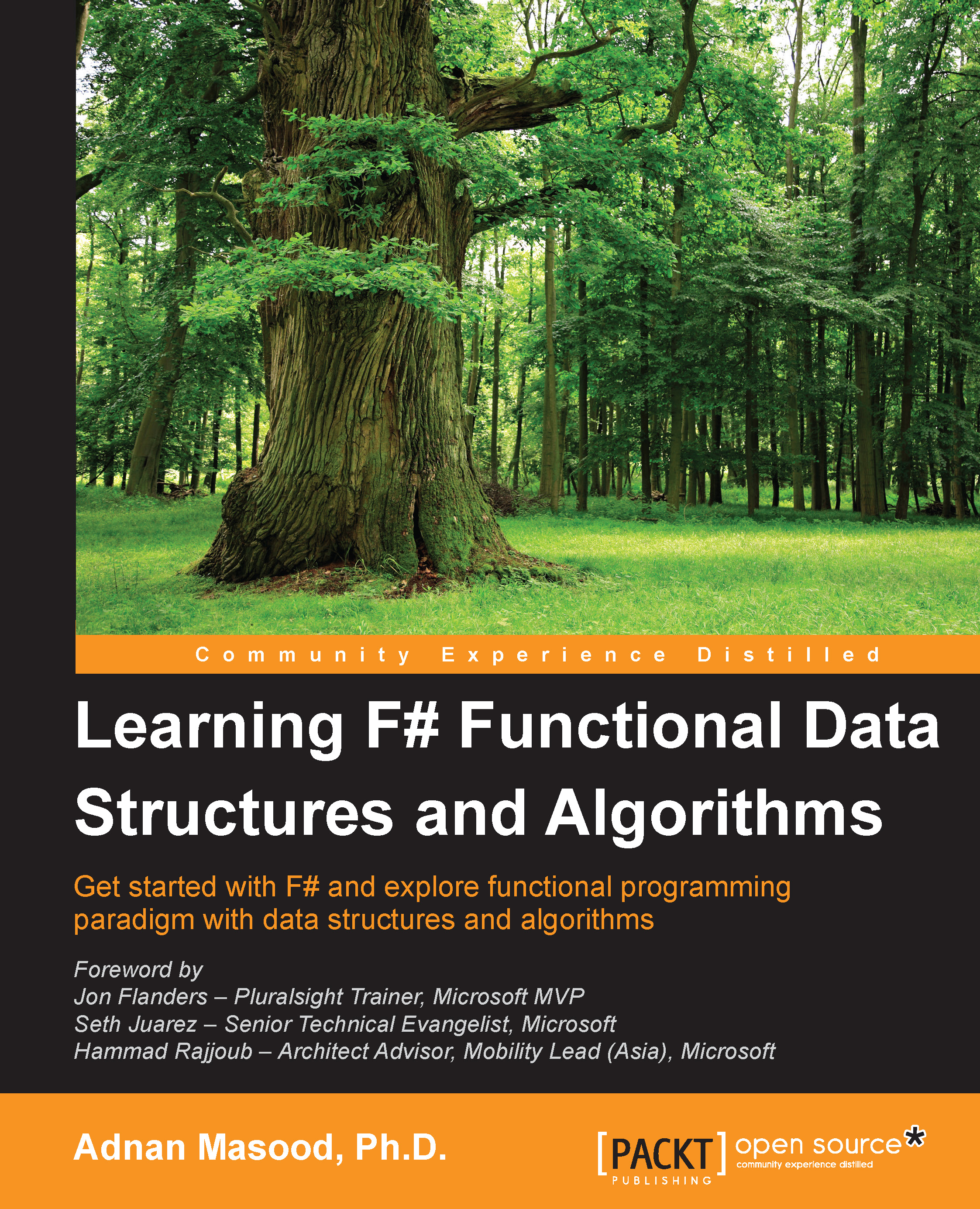
Learning F# Functional Data Structures and Algorithms

Learning F# Functional Data Structures and Algorithms

By : Adnan Masood
4 (9)
close
close
Learning F# Functional Data Structures and Algorithms

Learning F# Functional Data Structures and Algorithms

4 (9)
By: Adnan Masood

Overview of this book

If you have just started your adventure with F#, then this book will help you take the right steps to become a successful F# coder. An intermediate knowledge of imperative programming concepts, and a basic understanding of the algorithms and data structures in .NET environments using the C# language and BCL (Base Class Library), would be helpful.
Table of Contents (12 chapters)
close
close
11
Index

Thinking functional – why functional programming matters

Maintainability is one of the key non-functional requirements when it comes to code upkeep. Software complexity is a deterrent for feature additions, bug fixes, reusability, and refactoring. A well-structured program is not only easy to maintain, but also easy to debug and reuse. In Why Functional Programming Matters - Research topics in functional programming, John Huges argues that modularity is key to effective software maintainability, and modularity means more than mere code segmentation. Decomposing a technology or business problem into smaller segments, and then integrating these smaller problems to build a solution, promotes modular and reusable development practices. Code must be usable before it is reusable; the higher order functions and non-strict (lazy) evaluation of functional programming help build smaller, readable, easily testable, and generic modules.

Functional programing provides abstraction but it is relatively different from the hierarchical facet which we are used to seeing in the object oriented paradigm. In contrast with the object oriented tenet of abstraction, functional abstraction hides how the code executes, and provides a protected logical environment which supports referential transparency, that is, programming without side effects. This lets the developer focus on the results based on the statement provided. Functional code is a declaration that describes the results that a developer is trying to achieve, instead of focusing on the steps to get there.

Functional syntax tends to be less verbose and more terse than its imperative or object oriented counterpart. The terseness keeps KLOC low and often results to the improved developer productivity. In terms of productivity, since functional programming promotes and encourages rapid prototyping, it benefits building and testing out proof of concept implementations. This results in code that has more brevity, is more resilient to change, and has fewer bugs.

Even though this is not strictly a feature of functional programming, several cross-cutting concerns come standard along with most functional programming languages. These include protected environments, pattern matching, tail-call optimization, immutable data structures, and garbage collection.

If you have written multi-threaded code, you'd know that debugging the concurrency issues in a multi-threaded environment is difficult to say the least. Arguably, one of the best features of functional programming is thread safety through immutability. The notion of concurrent collections in modern programming languages has its roots in functional programming. The design and use of immutable data structures prevents the process from running into race conditions and therefore does not present a need for explicit locking, semaphores, and mutex programs. This also helps in parallelization, one of the unrealized promises of functional programming.

In this book, we will discuss these and various other functional programming features in detail, especially in context of F#. As a reader who is potentially familiar with either object oriented or imperative programming, you will enjoy the use of fluent-interface methods, lazy and partial evaluation, currying and memoization, and other unique and interesting concepts that make your life as a developer more fulfilling, and easier too.

CONTINUE READING
83
Tech Concepts
36
Programming languages
73
Tech Tools
Icon Unlimited access to the largest independent learning library in tech of over 8,000 expert-authored tech books and videos.
Icon Innovative learning tools, including AI book assistants, code context explainers, and text-to-speech.
Icon 50+ new titles added per month and exclusive early access to books as they are being written.
Learning F# Functional Data Structures and Algorithms
notes
bookmark Notes and Bookmarks search Search in title playlist Add to playlist download Download options font-size Font size

Change the font size

margin-width Margin width

Change margin width

day-mode Day/Sepia/Night Modes

Change background colour

Close icon Search
Country selected

Close icon Your notes and bookmarks

Confirmation

Modal Close icon
claim successful

Buy this book with your credits?

Modal Close icon
Are you sure you want to buy this book with one of your credits?
Close
YES, BUY

Submit Your Feedback

Modal Close icon
Modal Close icon
Modal Close icon