Sign In Start Free Trial
Account

Add to playlist

Create a Playlist

Modal Close icon
You need to login to use this feature.
  • Book Overview & Buying Learning F# Functional Data Structures and Algorithms
  • Table Of Contents Toc
Learning F# Functional Data Structures and Algorithms

Learning F# Functional Data Structures and Algorithms

By : Adnan Masood
4 (9)
close
close
Learning F# Functional Data Structures and Algorithms

Learning F# Functional Data Structures and Algorithms

4 (9)
By: Adnan Masood

Overview of this book

If you have just started your adventure with F#, then this book will help you take the right steps to become a successful F# coder. An intermediate knowledge of imperative programming concepts, and a basic understanding of the algorithms and data structures in .NET environments using the C# language and BCL (Base Class Library), would be helpful.
Table of Contents (12 chapters)
close
close
11
Index

Preface


"If there's a book that you want to read, but it hasn't been written yet, then you must write it."

 
 -- Toni Morrison

F# is a multiparadigm programming language that encompasses object-oriented, imperative, and functional programming language properties. The functional paradigm can be defined as programming with pure functions, programming by function composition, and a combination of both. For over a quarter of a century, functional programming languages such as Lisp, Haskell, and standard ML existed in academia, but industry adaption has been quite slow. With the introduction of F#, an open source functional programming language, this trend is witnessing a significant change. F# runs on the .NET runtime and supports libraries from other IL-based programming languages.

Due to the seemingly overarching title of this manuscript, a few disclaimers are in order. This book is an introduction to F#, functional data structures, and algorithms. These topics are fairly large in their individual capacity. A large body of growing literature exists in each of these areas itself. Therefore, it won't be a reasonable expectation to provide a comprehensive picture of data structures and algorithms in the limited amount of space available in this book. Instead, this book is intended as a cursory introduction to the use and development of data structures and algorithms using F#. The goal is to provide a broader overview and resources to the reader to get started with functional programming using F#.

This book is written with a few assumptions, keeping the reader in mind. We assume that the reader has basic knowledge of an imperative programming language and object-oriented concepts. Readers are highly encouraged to try out examples, use the resources listed in Chapter 10, Where to Go Next?, and review specialized texts for a more comprehensive treatment of algorithms and data structures.

Starting with the basic concepts of F#, this book will help you to solve complex computing problems with simple, maintainable, and robust code. Using easy-to-understand examples, you will learn how to design data structures and algorithms in F# and apply these concepts in real-life projects, as well as gain insights into how to reuse libraries available in community projects. You will also learn how to set up Visual Studio .NET and F# compiler to work together, implement the Fibonacci sequence and Tower of Hanoi using recursion, and apply lazy evaluation for quick sorts. The book will then cover built-in data structures and take you through enumerations and sequences. You will gain knowledge about stacks, graph-related algorithms, and implementations of binary trees. Next, you will understand the custom functional implementation of a queue and look at the already available collection and concurrent collection structures. You will also review sets and maps and explore the implementation of a vector.

In the final leg of this book, you will find resources and references that will give you a great overview of how to build an application in F# and do great things. We have tried our best to provide attribution to all the resources used in this book. However, if anything has been missed, let us know. To build upon the fundamentals you would learn in this book, we have created a code repository to solve project Euler algorithmic problems. Project Euler is a series of challenging mathematical and computer programming problems that require working with algorithms and data structures. You will see our solutions on the GitHub repo at https://github.com/adnanmasood/Euler.Polyglot.

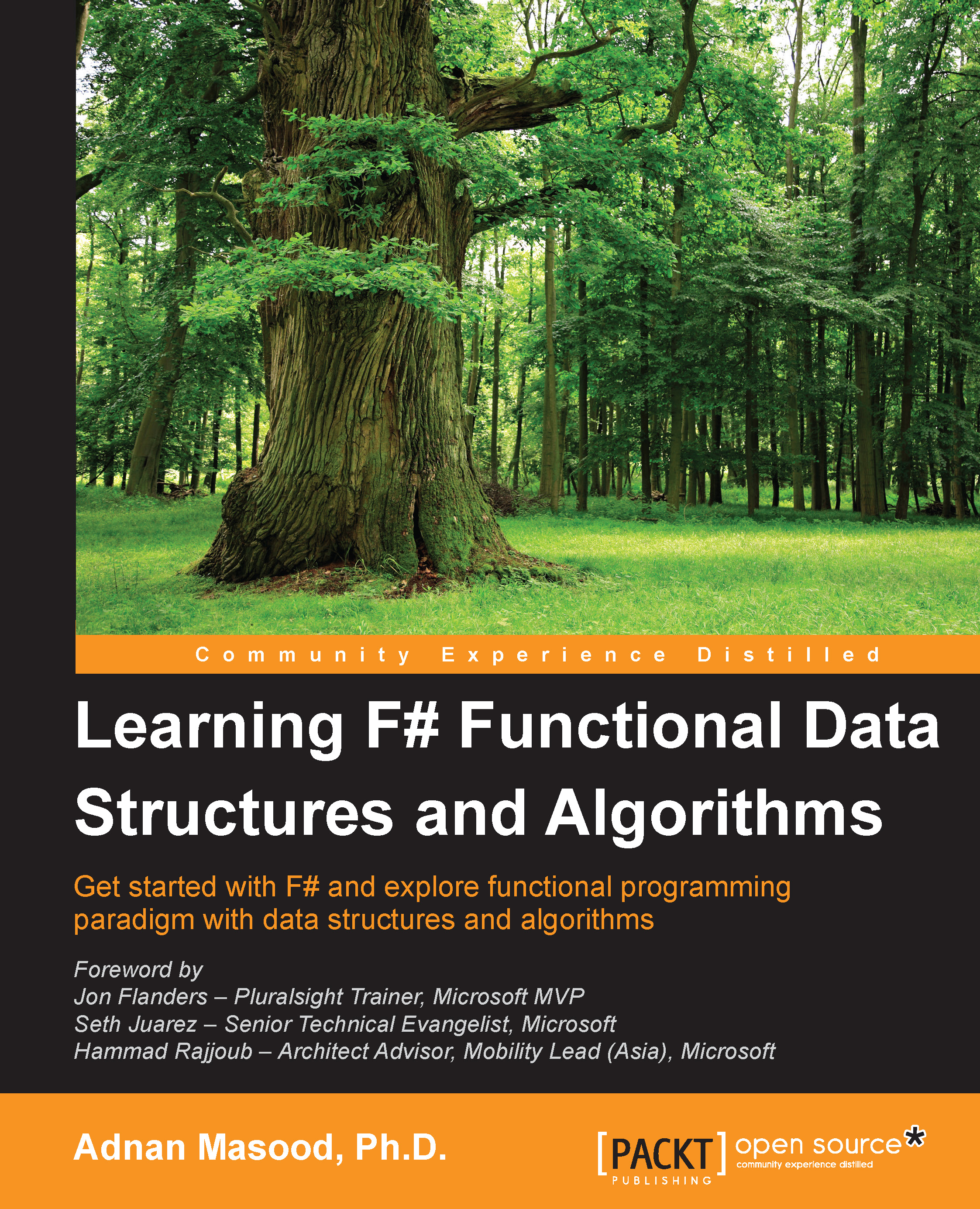
In the cover, the choice of lush landscape and central figure reminiscent of general Sherman trail is an attempt to portray the variety of programming paradigms and the potential strength of functional concepts. In the words of Ryan Bozis, learn these functional constructs, and you'll be able to program your very own forest. Being polyglot is good! Learning a new programming language broadens your thinking and provides you a competitive edge. Happy functional programming!

CONTINUE READING
83
Tech Concepts
36
Programming languages
73
Tech Tools
Icon Unlimited access to the largest independent learning library in tech of over 8,000 expert-authored tech books and videos.
Icon Innovative learning tools, including AI book assistants, code context explainers, and text-to-speech.
Icon 50+ new titles added per month and exclusive early access to books as they are being written.
Learning F# Functional Data Structures and Algorithms
notes
bookmark Notes and Bookmarks search Search in title playlist Add to playlist download Download options font-size Font size

Change the font size

margin-width Margin width

Change margin width

day-mode Day/Sepia/Night Modes

Change background colour

Close icon Search
Country selected

Close icon Your notes and bookmarks

Confirmation

Modal Close icon
claim successful

Buy this book with your credits?

Modal Close icon
Are you sure you want to buy this book with one of your credits?
Close
YES, BUY

Submit Your Feedback

Modal Close icon
Modal Close icon
Modal Close icon