Sign In Start Free Trial
Account

Add to playlist

Create a Playlist

Modal Close icon
You need to login to use this feature.
  • Book Overview & Buying Clojure Data Structures and Algorithms Cookbook
  • Table Of Contents Toc
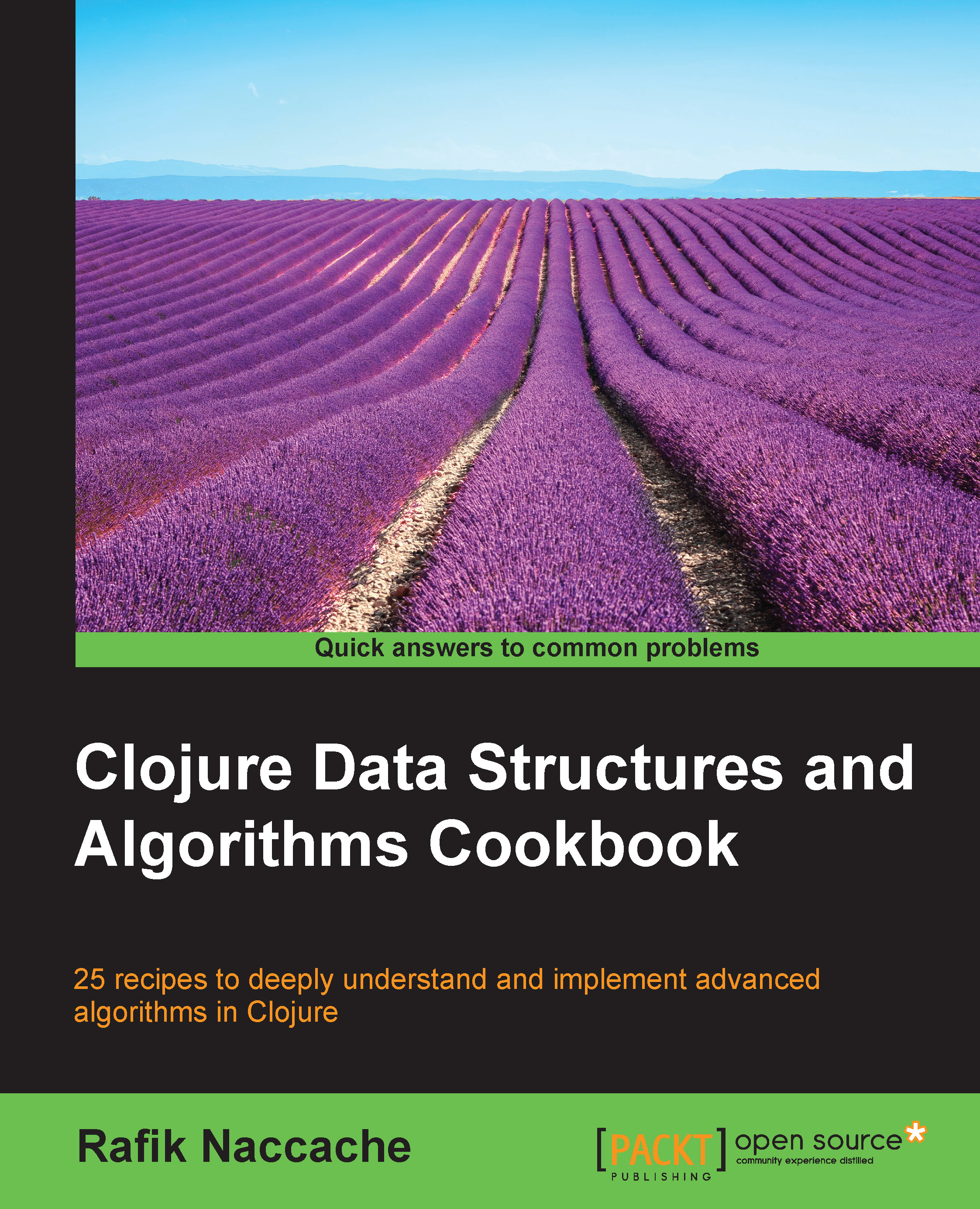
Clojure Data Structures and Algorithms Cookbook

Clojure Data Structures and Algorithms Cookbook

By : Rafik Naccache
4 (4)
close
close
Clojure Data Structures and Algorithms Cookbook

Clojure Data Structures and Algorithms Cookbook

4 (4)
By: Rafik Naccache

Overview of this book

Data-structures and algorithms often cross your path when you compress files, compile programs, access databases, or simply use your favourite text editor. Understanding and implementing them can be daunting. Curious learners and industrial developers can find these complex, especially if they focus on the detailed implementation of these data structures. Clojure is a highly pragmatic and expressive language with efficient and easy data manipulation capabilities. As such, it is great for implementing these algorithms. By abstracting away a great share of the unnecessary complexity resulting from implementation, Clojure and its contrib libraries will help you address various algorithmic challenges, making your data exploration both profitable and enjoyable. Through 25 recipes, you'll explore advanced algorithms and data-structures, well served by a sound Clojure implementation. This book opens with an exploration of alternative uses of the array data-structure, covering LZ77 compression, drawing fractals using Pascal's triangles, simulating a multi-threaded program execution, and implementing a call-stack winding and un-winding operations. The book elaborates on linked lists, showing you how to construct doubly linked ones, speed up search times over the elements of such structures, use a linked-list as the foundation of a shift-reduce parser, and implement an immutable linked-list using skew binary numbers representation. After that, the tree data-structure is explored, focusing on building self-balancing Splay Trees, designing a B-Tree backing-up an efficient key-value data-store, constructing an undo capable Rope, and showing how Tries can make for an auto-completing facility. Next, some optimization and machine learning techniques are discussed, namely for building a co-occurrence-based recommendation engine, using branch-and-bound to optimize integral cost and profit problems, using Dijkstra's algorithm to determine optimal paths and summarizing texts using the LexRank algorithm. Particular attention is given to logic programming, you will learn to use this to discover interesting relations between social website data, by designing a simple type inferencer for a mini Java-like language, and by building a simple checkers game engine. Asynchronous programming will be addressed and you will design a concurrent web-crawler, an interactive HTML5 game, and an online taxi booking platform. Finally, you'll explore advanced cases for higher order functions in Clojure while implementing a recursive descent parser using efficient mutual resucrsion, devising a mini resusable firewall simulator thanks to Clojure 1.7 new tansducers feature or building a simple unification engine with the help of Continuation Passing Style.
Table of Contents (9 chapters)
close
close
8
Index

Introduction

In this book, we will go on a journey through the broad land of algorithms and data structures, taking a ride on the comfortable vehicle that is Clojure programming language.

First, we will take a look at arrays, exploring their particular structures to tackle problems as interesting as compression, fractal drawing, multithreading, and call stacks.

Then we will elaborate on linked lists, transforming them in to doubly linked lists. We will do this to speed up access to their elements, build parsers, and devise fast random access.

The next step of our trip will concern trees of data. We'll show you how to implement self-balancing red-black trees, how to design efficient key-value stores — thanks to B-trees (way to go in order to design undo-capable text editors), and lastly, a methodology to construct autocomplete text typing systems.

After that, we'll focus on exploring some optimization and machine-learning techniques. We will see how to set up a recommendation engine, the way to go to optimize a problem where costs and profits are involved, a methodology to find the best possible paths in graphs, and how to summarize texts.

Then we'll study the topic of logic programming, analyzing some website traffic logs to detect visitors of interest to us. Doing this, we'll dive into the problem of type inferencing for the Java language, and simulate a turn of a checkers game.

At that point, we'll talk about asynchronous programming as a means of tackling difficult problems. We'll build a tiny web spider, design an interactive HTML5 game, and design a complex online taxi-booking solution.

The last rally point of this trip, but certainly not the least, is that we'll have a look at the higher order functions and transducers at the heart of Clojure. We'll design a recursive descent parser using a trampoline, build a reusable mini firewall thanks to transducers, and lastly, explore the continuation passing style as a tool to design a simple unification engine.

This will be quite a tour, in which we will bring to life various real-world use cases related to the essential theory of computing as far as data structures and algorithms are involved, which are all served by the high expressive power of Clojure. By the end of this book, you'll be familiar with many of the advanced concepts that fuel most of the nontrivial applications of our world while you enhance your mastery of Clojure!

CONTINUE READING
83
Tech Concepts
36
Programming languages
73
Tech Tools
Icon Unlimited access to the largest independent learning library in tech of over 8,000 expert-authored tech books and videos.
Icon Innovative learning tools, including AI book assistants, code context explainers, and text-to-speech.
Icon 50+ new titles added per month and exclusive early access to books as they are being written.
Clojure Data Structures and Algorithms Cookbook
notes
bookmark Notes and Bookmarks search Search in title playlist Add to playlist font-size Font size

Change the font size

margin-width Margin width

Change margin width

day-mode Day/Sepia/Night Modes

Change background colour

Close icon Search
Country selected

Close icon Your notes and bookmarks

Confirmation

Modal Close icon
claim successful

Buy this book with your credits?

Modal Close icon
Are you sure you want to buy this book with one of your credits?
Close
YES, BUY

Submit Your Feedback

Modal Close icon
Modal Close icon
Modal Close icon