Sign In Start Free Trial
Account

Add to playlist

Create a Playlist

Modal Close icon
You need to login to use this feature.
  • Book Overview & Buying Clojure Data Structures and Algorithms Cookbook
  • Table Of Contents Toc
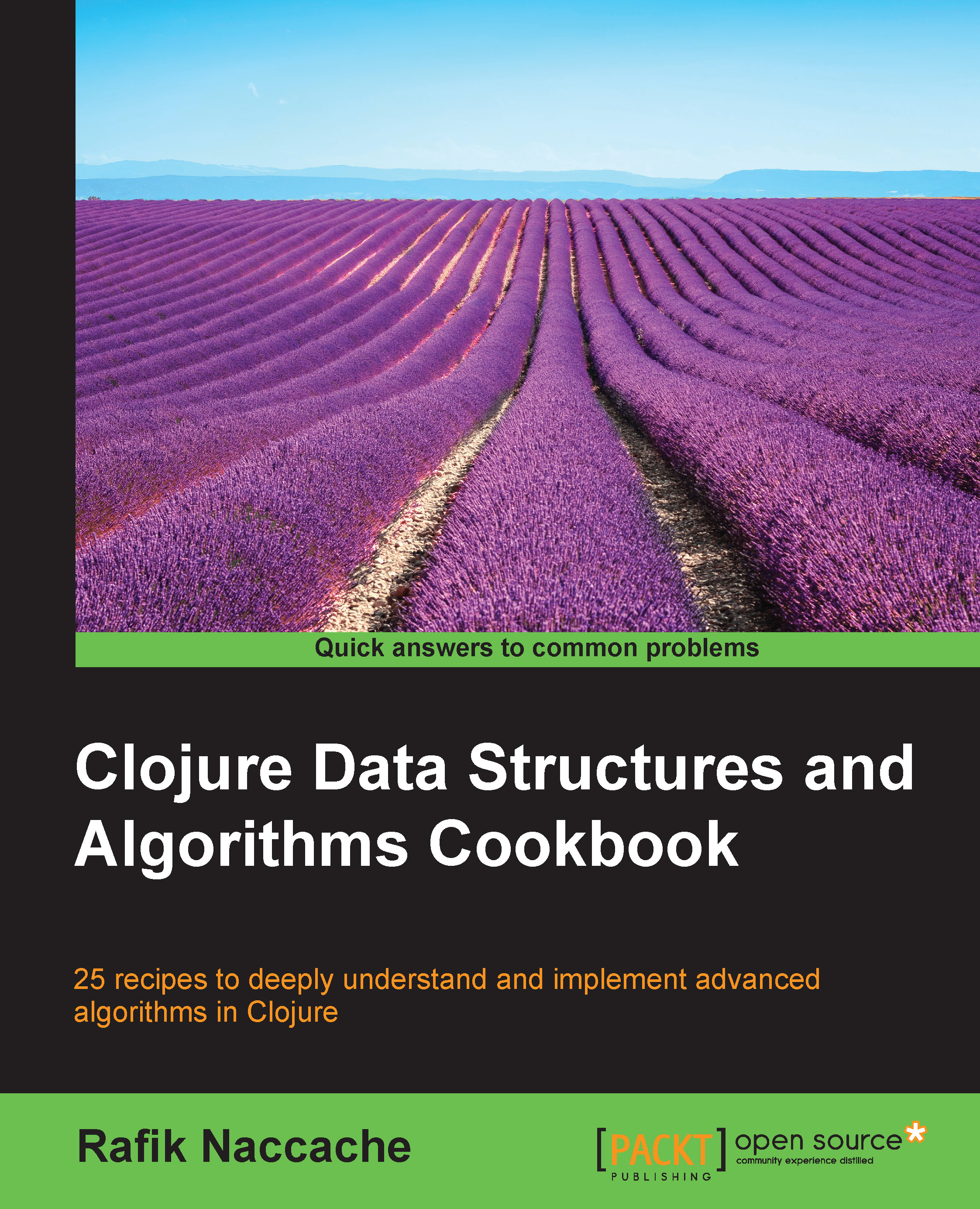
Clojure Data Structures and Algorithms Cookbook

Clojure Data Structures and Algorithms Cookbook

By : Rafik Naccache
4 (4)
close
close
Clojure Data Structures and Algorithms Cookbook

Clojure Data Structures and Algorithms Cookbook

4 (4)
By: Rafik Naccache

Overview of this book

Data-structures and algorithms often cross your path when you compress files, compile programs, access databases, or simply use your favourite text editor. Understanding and implementing them can be daunting. Curious learners and industrial developers can find these complex, especially if they focus on the detailed implementation of these data structures. Clojure is a highly pragmatic and expressive language with efficient and easy data manipulation capabilities. As such, it is great for implementing these algorithms. By abstracting away a great share of the unnecessary complexity resulting from implementation, Clojure and its contrib libraries will help you address various algorithmic challenges, making your data exploration both profitable and enjoyable. Through 25 recipes, you'll explore advanced algorithms and data-structures, well served by a sound Clojure implementation. This book opens with an exploration of alternative uses of the array data-structure, covering LZ77 compression, drawing fractals using Pascal's triangles, simulating a multi-threaded program execution, and implementing a call-stack winding and un-winding operations. The book elaborates on linked lists, showing you how to construct doubly linked ones, speed up search times over the elements of such structures, use a linked-list as the foundation of a shift-reduce parser, and implement an immutable linked-list using skew binary numbers representation. After that, the tree data-structure is explored, focusing on building self-balancing Splay Trees, designing a B-Tree backing-up an efficient key-value data-store, constructing an undo capable Rope, and showing how Tries can make for an auto-completing facility. Next, some optimization and machine learning techniques are discussed, namely for building a co-occurrence-based recommendation engine, using branch-and-bound to optimize integral cost and profit problems, using Dijkstra's algorithm to determine optimal paths and summarizing texts using the LexRank algorithm. Particular attention is given to logic programming, you will learn to use this to discover interesting relations between social website data, by designing a simple type inferencer for a mini Java-like language, and by building a simple checkers game engine. Asynchronous programming will be addressed and you will design a concurrent web-crawler, an interactive HTML5 game, and an online taxi booking platform. Finally, you'll explore advanced cases for higher order functions in Clojure while implementing a recursive descent parser using efficient mutual resucrsion, devising a mini resusable firewall simulator thanks to Clojure 1.7 new tansducers feature or building a simple unification engine with the help of Continuation Passing Style.
Table of Contents (9 chapters)
close
close
8
Index

Preface

The invention of Lisp by John McCarthy in 1958 is certainly one of the most seminal events in the history of computer science. Originally intended as a way of porting Alonzo Church's lambda calculus theory into the realm of computer programs, Lisp pioneered many original ideas, such as higher order functions, recursion, and even garbage collection that proved to be so highly pragmatic that practically every modern high-level programming language of today is very likely built on some significant Lisp legacy.

However, beyond any practical or technical contribution, Lisp's most important trait is undeniably its unparalleled expressiveness. It's simplistic, yet its extremely elegant syntax propels it as a privileged tool for creative computer scientists, one which you could use as a powerful "building material" to erect algorithmic monuments without worrying about ancillary implementation details. It's certainly this ability of abstracting away "incidental complexity" that made Lisp the language for conducting Artificial Intelligence experiments, for instance.

Clojure, as a modern Lisp language, leverages this extraordinary expressive power to provide a platform that is highly suitable for algorithmic exploration. The abstractions it offers, the functional approach it suggests, as well as the built-in concurrency it supports, are all valuable facilities that enable straight and noise-free problem solving, which is an alternative way of approaching algorithms' design and sometimes, even innovative out-of-the-box thinking.

This book tries to underpin this idea. Using Clojure, we'll consider seven areas of algorithmic challenges and try to address them by taking advantage of all the power that we can get from this Lisp dialect. Besides, while choosing these seven problem domains, I tried to attain two main objectives. First, I wanted to tackle algorithms that have concrete real-world usage, and theory in the recipes will only be present to serve well-defined use cases in our everyday work with computers. Second, I tried to come up with material as varied as possible, so that the recipes cover a wide range of topics, from compressing files and building parsers to designing HTML5 interactive games and assembling type inferencers.

As far as the recipes' general layout is concerned, at the beginning, you will be given a thorough introduction to the intuition and the theory behind the algorithm being studied. Then, I will elaborate on every recipe's detail, making sure that I've explained every step and extensively commented the code. At the end of every recipe, you will see a sample usage of what has been implemented. This way, you will be guided through the whole process: the algorithm inception, its implementation, and its testing. In this process, I hope to have had mirrored the Clojure interactive workflow, in which the developer builds their program function by function, going back and forth to his/her REPL.

I really enjoyed the process of writing this book. I can, for sure, assert that the Clojure promise of high expressive power has been fulfilled for this particular project, as I came up with quite complex algorithmic implementations with reasonable effort while being really productive. My only wish is that you, by the end of this work, will be as convinced by Clojure and Lisp as I am.

You can reach me at @turbopape on Twitter, I'll answer, with extreme pleasure, all your questions.

CONTINUE READING
83
Tech Concepts
36
Programming languages
73
Tech Tools
Icon Unlimited access to the largest independent learning library in tech of over 8,000 expert-authored tech books and videos.
Icon Innovative learning tools, including AI book assistants, code context explainers, and text-to-speech.
Icon 50+ new titles added per month and exclusive early access to books as they are being written.
Clojure Data Structures and Algorithms Cookbook
notes
bookmark Notes and Bookmarks search Search in title playlist Add to playlist font-size Font size

Change the font size

margin-width Margin width

Change margin width

day-mode Day/Sepia/Night Modes

Change background colour

Close icon Search
Country selected

Close icon Your notes and bookmarks

Confirmation

Modal Close icon
claim successful

Buy this book with your credits?

Modal Close icon
Are you sure you want to buy this book with one of your credits?
Close
YES, BUY

Submit Your Feedback

Modal Close icon
Modal Close icon
Modal Close icon