Sign In Start Free Trial
Account

Add to playlist

Create a Playlist

Modal Close icon
You need to login to use this feature.
  • Book Overview & Buying Swift High Performance
  • Table Of Contents Toc
  • Feedback & Rating feedback
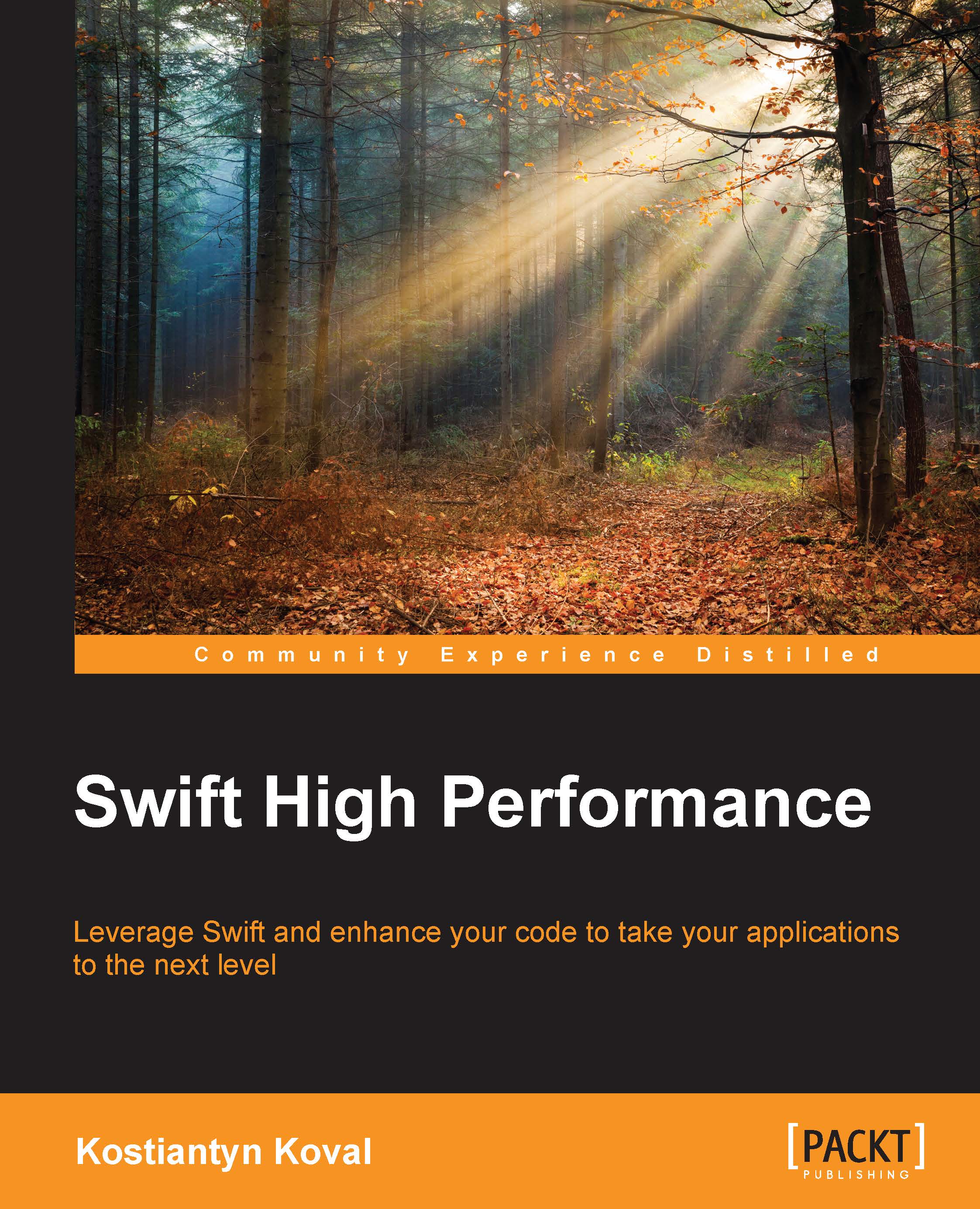
Swift High Performance

Swift High Performance

By : Koval
4 (8)
close
close
Swift High Performance

Swift High Performance

4 (8)
By: Koval

Overview of this book

Swift is one of the most popular and powerful programming languages for building iOS and Mac OS applications, and continues to evolve with new features and capabilities. Swift is considered a replacement to Objective-C and has performance advantages over Objective-C and Python. Swift adopts safe programming patterns and adds modern features to make programming easier, more flexible, and more fun. Develop Swift and discover best practices that allow you to build solid applications and optimize their performance. First, a few of performance characteristics of Swift will be explained. You will implement new tools available in Swift, including Playgrounds and REPL. These will improve your code efficiency, enable you to analyse Swift code, and enhance performance. Next, the importance of building solid applications using multithreading concurrency and multi-core device architecture is covered, before moving on to best practices and techniques that you should utilize when building high performance applications, such as concurrency and lazy-loading. Finally, you will explore the underlying structure of Swift further, and learn how to disassemble and compile Swift code.
Table of Contents (10 chapters)
close
close
9
Index

Intelligent code


Because Swift is a static and strongly typed language it can read, understand, and optimize code very well. Swift tries to remove the execution of all unnecessary code. For a better explanation let's have a look at a simple example:

class Object {
 
  func nothing() {  
  }
}

let object = Object()
object.nothing()
object.nothing()

We create an instance of the Object class and call a nothing method. The nothing method is empty and calling it does nothing. The Swift compiler understands that and removes those method calls. After this we have only one line of code:

let object = Object()

The Swift compiler can also obviate the creation of objects that are never used. It reduces memory usage and unnecessary function calls, which also reduces CPU usage. In our example the object instance is not used after removing the nothing method call and the creation of Object can be dispensed with as well. This way, Swift removes all three lines of code and we end up with no code to execute...

Visually different images
CONTINUE READING
83
Tech Concepts
36
Programming languages
73
Tech Tools
Icon Unlimited access to the largest independent learning library in tech of over 8,000 expert-authored tech books and videos.
Icon Innovative learning tools, including AI book assistants, code context explainers, and text-to-speech.
Icon 50+ new titles added per month and exclusive early access to books as they are being written.
Swift High Performance
notes
bookmark Notes and Bookmarks search Search in title playlist Add to playlist font-size Font size

Change the font size

margin-width Margin width

Change margin width

day-mode Day/Sepia/Night Modes

Change background colour

Close icon Search
Country selected

Close icon Your notes and bookmarks

Confirmation

Modal Close icon
claim successful

Buy this book with your credits?

Modal Close icon
Are you sure you want to buy this book with one of your credits?
Close
YES, BUY

Submit Your Feedback

Modal Close icon
Modal Close icon
Modal Close icon