Sign In Start Free Trial
Account

Add to playlist

Create a Playlist

Modal Close icon
You need to login to use this feature.
  • Book Overview & Buying Entity Framework Core Cookbook
  • Table Of Contents Toc
Entity Framework Core Cookbook

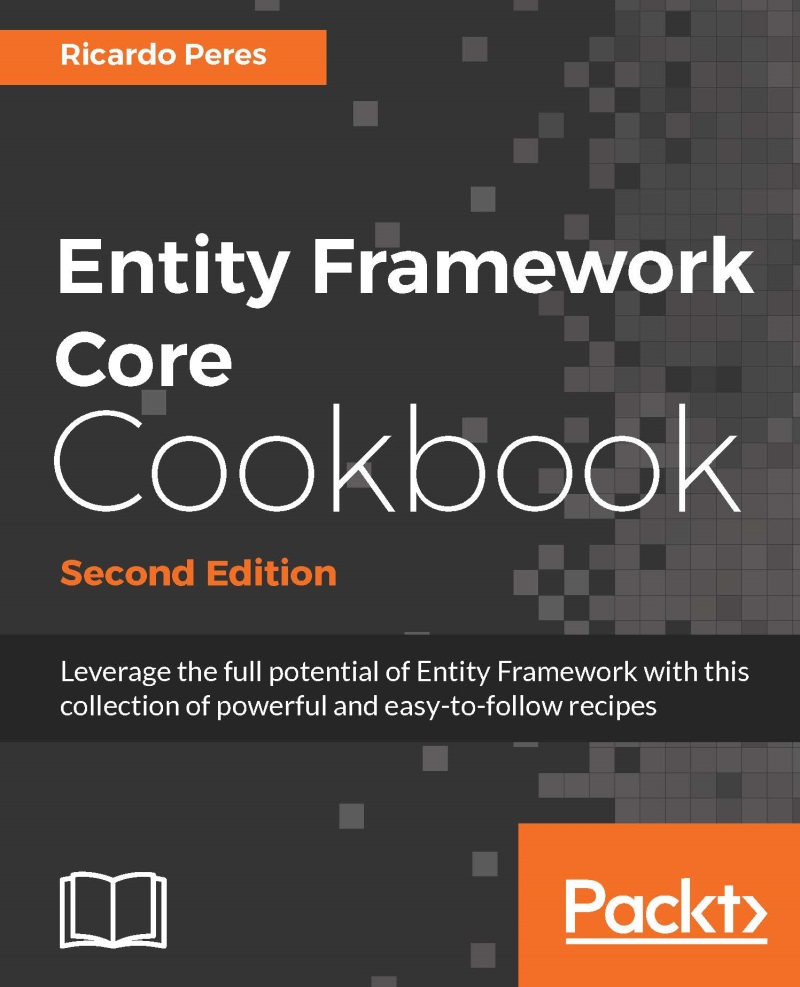
Entity Framework Core Cookbook - Second Edition

By : Peres
2 (3)
close
close
Entity Framework Core Cookbook

Entity Framework Core Cookbook

2 (3)
By: Peres

Overview of this book

Entity Framework is a highly recommended Object Relation Mapping tool used to build complex systems. In order to survive in this growing market, the knowledge of a framework that helps provide easy access to databases, that is, Entity Framework has become a necessity. This book will provide .NET developers with this knowledge and guide them through working efficiently with data using Entity Framework Core. You will start off by learning how to efficiently use Entity Framework in practical situations. You will gain a deep understanding of mapping properties and find out how to handle validation in Entity Framework. The book will then explain how to work with transactions and stored procedures along with improving Entity Framework using query libraries. Moving on, you will learn to improve complex query scenarios and implement transaction and concurrency control. You will then be taught to improve and develop Entity Framework in complex business scenarios. With the concluding chapter on performance and scalability, this book will get you ready to use Entity Framework proficiently.
Table of Contents (10 chapters)
close
close
9
Index

Database null semantics

Doing comparisons with NULL can yield unexpected results.

Problem

Relational database engines treat the NULL case differently. NULL is not a value; rather, it is the absence of a value, so the syntax around it is special. To check if a column value is NULL, this is the syntax we use:

SELECT * FROM MyTable WHERE MyCol IS NULL

Entity Framework, as with other Object-Relational Mappers, has to take this into account. So, what happens if we issue a LINQ query that needs to be executed with a parameter value that may be null? Let's consider this query:

var name = GetParameterValue();
var records = ctx
  .MyEntities
  .Where(x => x.Name == name)
  .ToList();

By default, it will produce the following SQL:

SELECT [x].[Id] AS Id, [x].[Name] AS Name
FROM [dbo].[MyEntities] AS [x]
WHERE ([x].[Name] == @__name_0)
OR (([x].[Name] IS NULL) AND ((@__name_0 IS NULL))

This is hardly ideal and it is caused by the fact that, when the SQL is being generated, Entity Framework does not...

CONTINUE READING
83
Tech Concepts
36
Programming languages
73
Tech Tools
Icon Unlimited access to the largest independent learning library in tech of over 8,000 expert-authored tech books and videos.
Icon Innovative learning tools, including AI book assistants, code context explainers, and text-to-speech.
Icon 50+ new titles added per month and exclusive early access to books as they are being written.
Entity Framework Core Cookbook
notes
bookmark Notes and Bookmarks search Search in title playlist Add to playlist download Download options font-size Font size

Change the font size

margin-width Margin width

Change margin width

day-mode Day/Sepia/Night Modes

Change background colour

Close icon Search
Country selected

Close icon Your notes and bookmarks

Confirmation

Modal Close icon
claim successful

Buy this book with your credits?

Modal Close icon
Are you sure you want to buy this book with one of your credits?
Close
YES, BUY

Submit Your Feedback

Modal Close icon
Modal Close icon
Modal Close icon