Sign In Start Free Trial
Account

Add to playlist

Create a Playlist

Modal Close icon
You need to login to use this feature.
  • Book Overview & Buying Swift Data Structure and Algorithms
  • Table Of Contents Toc
Swift Data Structure and Algorithms

Swift Data Structure and Algorithms

By : Erik Azar, Mario Eguiluz Alebicto
3.7 (3)
close
close
Swift Data Structure and Algorithms

Swift Data Structure and Algorithms

3.7 (3)
By: Erik Azar, Mario Eguiluz Alebicto

Overview of this book

Apple’s Swift language has expressive features that are familiar to those working with modern functional languages, but also provides backward support for Objective-C and Apple’s legacy frameworks. These features are attracting many new developers to start creating applications for OS X and iOS using Swift. Designing an application to scale while processing large amounts of data or provide fast and efficient searching can be complex, especially running on mobile devices with limited memory and bandwidth. Learning about best practices and knowing how to select the best data structure and algorithm in Swift is crucial to the success of your application and will help ensure your application is a success. That’s what this book will teach you. Starting at the beginning, this book will cover the basic data structures and Swift types, and introduce asymptotic analysis. You’ll learn about the standard library collections and bridging between Swift and Objective-C collections. You will see how to implement advanced data structures, sort algorithms, work with trees, advanced searching methods, use graphs, and performance and algorithm efficiency. You’ll also see how to choose the perfect algorithm for your problem.
Table of Contents (10 chapters)
close
close

Data types in Swift

If you have programmed in other languages, such as C or its superset languages such as Objective-C or C++, you're probably familiar with the built-in primitive data types those languages provide. A primitive data type is generally a scalar type, which contains a single value. Examples of scalar data types are int, float, double, char, and bool. In Swift however, its primitive types are not implemented as scalar types. In this section, we'll discuss the fundamental types that Swift supports and how these are different from other popular languages.

Value types and reference types

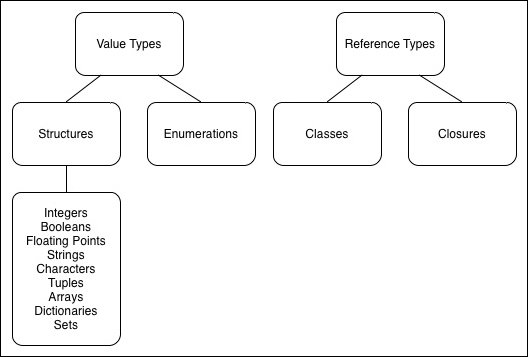
Swift has two fundamental types: value types and reference types. Value types are a type whose value is copied when it is assigned to a variable or constant, or when it is passed to a function. Value types have only one owner. Value types include structures and enumerations. All of Swift's basic types are implemented as structures.

Reference types, unlike value types, are not copied on assignment but are shared. Instead of a copy being made when assigning a variable or passing to a function, a reference to the same existing instance is used. Reference types have multiple owners.

The Swift standard library defines many commonly used native types such as int, double, float, string, character, bool, array, dictionary, and set.

Value types and reference types

It's important to remember though that the preceding types, unlike in other languages, are not primitive types. They are actually named types, defined and implemented in the Swift standard library as structures. We'll discuss named types in the following section.

Named and compound types

In Swift, types are also classified as named types and compound types. A named type is a type that can be user-defined and given a particular name when it's defined. Named types include classes, structures, enumerations, and protocols. In addition to user-defined named types, the Swift standard library also includes named types that represent arrays, dictionaries, sets, and optional values. Named types can also have their behavior extended by using an extension declaration.

Named and compound types

Compound types are types without a name, In Swift, the language defines two compound types: function types and type types. A compound type can contain both named types, and other compound types. As an example, the following tuple type contains two elements: the first is the named type Int, and the second is another compound type (Float, Float):

(Int, (Float, Float))

Type aliases

Type aliases define an alternative name for existing types. The typealias keyword is similar to typedef in C-based languages. Type aliases are useful when working with existing types that you want to be more contextually appropriate to the domain you are working in. For example, the following associates the identifier TCPPacket with the type UInt16:

typealias TCPPacket = UInt16

Once you define a type alias you can use the alias anywhere you would use the original type:

1> typealias TCPPacket = UInt16
2> var maxTCPPacketSize = TCPPacket.max
maxTCPPacketSize: UInt16 = 65535

Collection types in the Swift standard library

Swift provides three types of collections: arrays, dictionaries, and sets. There is one additional type we'll also discuss, even though it's technically not a collection—tuples, which allow for the grouping of multiple values into a compound value. The values that are ordered can be of any type and do not have to be of the same type as each other. We'll look at these collection classes in depth in the next chapter.

CONTINUE READING
83
Tech Concepts
36
Programming languages
73
Tech Tools
Icon Unlimited access to the largest independent learning library in tech of over 8,000 expert-authored tech books and videos.
Icon Innovative learning tools, including AI book assistants, code context explainers, and text-to-speech.
Icon 50+ new titles added per month and exclusive early access to books as they are being written.
Swift Data Structure and Algorithms
notes
bookmark Notes and Bookmarks search Search in title playlist Add to playlist download Download options font-size Font size

Change the font size

margin-width Margin width

Change margin width

day-mode Day/Sepia/Night Modes

Change background colour

Close icon Search
Country selected

Close icon Your notes and bookmarks

Confirmation

Modal Close icon
claim successful

Buy this book with your credits?

Modal Close icon
Are you sure you want to buy this book with one of your credits?
Close
YES, BUY

Submit Your Feedback

Modal Close icon
Modal Close icon
Modal Close icon