Sign In Start Free Trial
Account

Add to playlist

Create a Playlist

Modal Close icon
You need to login to use this feature.
  • Book Overview & Buying Swift Data Structure and Algorithms
  • Table Of Contents Toc
Swift Data Structure and Algorithms

Swift Data Structure and Algorithms

By : Alebicto
3.7 (3)
close
close
Swift Data Structure and Algorithms

Swift Data Structure and Algorithms

3.7 (3)
By: Alebicto

Overview of this book

Apple’s Swift language has expressive features that are familiar to those working with modern functional languages, but also provides backward support for Objective-C and Apple’s legacy frameworks. These features are attracting many new developers to start creating applications for OS X and iOS using Swift. Designing an application to scale while processing large amounts of data or provide fast and efficient searching can be complex, especially running on mobile devices with limited memory and bandwidth. Learning about best practices and knowing how to select the best data structure and algorithm in Swift is crucial to the success of your application and will help ensure your application is a success. That’s what this book will teach you. Starting at the beginning, this book will cover the basic data structures and Swift types, and introduce asymptotic analysis. You’ll learn about the standard library collections and bridging between Swift and Objective-C collections. You will see how to implement advanced data structures, sort algorithms, work with trees, advanced searching methods, use graphs, and performance and algorithm efficiency. You’ll also see how to choose the perfect algorithm for your problem.
Table of Contents (10 chapters)
close
close

Prim algorithm

It was Robert C. Prim in 1957 who gave his surname to Prim's algorithm, which takes an undirected connected graph and calculates its MST in linear time.

Other algorithms, such as Kruskal and Borûvka, also calculate the MST of a graph, but in these cases the initial graph is a forest, not an undirected connected graph, which is what we are going to try out now.

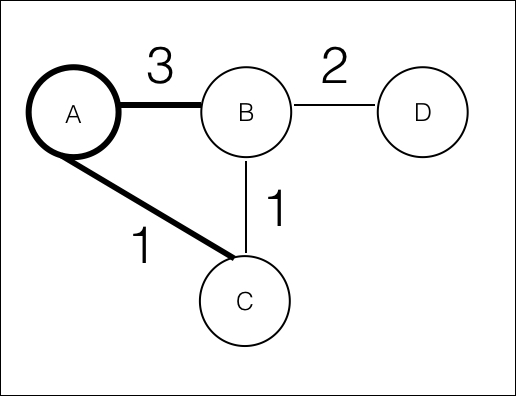
Let's see how Prim's algorithm works with a real example. Here's a graph G with the following vertices, edges, and weights:

Prim algorithm

Initial undirected connected graph

Here are the steps to calculate the MST:

  1. Start with an arbitrary vertex of the graph. For clarity, we are going to start with vertex A. Initialize a tree with that vertex:

    Prim algorithm

    Prim Step 1: Start with an arbitrary vertex

  2. For each edge of the selected node, take the edge with the minimum weight, which points to a node that is not visited. In our case, we get the edge from A to C. Then mark C as visited and save that edge as part...
Visually different images
CONTINUE READING
83
Tech Concepts
36
Programming languages
73
Tech Tools
Icon Unlimited access to the largest independent learning library in tech of over 8,000 expert-authored tech books and videos.
Icon Innovative learning tools, including AI book assistants, code context explainers, and text-to-speech.
Icon 50+ new titles added per month and exclusive early access to books as they are being written.
Swift Data Structure and Algorithms
notes
bookmark Notes and Bookmarks search Search in title playlist Add to playlist download Download options font-size Font size

Change the font size

margin-width Margin width

Change margin width

day-mode Day/Sepia/Night Modes

Change background colour

Close icon Search
Country selected

Close icon Your notes and bookmarks

Confirmation

Modal Close icon
claim successful

Buy this book with your credits?

Modal Close icon
Are you sure you want to buy this book with one of your credits?
Close
YES, BUY

Submit Your Feedback

Modal Close icon
Modal Close icon
Modal Close icon