Sign In Start Free Trial
Account

Add to playlist

Create a Playlist

Modal Close icon
You need to login to use this feature.
  • Book Overview & Buying F# 4.0 Design Patterns
  • Table Of Contents Toc
F# 4.0 Design Patterns

F# 4.0 Design Patterns

By : Gene Belitski
3.5 (4)
close
close
F# 4.0 Design Patterns

F# 4.0 Design Patterns

3.5 (4)
By: Gene Belitski

Overview of this book

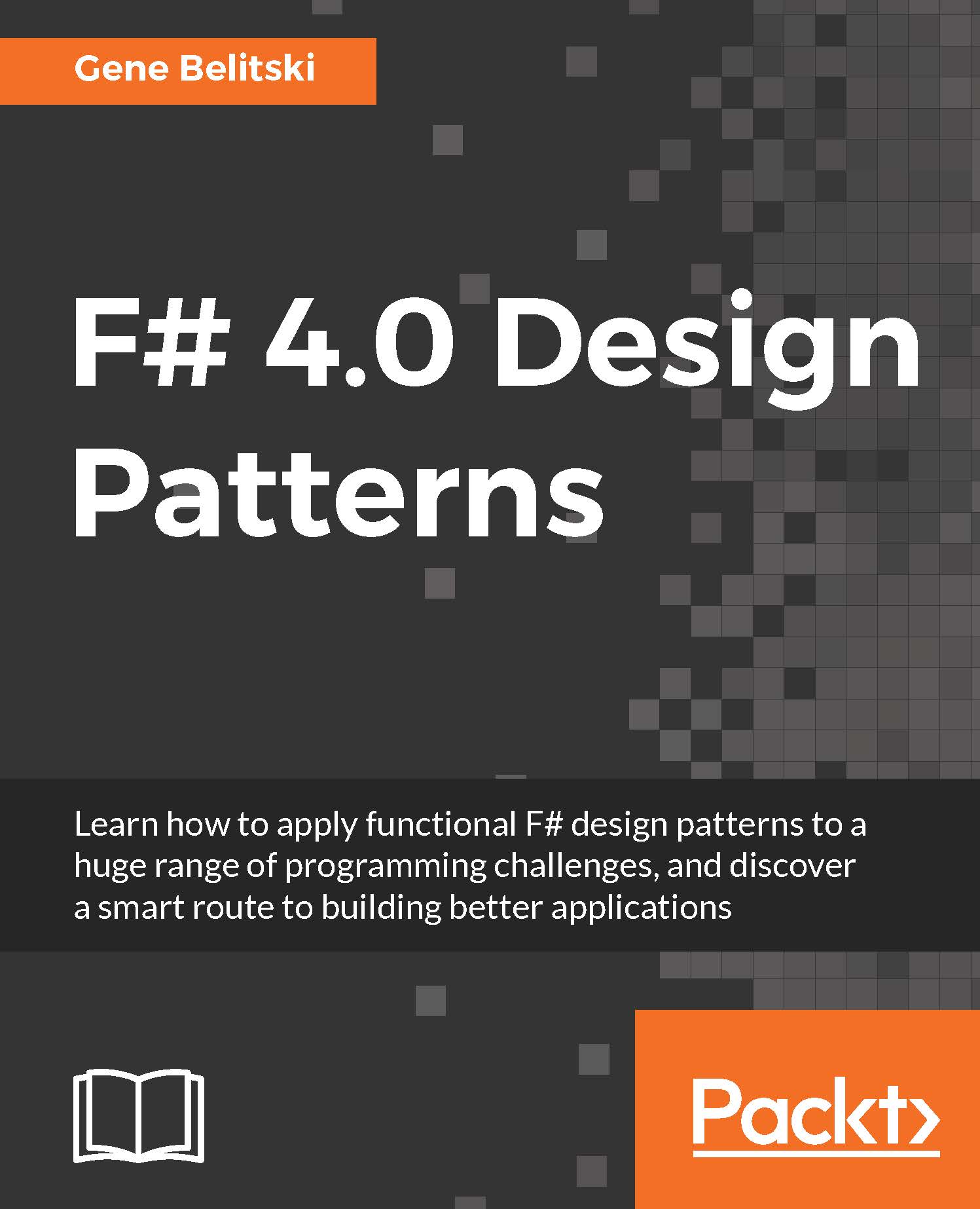
Following design patterns is a well-known approach to writing better programs that captures and reuses high-level abstractions that are common in many applications. This book will encourage you to develop an idiomatic F# coding skillset by fully embracing the functional-first F# paradigm. It will also help you harness this powerful instrument to write succinct, bug-free, and cross-platform code. F# 4.0 Design Patterns will start off by helping you develop a functional way of thinking. We will show you how beneficial the functional-first paradigm is and how to use it to get the optimum results. The book will help you acquire the practical knowledge of the main functional design patterns, the relationship of which with the traditional Gang of Four set is not straightforward. We will take you through pattern matching, immutable data types, and sequences in F#. We will also uncover advanced functional patterns, look at polymorphic functions, typical data crunching techniques, adjusting code through augmentation, and generalization. Lastly, we will take a look at the advanced techniques to equip you with everything you need to write flawless code.
Table of Contents (14 chapters)
close
close

Chapter 1. Begin Thinking Functionally

A man with a chainsaw enters a hardware shop and says to the assistant: "Two weeks ago, you told me this thing would allow me to chop down 30 trees in an hour. But I can only manage one tree. I want to return this for a refund". The assistant says "let me see" and starts the chainsaw. The visitor jumps back screaming "What's that noise?!"-An old joke

The joke opening my narrative is very relevant to the subject of this chapter: in order to achieve the benefits expected from the use of any tool, you should know how to use that tool the right way. Moreover, an advanced tool used in a wrong manner may be even less productive than the corresponding simple one used the right way. A hammer outperforms a microscope when it comes to nailing wooden boards together.

Chapter 1, Begin Thinking Functionally, should help you develop a manner of solving day-to-day software engineering problems that are usually associated with the functional paradigm. This means presenting the solution by verbs rather than nouns, avoiding the use of mutable entities to carry states, avoiding relying upon side-effects, and minimizing the amount of moving parts in the code.

In this chapter, we will cover the following topics:

  • The multi-paradigm nature of F#
  • A comparison of F# paradigms by solving the sample problem applying:
    • An imperative monolithic solution
    • An object-oriented solution
    • A functional solution
  • Properties of the functional paradigm

I will wrap up this chapter with a list of key concepts to retain and recognize, as well as skills to reuse in your functional solutions.

Visually different images
CONTINUE READING
83
Tech Concepts
36
Programming languages
73
Tech Tools
Icon Unlimited access to the largest independent learning library in tech of over 8,000 expert-authored tech books and videos.
Icon Innovative learning tools, including AI book assistants, code context explainers, and text-to-speech.
Icon 50+ new titles added per month and exclusive early access to books as they are being written.
F# 4.0 Design Patterns
notes
bookmark Notes and Bookmarks search Search in title playlist Add to playlist font-size Font size

Change the font size

margin-width Margin width

Change margin width

day-mode Day/Sepia/Night Modes

Change background colour

Close icon Search
Country selected

Close icon Your notes and bookmarks

Confirmation

Modal Close icon
claim successful

Buy this book with your credits?

Modal Close icon
Are you sure you want to buy this book with one of your credits?
Close
YES, BUY

Submit Your Feedback

Modal Close icon
Modal Close icon
Modal Close icon