Sign In Start Free Trial
Account

Add to playlist

Create a Playlist

Modal Close icon
You need to login to use this feature.
  • Book Overview & Buying Haskell High Performance Programming
  • Table Of Contents Toc
  • Feedback & Rating feedback
Haskell High Performance Programming

Haskell High Performance Programming

By : Thomasson
3 (2)
close
close
Haskell High Performance Programming

Haskell High Performance Programming

3 (2)
By: Thomasson

Overview of this book

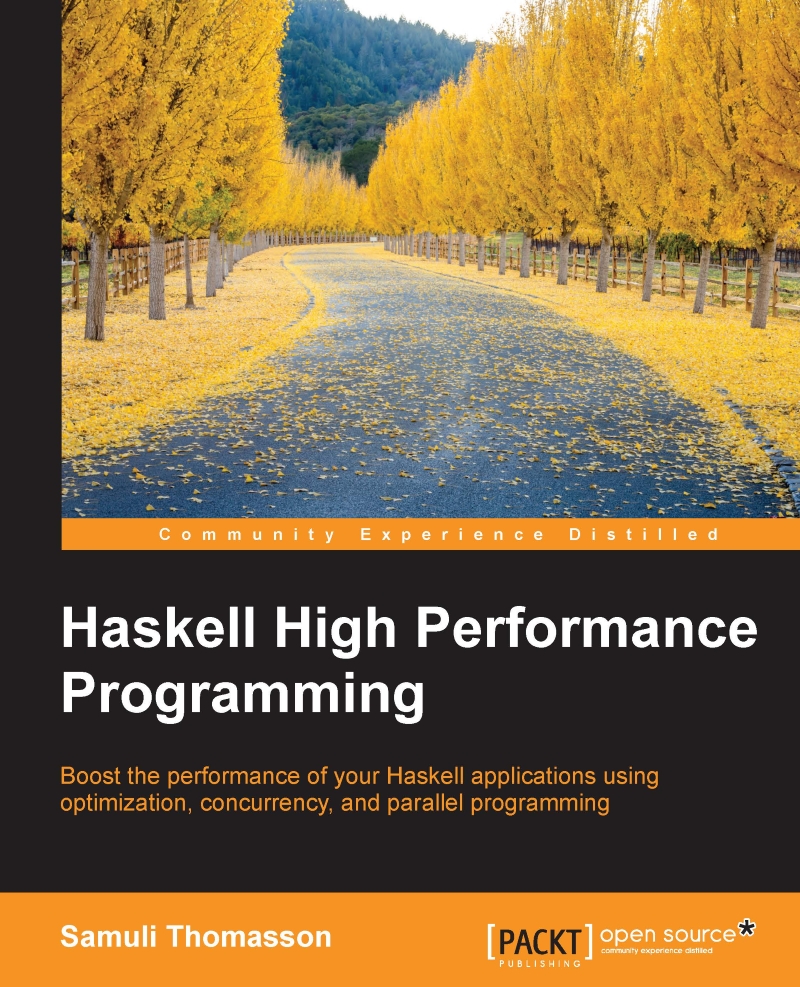
Haskell, with its power to optimize the code and its high performance, is a natural candidate for high performance programming. It is especially well suited to stacking abstractions high with a relatively low performance cost. This book addresses the challenges of writing efficient code with lazy evaluation and techniques often used to optimize the performance of Haskell programs. We open with an in-depth look at the evaluation of Haskell expressions and discuss optimization and benchmarking. You will learn to use parallelism and we'll explore the concept of streaming. We’ll demonstrate the benefits of running multithreaded and concurrent applications. Next we’ll guide you through various profiling tools that will help you identify performance issues in your program. We’ll end our journey by looking at GPGPU, Cloud and Functional Reactive Programming in Haskell. At the very end there is a catalogue of robust library recommendations with code samples. By the end of the book, you will be able to boost the performance of any app and prepare it to stand up to real-world punishment.
Table of Contents (16 chapters)
close
close
15
Index

Handling binary and textual data

The smallest piece of data is a bit (0 or 1), which is isomorphic to Bool (True or False). When you need just one bit, a Bool should be your choice. If you need a few bits, then a tuple of Bools will fit the purpose when performance is not critical. A [Bool] is sometimes convenient, but should only be chosen for convenience in some situations.

For high-performance binary data, you could define your own data type with strict Bool fields. But this has an important caveat, namely that Bool is not a primitive but an algebraic data type:

data Bool = False | True

The consequence is that you cannot unpack a Bool similar to how you could an Int or Double. In Haskell, Bool values will always be represented by pointers. Fortunately for many bit-fiddling applications, you can define a data type like this:

data BitStruct = BitStore !Bool !Bool !Bool

This will get respectable performance. However, if you need a whole array of bits it quickly becomes inconvenient to define...

Visually different images
CONTINUE READING
83
Tech Concepts
36
Programming languages
73
Tech Tools
Icon Unlimited access to the largest independent learning library in tech of over 8,000 expert-authored tech books and videos.
Icon Innovative learning tools, including AI book assistants, code context explainers, and text-to-speech.
Icon 50+ new titles added per month and exclusive early access to books as they are being written.
Haskell High Performance Programming
notes
bookmark Notes and Bookmarks search Search in title playlist Add to playlist download Download options font-size Font size

Change the font size

margin-width Margin width

Change margin width

day-mode Day/Sepia/Night Modes

Change background colour

Close icon Search
Country selected

Close icon Your notes and bookmarks

Confirmation

Modal Close icon
claim successful

Buy this book with your credits?

Modal Close icon
Are you sure you want to buy this book with one of your credits?
Close
YES, BUY

Submit Your Feedback

Modal Close icon
Modal Close icon
Modal Close icon